

Categories
Change Password!
Reset Password!



Acute migraine commonly presents to emergency departments as severe or refractory pain, with standard intravenous (IV) treatments often delivering incomplete or short-lived relief.
Greater occipital nerve block combined with standard intravenous therapy significantly improves acute migraine relief in emergency settings.
Acute migraine commonly presents to emergency departments as severe or refractory pain, with standard intravenous (IV) treatments often delivering incomplete or short-lived relief. These limitations have driven interest in adjunctive interventional strategies. This prospective, randomized study was designed to evaluate the efficacy and safety of adding a greater occipital nerve (GON) block to triple IV therapy compared with triple therapy alone for acute migraine management in emergency care.
Adult patients presenting with migraine and meeting the International Classification of Headache Disorders, 3rd edition criteria were recruited. Participants were allocated in a 1:1 ratio to receive either a GON block with methylprednisolone 80 mg and lidocaine 20 mg in addition to standard triple IV therapy (ketorolac, paracetamol, and metoclopramide) or standard triple therapy alone.
The key endpoint was the achievement of at least a 50% decrease in headache intensity on the visual analog scale (VAS) 2 hours following treatment. The secondary endpoints, assessed at 30-day follow-up, encompassed alteration in pain-free days, monthly migraine days, hospital readmission rates, and headache impact test-6 (HIT-6) scores.
A total of 42 patients participated, evenly segregated between the two treatment groups. At 2 hours post-intervention, the GON block + triple therapy group showed significantly greater pain reduction than controls. Over 30 days, the intervention group experienced fewer migraine days, more pain-free days, and lower HIT-6 scores. Although readmissions were fewer in the intervention arm, the difference was not prominent (Table 1).
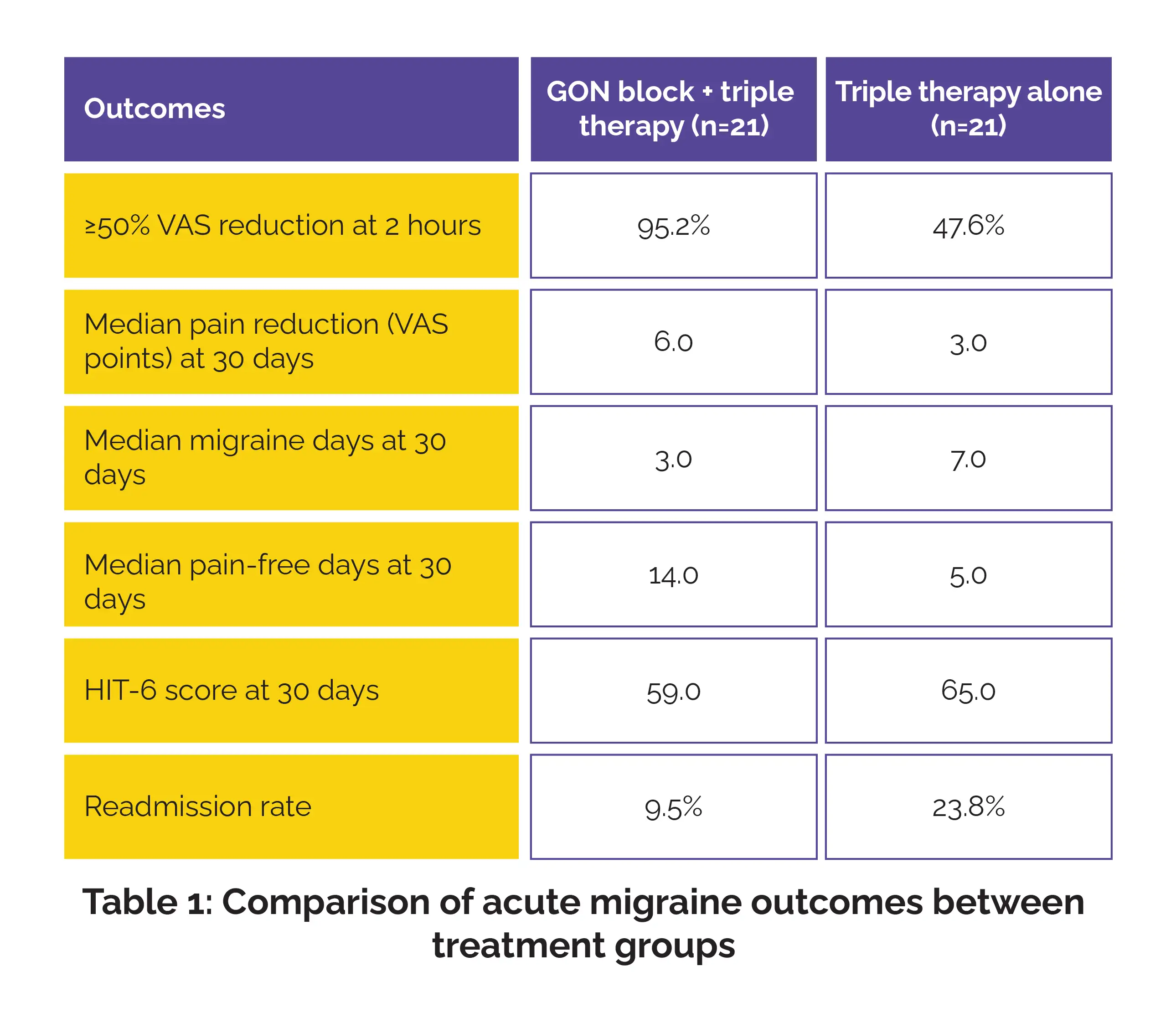
In the GON block + triple therapy group, adverse events were mild and transient: local pain occurred in 47.6% of patients, and minor bleeding in 14.3%. No serious complications were reported.
Adjunctive GON block combined with standard IV therapy provided effective and well-tolerated acute migraine relief in the emergency department. Patients experienced rapid pain reduction and better outcomes at 30 days, supporting its role as a practical addition for severe or refractory cases.
Cephalalgia
Adjunctive occipital nerve block for emergency treatment of acute migraine: A randomized, controlled trial
Cesar David Tamayo de Leon et al.














Comments (0)