

Categories
Change Password!
Reset Password!



Robotic-assisted cholecystectomy demonstrates safety and effectiveness comparable to laparoscopic surgery in children, supporting its broader use in pediatric biliary disease.
Pediatric gallstone disease is becoming increasingly common, driven in part by escalating obesity rates. Laparoscopic cholecystectomy (LC) remains the standard treatment; however, robotic-assisted surgery is being adopted more frequently in pediatric practice. Evidence regarding its real-world performance and safety in children remains limited.
This retrospective cohort study examined the implementation of robotic-assisted cholecystectomy (RAC) and compared its clinical outcomes with those of conventional LC at a children's hospital over an eight-year period. Patient demographics, surgical indications, operative characteristics, and postoperative outcomes were reviewed.
Outcomes following RAC were compared with those after LC using statistical analyses. A total of 420 pediatric cholecystectomies were analyzed, including 224 RAC and 196 LC. The median patient age was 15.5 years, and 75% were females. The most common reasons for surgery were choledocholithiasis and symptomatic cholelithiasis, with the number of cholecystectomies increasing over time.
LC was more frequently used for urgent cases, whereas RAC was more commonly performed in patients with obesity. Although robotic procedures took slightly longer, both surgical approaches illustrated comparable postoperative outcomes and excellent safety profiles, with very low complication rates and no major biliary injuries or deaths (Table 1).
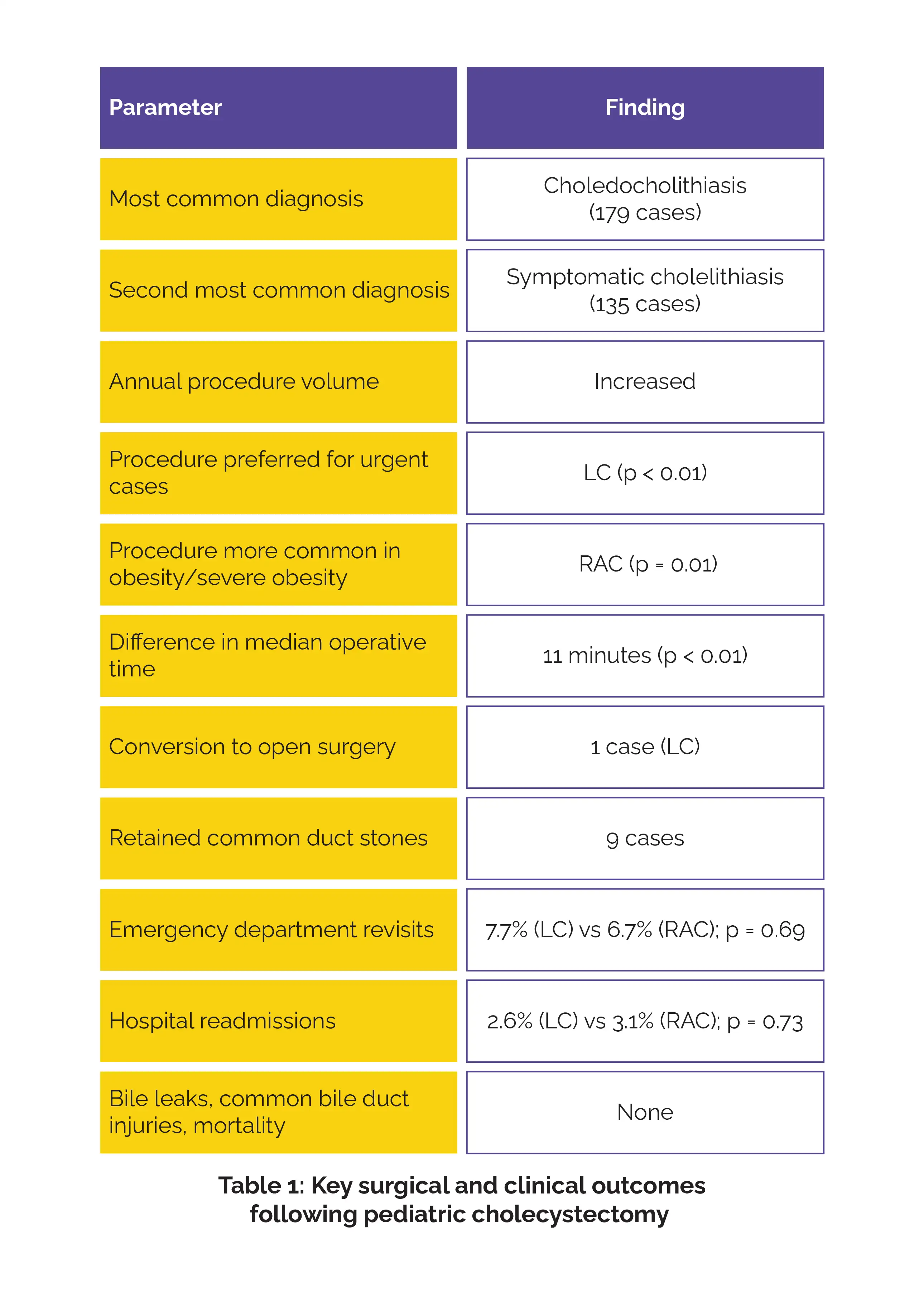
Thus, RAC proved to be a safe and effective strategy for managing pediatric biliary tract disease. Clinical outcomes were comparable to those of laparoscopic surgery, including in children with obesity. These outcomes support the continued implementation of robotic-assisted techniques into pediatric surgical practice without compromising patient safety.
Journal of Pediatric Surgery
Outcomes following adoption and integration of robotic-assisted cholecystectomy for pediatric biliary tract disease: An eight-year, single-center experience
Joyce J.L.H. McRae et al.













Comments (0)