

Categories
Change Password!
Reset Password!


Safe and effective airway management in pediatric anesthesia remains a critical challenge, particularly when using second-generation supraglottic airway devices.
Videolaryngoscopy delivers the highest oropharyngeal leak pressure and best glottic visualization, making it the most effective technique for laryngeal mask airway ProSeal placement in children.
Safe and effective airway management in pediatric anesthesia remains a critical challenge, particularly when using second-generation supraglottic airway devices. Achieving optimal ventilation and minimizing air leakage are essential for preventing perioperative respiratory complications.
This prospective randomized study evaluated 3 different laryngeal mask airway (LMA) ProSeal insertion techniques—standard digital insertion, direct laryngoscopy, and videolaryngoscopy—and compared their impact on oropharyngeal leak pressure (OLP), insertion success rate, and fiberoptic glottic visualization in children.
Overall, 150 children (aged 1–10 years) undergoing short elective surgeries (≤90 minutes) were included. Volunteers were randomized to one of the three groups:
After LMA ProSeal placement, OLP was examined by detecting air leakage at the thyroid cartilage during the closure of the adjustable pressure-limiting valve up to 30 cmH2O. For assessing glottic alignment and positioning accuracy, a fiberoptic bronchoscope was used.
Out of 159 screened patients, 150 were examined according to the protocol.
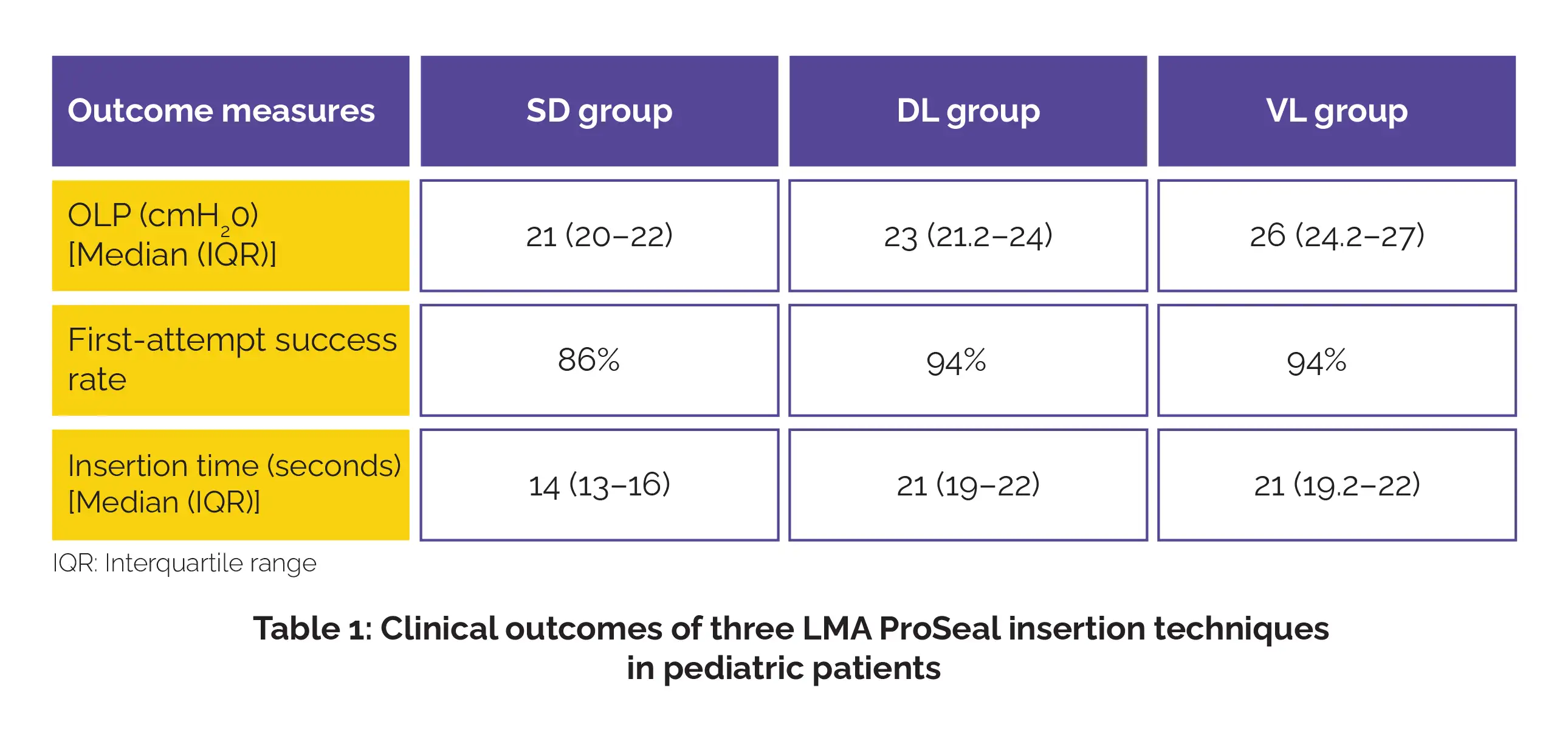
Videolaryngoscopy achieved the highest OLP and superior fiberoptic glottic views, ensuring optimal supraglottic airway device placement, while direct laryngoscopy improved outcomes over the standard technique but remained less efficient than videolaryngoscopy.
MINERVA ANESTESIOLOGICA
Optimizing LMA ProSeal insertion in children: a randomized trial comparing videolaryngoscopy, direct laryngoscopy, and standard techniques
Hilal Dokmeci et al.












Comments (0)