

Categories
Change Password!
Reset Password!



Upadacitinib 15 mg once daily achieves substantial skin clearance in elderly patients with moderate-to-severe atopic dermatitis, while treatment persistence declines most sharply during the first 6 months. Early itch improvement is associated with longer treatment persistence, whereas psychotropic medication use is associated with shorter persistence.
Why persistence matters in elderly AD
Tackling moderate-to-severe atopic dermatitis (AD) in older adults can be challenging because treatment decisions often occur alongside multimorbidity, polypharmacy, and psychosocial comorbidities. Although upadacitinib has illustrated efficacy in AD, elderly patients have been less represented in clinical trials, leaving longer-term real-world treatment persistence less well characterized.
Researchers therefore explored the effectiveness, safety, persistence, and predictors of treatment discontinuation among elderly patients receiving upadacitinib.
Skin clearance remains strong through follow-up
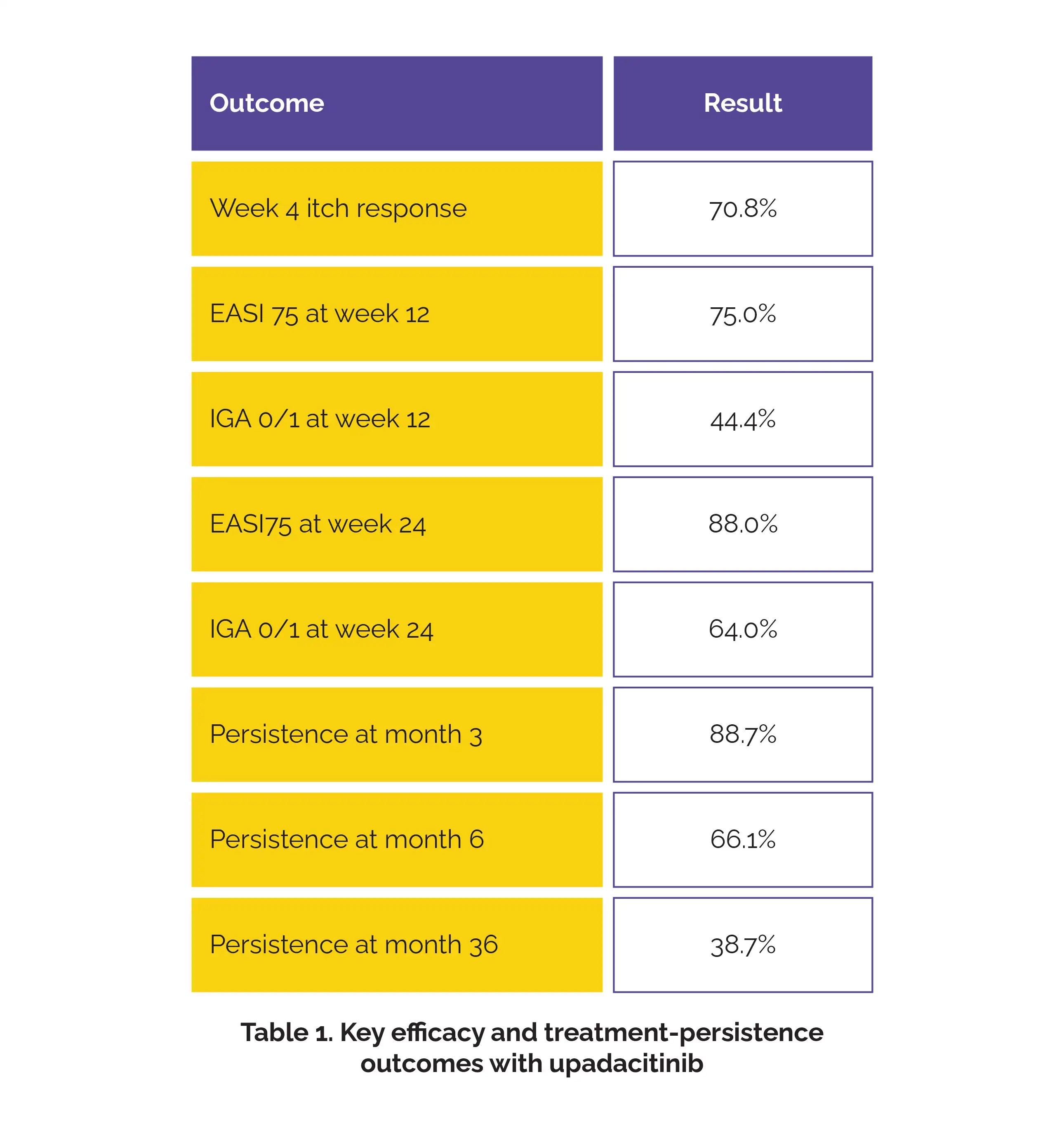
This retrospective cohort included 62 Chinese patients aged ≥65 years with moderate-to-severe AD treated with upadacitinib 15 mg once daily. Clinical improvement increased during follow-up, with both Eczema Area and Severity Index (EASI) 75 and Investigator's Global Assessment (IGA) 0/1 responses becoming more pronounced by week 24, as shown in Table 1.
The first 6 months reveal a clear persistence shift
The persistence curve showed a distinct change during the early treatment period, with the steepest decline occurring between months 3 and 6. After this period, persistence continued to decrease more gradually through the remainder of follow-up. This pattern suggests that maintaining treatment beyond the initial months could be an important consideration in long-term management of elderly patients with AD.
Early itch response carries a longer-term signal
They examined whether early clinical characteristics could identify patients more likely to remain on treatment. Week 4 itch response emerged as an independent predictor of longer persistence (HR 0.203). Baseline psychotropic medication use showed the opposite association and independently predicted shorter persistence (HR 2.814). Other examined factors, including age, sex, baseline EASI, Charlson Comorbidity Index, polypharmacy, and atopic comorbidities, were not significant predictors of persistence.
Safety findings add real-world context
Treatment-emergent adverse events (TEAEs) occurred during follow-up, with herpesvirus infection being the most frequently reported event. Serious AEs were also documented. Importantly, the study reported no AE-related treatment discontinuations, major adverse cardiovascular events (MACE), or venous thromboembolism.
Upadacitinib demonstrated sustained clinical effectiveness in this real-world cohort of elderly AD patients, while treatment persistence showed its most pronounced decline during the early months of therapy. The study identified early itch response and psychotropic medication use as independent indicators of treatment persistence, highlighting the potential value of closer assessment during the early treatment period.
Journal of Clinical Medicine
Real-World Effectiveness, Safety, and 36-Month Persistence of Upadacitinib in Elderly Patients with Moderate-to-Severe Atopic Dermatitis: The 3–6 Month Critical Window and the Role of Early Itch Response and Psychotropic Medication Use
Yaoyao Wang et al.














Comments (0)