The European Society of Human Reproduction and Embryology (ESHRE) has updated its benchmark clinical practice guideline on ovarian stimulation for in vitro fertilization (IVF) and intracytoplasmic sperm injection (ICSI). Originally published in 2019, this updated version incorporates rigorous, up-to-date evidence to assist reproductive endocrinologists and fertility specialists in optimizing patient outcomes.
Key Recommendations
1. Pre-Stimulation Evaluation
- Use antral follicle count (AFC) or anti-Müllerian hormone (AMH) levels to predict ovarian response, rather than age, body mass index (BMI), or basal hormonal markers.
- Female age and BMI predict pregnancy and live birth, whereas AFC, AMH and basal hormonal markers are not recommended for these outcomes.
2. Pretreatment
- Oestrogen, progesterone and combined oral contraceptive pretreatment are not recommended to improve efficacy; delayed-start gonadotropin-releasing hormone (GnRH) antagonist protocols are also discouraged.
- A minimum five-day washout may be considered before fresh transfer.
- Oestrogen or progesterone may be used for cycle scheduling; human chorionic gonadotropin (hCG) pretreatment should be limited to clinical trials.
3. Stimulation Protocols and Gonadotropin Dosing
- For high responders, a reduced gonadotropin dose of 100 to less than 150 International units (IU) is probably recommended, and GnRH antagonist protocols are recommended. Delayed-start stimulation is probably not recommended.
- For normal responders, conventional gonadotropin doses of 150–225 IU are preferred over reduced or increased doses. Delayed-start stimulation is probably not suggested.
- For low responders, gonadotropin doses above 300 IU are not recommended. Modified natural cycles are probably not routinely advised, but may be considered with very low ovarian reserve.
- The use of GnRH antagonists is recommended in preference to GnRH agonists in those undergoing IVF/ICSI. When GnRH agonists are utilized, the long protocol is preferred.
- Fixed GnRH antagonist protocols are probably preferred over flexible protocols. Progestin-based suppression is likely to be recommended to a similar extent as GnRH analogue therapy when freeze-all is planned.
- Mid-stimulation gonadotropin dose adjustments are probably not recommended; the starting dose must reflect patient characteristics and the desired outcome.
4. Gonadotropins and Additional Stimulation Agents
- Gonadotropin choices: Recombinant human follicle-stimulating hormone (r-hFSH), human menopausal gonadotropin (hMG), and purified FSH formulations are generally considered equally effective in the specified protocols. Long-acting and daily r-hFSH, as well as follitropin delta and alpha/beta, are also equally recommended.
- Combination therapy: r-hFSH + recombinant human luteinising hormone (r-hLH) is probably equally recommended to r-hFSH alone across general IVF, low responders and women aged ≥35 years. Combining r-hFSH with hMG is probably not preferred over either alone.
- Adjuncts: Adding low-dose hCG or letrozole is probably not advised. Clomiphene citrate addition is probably not recommended in high or normal responders; in low responders, clomiphene alone or with gonadotropins is probably equally recommended to gonadotropins alone.
5. Adjunct Therapies
- Metformin is probably not recommended for women with polycystic ovary syndrome (PCOS) undergoing GnRH antagonist protocols. Growth hormone is not recommended for normal responders or women with PCOS and is probably not advised for low responders.
- Testosterone and dehydroepiandrosterone (DHEA) are not recommended for low responders (DHEA is also not recommended for normal responders).
- Aspirin is not recommended in the general IVF/ICSI population or low responders; sildenafil is discouraged in low responders.
- Myo-inositol is probably not advised in women with PCOS and is not recommended in women without PCOS or low responders undergoing IVF.
6. Non-Conventional Stimulation Starts
- Random-start stimulation may be used when fresh transfer is not planned; the risk of ovarian hyperstimulation syndrome (OHSS) with concurrent spontaneous conception should be discussed.
- Luteal-start stimulation may be used when fresh transfer or natural conception is not possible; late luteal-phase initiation is probably not suggested in low responders planning fresh transfer.
- Double stimulation may be considered for urgent fertility preservation or oocyte/embryo accumulation without fresh transfer.
7. Fertility Preservation and Oocyte Donation
- For medical fertility preservation, stimulation may start at any cycle phase using GnRH antagonist protocols. Letrozole or tamoxifen may be considered in oestrogen-sensitive diseases; GnRH agonists are preferred for final oocyte maturation.
- For elective oocyte cryopreservation, any-cycle-phase initiation is acceptable. GnRH antagonist or progestin protocols are probably preferred for pituitary suppression, with GnRH agonists preferred for final oocyte maturation.
- For oocyte donation, conventional and random starts are equally recommended. Contraception is required with random starts; any method is acceptable before stimulation, while progestin or intrauterine contraception may be utilized during stimulation.
- GnRH antagonist and progestin protocols are probably equally appropriate; GnRH agonist suppression is not suggested. r-hFSH, purified FSH, long-acting r-hFSH and hMG are probably equally advocated, with doses tailored to ovarian reserve.
- Routine GnRH agonist triggering is advocated with GnRH antagonist or progestin protocols; hCG triggering is not routinely advised.
8. Monitoring and Trigger Timing
- Adding oestradiol or combined hormonal panels to ultrasound monitoring and routinely measuring endometrial thickness are probably not recommended. A single endometrial measurement on trigger or retrieval day may be considered for counselling.
- Trigger timing must consider follicular development, hormonal findings, stimulation duration, transfer strategy, patient burden, costs, previous cycles and centre logistics. Evidence is insufficient to define follicle size as a trigger criterion (leading follicles commonly measure 16–22 mm); oestradiol levels or the oestradiol-to-follicle ratio alone should not guide timing.
- Serum progesterone measurement on the final maturation day is probably recommended in fresh-transfer cycles; elevated levels warrant counselling about potentially lower ongoing pregnancy and live birth rates.
- Transfer deferral must consider oocyte yield, embryo number and quality. Routine oestradiol/LH testing on the hCG-trigger day in fresh-transfer cycles and hormonal testing on the GnRH agonist-trigger day in freeze-all cycles are not recommended.
9. Cycle Cancellation
- Low ovarian response alone is not a reason to cancel; unexpected low responders should receive counselling before deciding whether to continue.
- In GnRH agonist cycles with at least 19 follicles measuring 11 mm or more, preventive measures for OHSS are recommended, primarily cancellation of the trigger.
- Withholding GnRH agonist triggering may be taken into consideration in extremely high responders undergoing GnRH antagonist cycles.
10. Final Oocyte Maturation
- Recombinant and urinary hCG are equally recommended; 5,000 IU urinary hCG is probably preferred over 10,000 IU in GnRH agonist protocols. Recombinant human LH should not be used for triggering.
- GnRH agonist triggering is not suggested in the general IVF/ICSI population undergoing fresh transfer, irrespective of luteal support. Triptorelin doses of 0.1–0.4 mg may be used.
- Dual triggering with GnRH agonist + hCG is probably not advised in normal or low responders. Evidence is insufficient to conclude on double triggering.
11. Luteal Phase Support
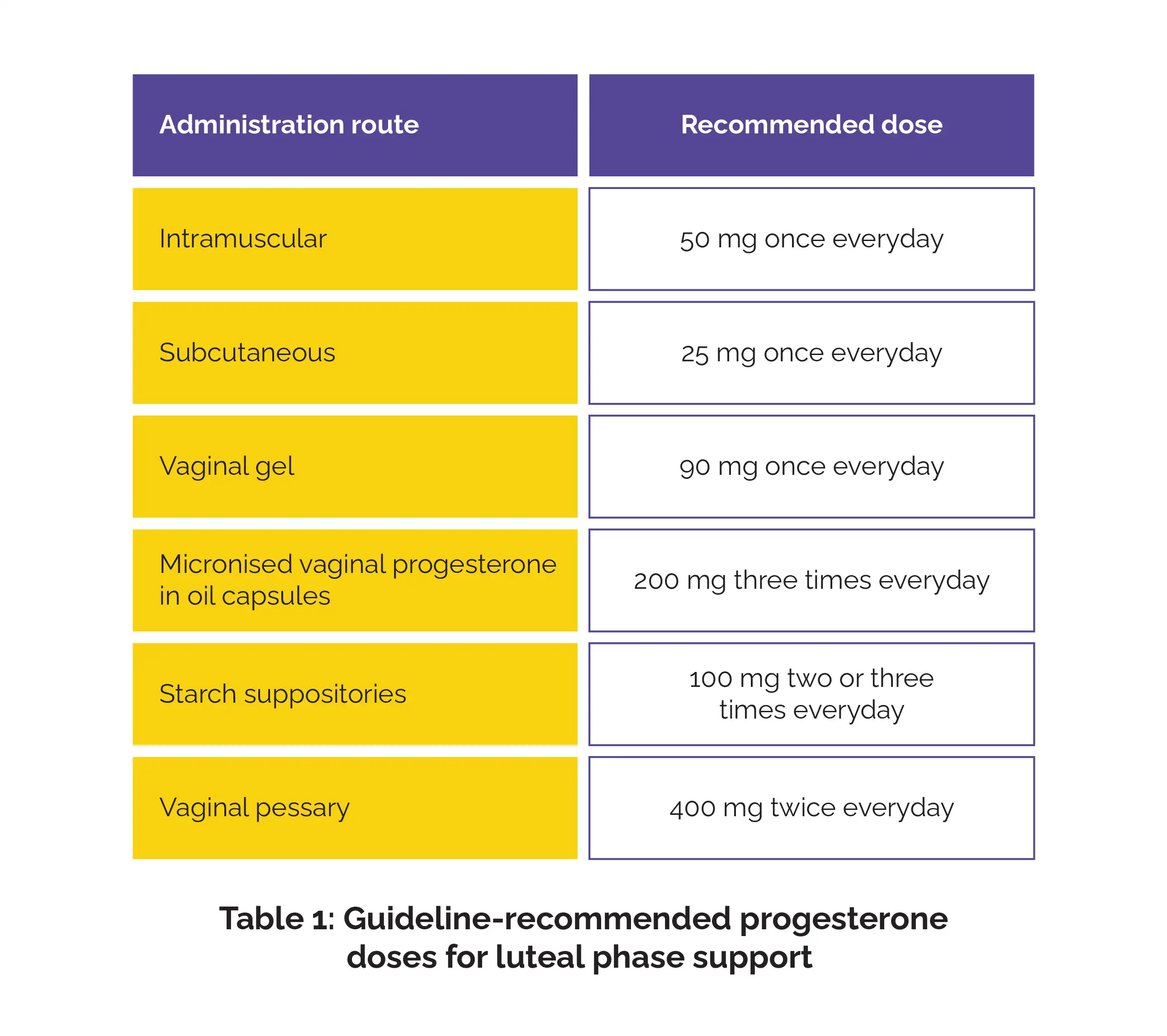
- Progesterone is advised after IVF/ICSI. Non-oral natural progesterone routes and the following doses are listed (Table 1):
- Initiate progesterone support between the evening of egg collection and the third day post-retrieval, continuing through the pregnancy test at a minimum. Dydrogesterone is probably recommended. Adding oestradiol to progesterone is probably not recommended.
- Standard-dose hCG (1,500 IU) is not recommended for luteal support in hCG-triggered cycles. GnRH agonist boluses or repeated injections are probably not recommended.
- Adding LH to progesterone must only be used in clinical trials.
12. OHSS Prevention
- For those at risk of OHSS, GnRH agonist triggering with a freeze-all strategy is suggested to prevent severe OHSS. When hCG triggering is used in high responders on GnRH agonist protocols, freeze-all is recommended to reduce late-onset OHSS. Dual triggering with GnRH agonist plus hCG is probably not advised in high responders.
- In patients at risk without fresh transfer, GnRH agonist triggering is preferred over hCG triggering and coasting. Dopamine agonists are recommended to minimize early OHSS, particularly with hCG use; freeze-all is suggested to prevent late-onset OHSS.
- Assess high-response risk before stimulation to individualise pituitary suppression, FSH dosing, trigger selection, and embryo-transfer planning.

















Comments (0)