

Categories
Change Password!
Reset Password!



In patients suffering from chronic knee osteoarthritis, transpedal genicular artery embolization shows sustained 6-month improvements in pain and function.
A single-center, prospective quality improvement (QI) initiative evaluated the feasibility, safety, and clinical outcomes of genicular artery embolization (GAE) performed through a transpedal access route—that is, through an artery in the foot—for patients with chronic knee pain caused by osteoarthritis (OA).
The study enrolled 69 patients with 110 affected knees, all of whom had chronic knee OA with a Kellgren-Lawrence (KL) grade of 2 or higher. The KL grading system is a standard radiographic scale used to classify the severity of knee OA. All participants provided informed consent, and the initiative followed institutional QI policies.
The study population had a mean age of 72.6 ± 7.43 years, with 62% being female and a mean body mass index of 33.48 ± 7.78. In terms of disease severity, 51.82% of knees were classified as KL grade 3, while 24.55% fell into the more advanced KL grade 4 category. Transpedal access was successfully achieved in 97.3% of cases, and technical success — meaning the embolization procedure itself was completed as intended — was recorded in 100% of cases.
On average, the procedure took 30.24 ± 16.24 minutes, with a fluoroscopy time (the duration of real-time X-ray imaging used to guide the procedure) of 10.17 ± 6.25 minutes and a contrast volume of 87.59 ± 25.6 mL. Pain and functional outcomes were examined at baseline and 1, 3, and 6 months via:
Meaningful and sustained pain relief
Both scores showed statistically significant improvement from baseline through the 6-month follow-up period. Table 1 below outlines the change in VAS and WOMAC scores from baseline through 6 months, illustrating the extent of clinical improvement following transpedal GAE.
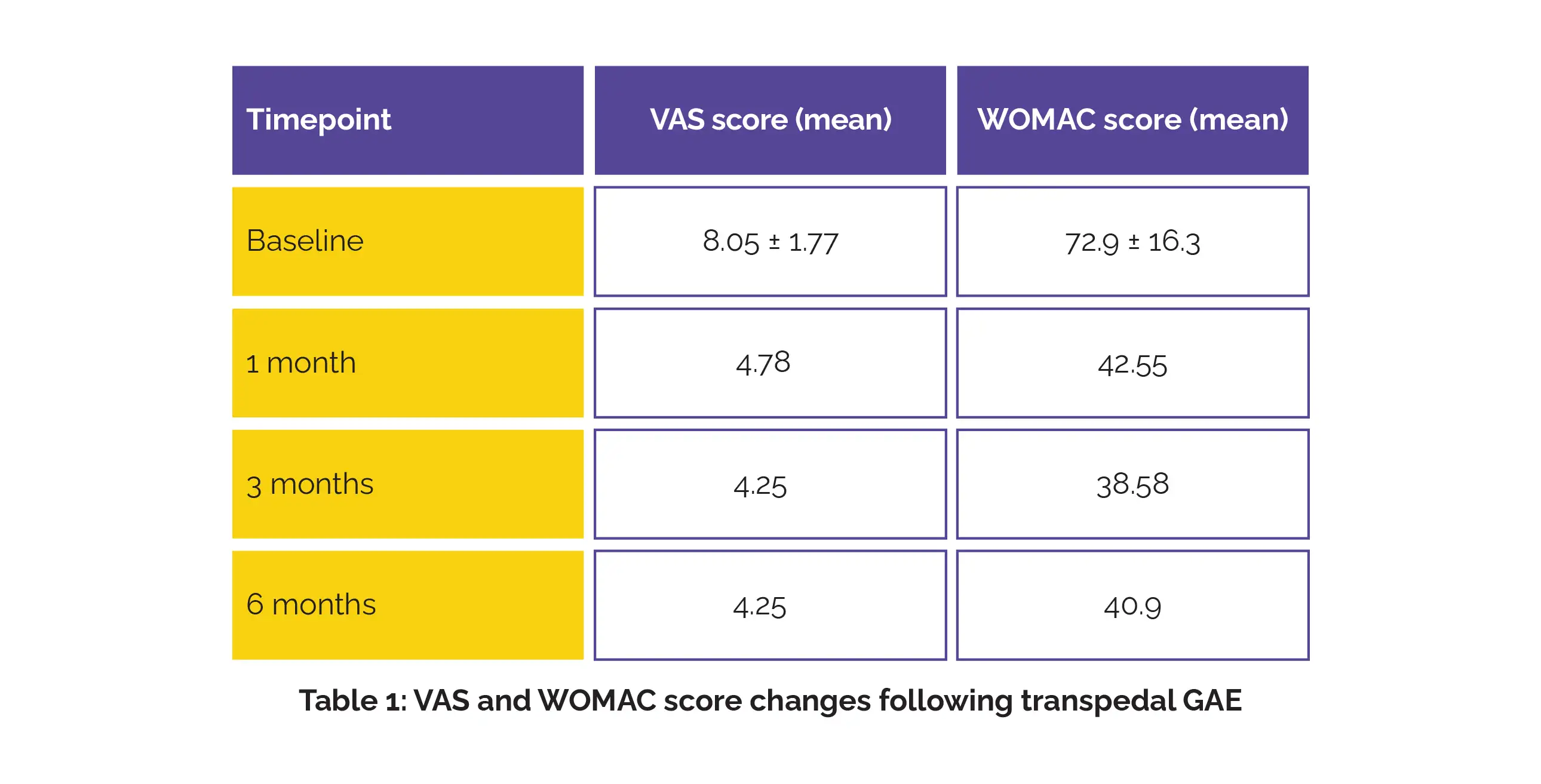
At the patient level, clinically meaningful benefit was achieved by a majority of participants. Using the minimal clinically important difference (MCID) — defined as a reduction of at least 2 points on the VAS or an improvement of at least 20 points on the WOMAC — 50 of 69 patients (72.5%) met the VAS MCID threshold while 49 of 69 patients (71.0%) met the WOMAC MCID threshold during follow-up.
Safety
Safety outcomes were notably favorable: no complications occurred at the access site, and only three patients (2.7%) experienced self-limiting adverse reactions, as classified under Society of Interventional Radiology standards.
Study implications
Transpedal GAE proved to be feasible, safe, and clinically beneficial for chronic knee OA, sustaining pain reduction and functional recovery through 6 months. While these findings validate transpedal access as a viable outpatient strategy in musculoskeletal radiology and pain management, larger multicenter comparative trials remain prudent to establish its definitive role alongside traditional access approaches.
European Journal of Radiology
The evolution of therapy for chronic osteoarthritic knee pain: Feasibility, safety and clinical outcomes of transpedal access for genicular artery embolization
Justin A Ratcliffe et al.












Comments (0)