

Categories
Change Password!
Reset Password!



LEVI-04, a new neurotrophin-3 inhibitor, is beneficial to improve pain and physical function in knee osteoarthritis while maintaining a favorable joint safety profile.
A new therapy targeting the nerve pathways behind chronic joint pain has shown significant promise for patients battling knee osteoarthritis, according to results of a randomised, double-blind, placebo-controlled phase 2 trial published in The Lancet. The therapy, intravenous LEVI-04, achieved meaningful pain relief across all doses tested, without raising safety concerns tied to joint damage.
A targeted approach to an undertreated condition
Current treatments for knee osteoarthritis remain limited, prompting researchers led by Prof Philip G Conaghan et al., to evaluate LEVI-04, a p75 neurotrophin receptor (p75NTR) fusion protein that inhibits neurotrophin-3, a molecule involved in transmitting joint pain signals. The trial enrolled patients across Poland, Denmark, Hong Kong, Moldova, and the Czech Republic.
Of 1,598 people screened, researchers randomised 518 participants with painful (Western Ontario and McMaster Universities Osteoarthritis Index [WOMAC] pain score ≥4/10) and radiographically confirmed knee osteoarthritis. The group included 292 women and 226 men, with a mean age of 64 years. Participants were assigned to receive a monthly intravenous placebo or one of three LEVI-04 doses through week 16, with safety tracked through week 30.
LEVI-04 delivered dose-dependent pain relief
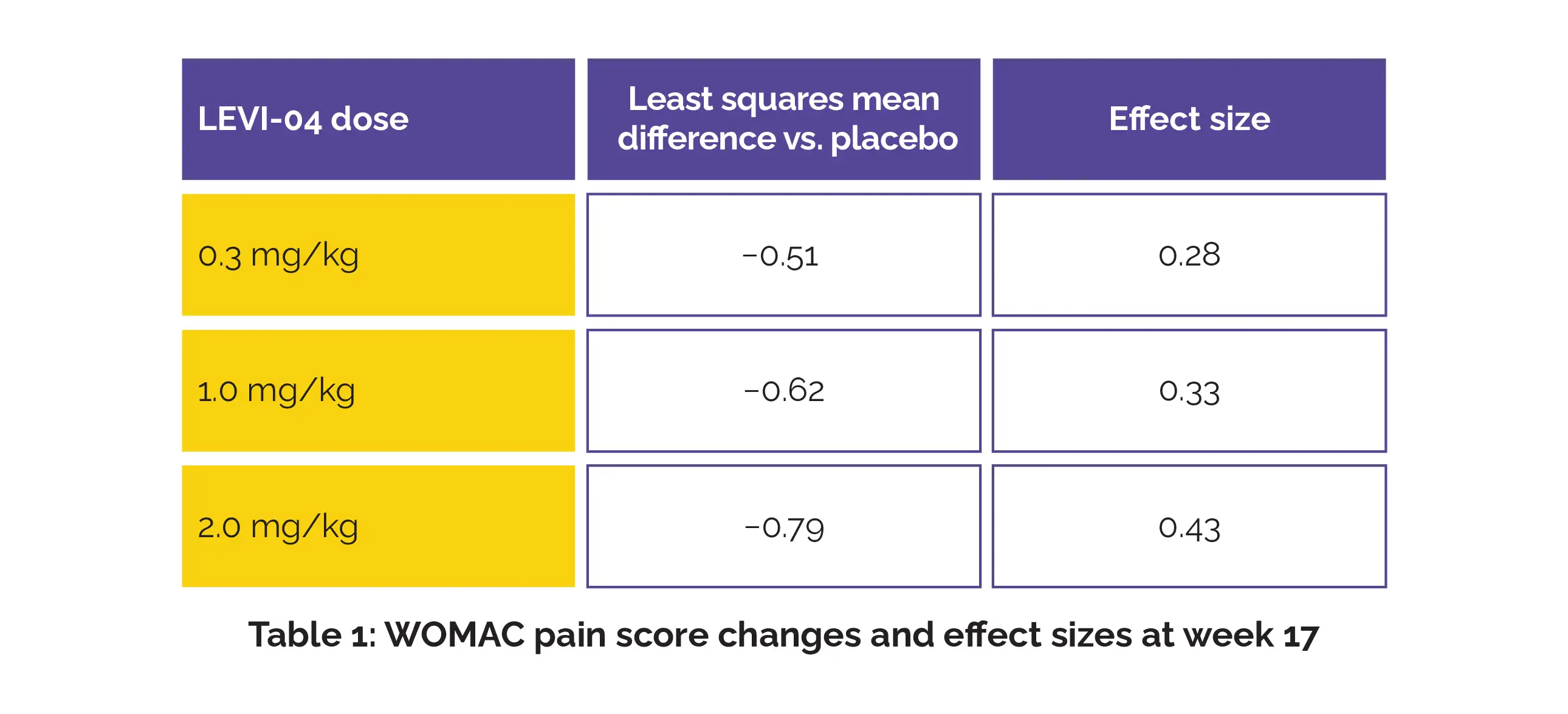
At week 17, all three LEVI-04 doses produced statistically significant reductions in WOMAC pain scores compared with placebo, with the effect strengthening as the dose increased (Table 1).
No added safety concerns
Despite the pain-relieving effects, LEVI-04 did not show an increased safety burden. Treatment-emergent adverse events occurred in 58% of patients on the 0.3 mg/kg dose, 66% on the 1.0 mg/kg dose, and 64% on the 2.0 mg/kg dose, compared with 67% in the placebo group. Notably, no increase in serious adverse events or joint pathologies — including rapidly progressive osteoarthritis, a key concern for this class of drugs — was observed at any dose.
What it means?
The study authors concluded that LEVI-04 was well-tolerated and produced significant improvements in both pain and function, supporting the strategy of supplementing endogenous p75NTR as a treatment approach for knee osteoarthritis.
The Lancet Journal
Efficacy and safety of LEVI-04 in patients with osteoarthritis of the knee: a randomised, double-blind, placebo-controlled, phase 2 trial
Prof Philip G Conaghan et al.















Comments (0)