

Categories
Change Password!
Reset Password!



DHA supplements in pregnancy boost early breast milk quality and positively influence gut microbiota, though the standard 100 mg/day dose is insufficient to maintain long-term DHA levels.
According to the findings of a new study, maternal supplementation with 100 mg/day docosahexaenoic acid (DHA) during the third trimester markedly increases DHA concentration in colostrum and is linked with higher Lactobacillus abundance at 42 days postpartum. However, the dose appears insufficient to maintain elevated DHA levels in mature breast milk.
Growing interest in early-life nutrition prompted Tingchao He et al. to investigate whether DHA supplementation in the third trimester boosts DHA levels in colostrum and whether continuing supplementation after birth is needed to maintain those levels during early lactation. The study also explored how maternal DHA intake affects both maternal and infant gut microbiota in the early postpartum phase. This multicenter, double-blind, randomized, placebo-controlled trial recruited 79 pregnant women and assigned them to one of three intervention arms:
Supplementation was delivered via milk powder, with all participants blinded to their assigned group. Breast milk samples were obtained on postpartum days 3 (colostrum) and 42 (early mature milk). Fatty acid composition was quantified using gas chromatography and reported as a percentage of total fatty acids. Maternal fecal samples were collected at gestational weeks 28 and 38 and again 42 days postpartum, while infant samples were taken at days 3 and 42.
All fecal specimens underwent 16S rRNA sequencing to evaluate microbial abundance and community shifts associated with the intervention. Results showed that DHA concentration in colostrum was highest in the FF group when compared to other groups (P-ANCOVA = 0.018). By day 42 postpartum, DHA levels in early mature milk had declined, showing no significant differences among the groups (P-ANCOVA = 0.646), as shown in Table 1:
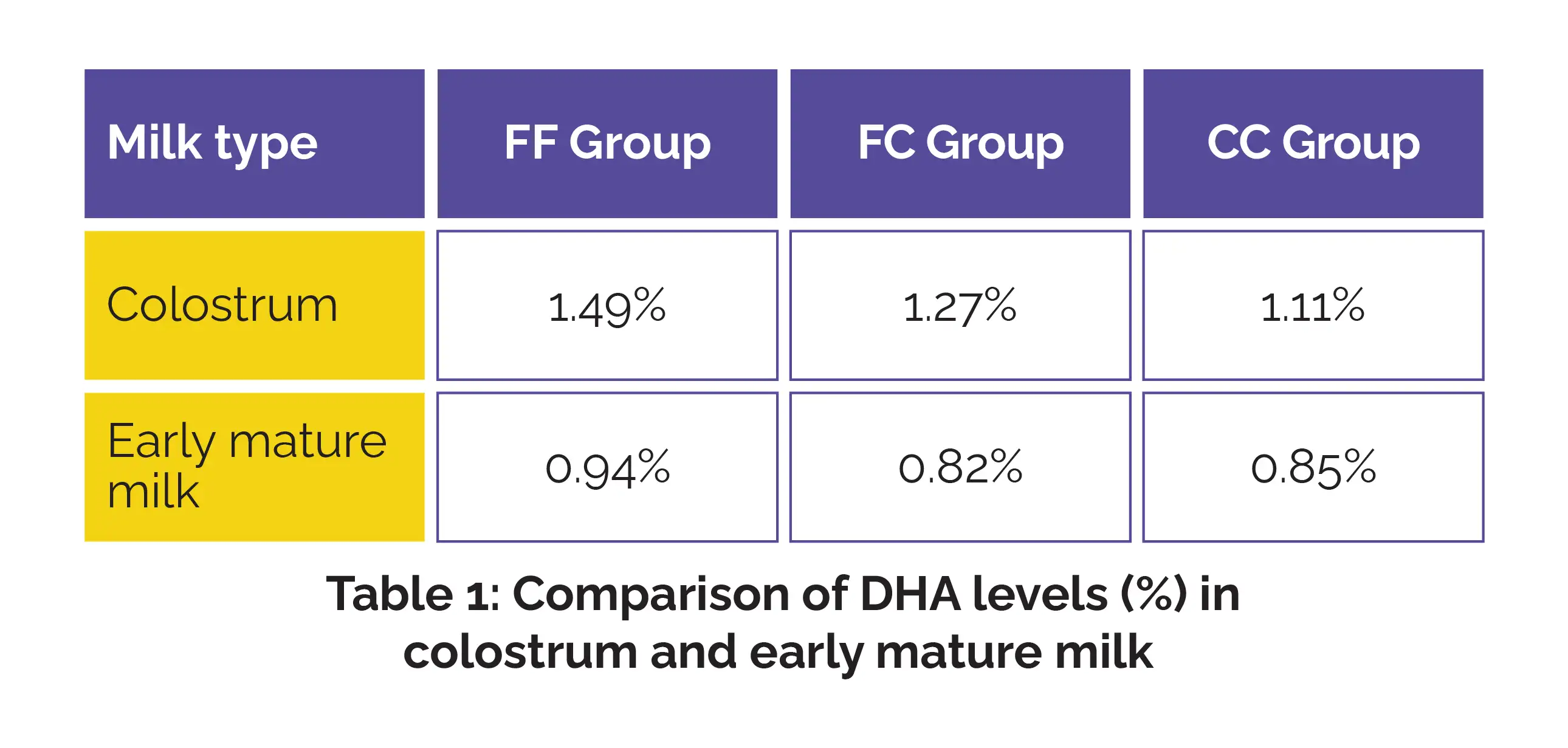
These findings indicate that while DHA supplementation during pregnancy successfully boosts early breast milk DHA content, 100 mg/day may not be sufficient to sustain DHA levels later in lactation. At 42 days postpartum, mothers and infants in the FF group exhibited a higher abundance of Lactobacillus, a beneficial bacterial genus linked to improved gut health and immunity.
This suggests that maternal DHA supplementation not only affects breast milk composition but may also positively influence the gut microbiota of both mother and child. To sum up, the study highlights the importance of DHA supplements during the third trimester for boosting colostrum DHA levels and supporting early infant nutrition. However, maintaining DHA levels throughout lactation may require higher doses or continued supplementation postpartum.
Clinical Nutrition
Docosahexaenoic acid supplementation in pregnancy and early lactation: Impacts on breast milk docosahexaenoic acid and Maternal–Infant gut microbiota – A randomized controlled trial
Tingchao He et al.














Comments (0)