

Categories
Change Password!
Reset Password!



Both sling surgery and Botox are effective for mixed urinary incontinence, with treatment choice guided by symptom profile and patient preference.
For many women, mixed urinary incontinence — a distressing combination of stress leakage during activities like coughing and an urgent, hard-to-control need to urinate — can hamper daily life and prove stubborn against standard treatments. Now, a new multicenter trial led by Heidi S Harvie et al. offers encouraging news! Two very different approaches, Botox injections into the bladder and sling surgery to support the urethra, appear to be equally effective overall in easing the symptoms.
The MUSA randomized clinical trial, conducted across 7 medical centers, enrolled women aged 21 and older whose incontinence had not improved with conservative strategies or oral medications. Volunteers were randomized to receive either:
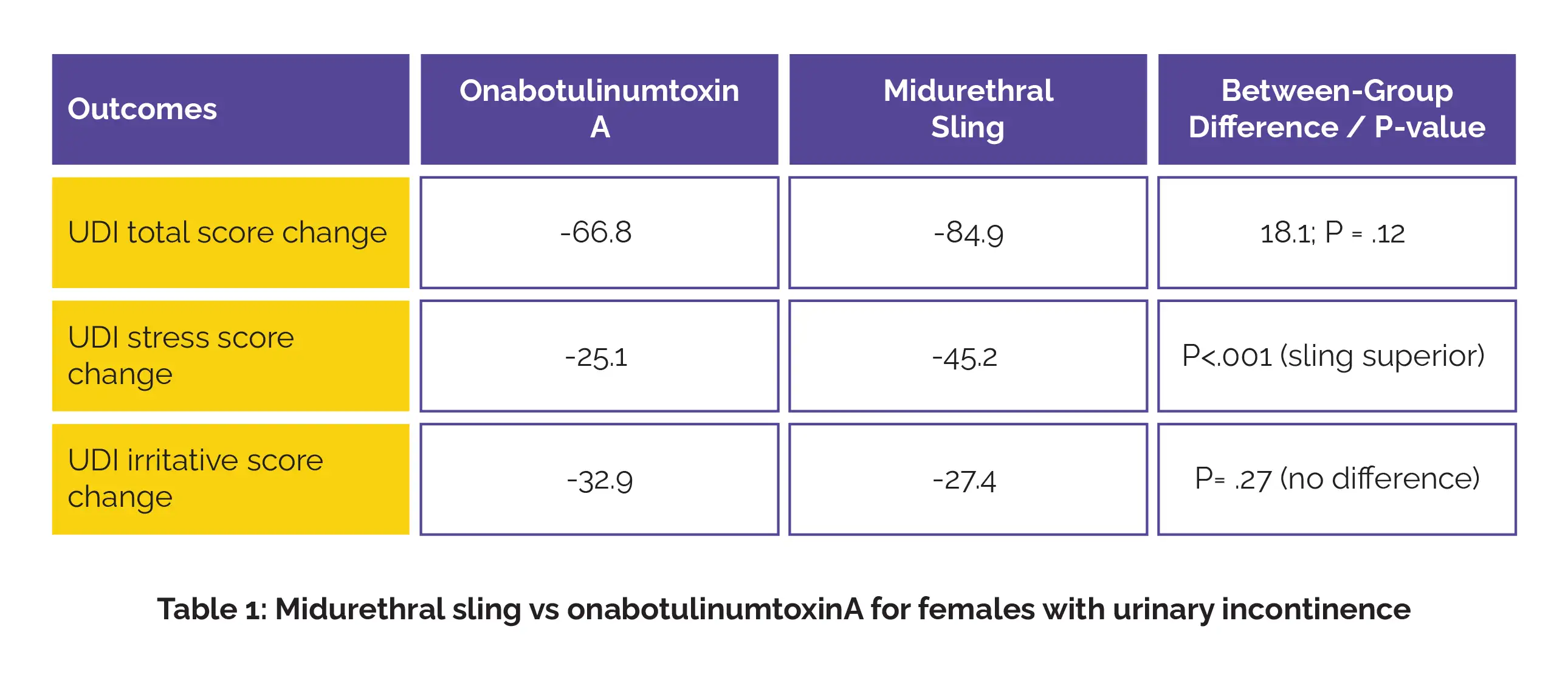
Both groups were allowed to cross over or receive additional treatment between 6 and 12 months if symptoms persisted. In total, 137 women, with an average age of 59 years, completed follow-up assessments. At 6 months, both treatments led to remarkable improvements in total Urogenital Distress Inventory (UDI) scores, a validated measure of incontinence-related bother (scale 0–300). The difference of 18.1 points between groups did not reach statistical significance. Sling surgery exhibited greater improvement in stress incontinence symptoms when compared with Botox. Improvements in urgency-related symptoms were similar between groups (Table 1).
At 6 months, 12.7% of females in the onabotulinumtoxinA arm received a repeat injection, increasing to 28.2% at 12 months. Over the same period, crossover treatments occurred: 30.3% of sling recipients later received onabotulinumtoxinA, and 15.5% of the onabotulinumtoxinA group proceeded to sling surgery. Importantly, adverse event rates did not differ markedly between the two approaches.
Researchers concluded that neither therapy outperformed the other in overall mixed incontinence relief, but each offered unique advantages: sling surgery better controlled stress leakage, while Botox provided a non-surgical option for those focusing on urgency. These findings highlight the value of tailoring treatment to patient preference and the specific type of symptom that elicits the most distress, reinforcing the importance of shared decision-making between women and their clinicians.
JAMA
Midurethral Sling vs OnabotulinumtoxinA in Females With Urinary Incontinence: The MUSA Randomized Clinical Trial
Heidi S Harvie et al.














Comments (0)