

Categories
Change Password!
Reset Password!



A targeted Helicobacter pylori screen-and-treat program demonstrates strong feasibility, excellent eradication rates, and acceptable safety in young adults.
Although Helicobacter pylori (H. pylori) screening has long been proposed as a strategy to reduce future gastric cancer risk, evidence from real-world population programs has remained limited. The EUROHELICAN study bridges this gap by showing that screening can move beyond theory and be successfully integrated into routine healthcare for young adults.
Invitations were extended to healthy adults aged 30–34 years across Slovenia, where participants first underwent serological testing before confirmatory urea breath testing (UBT) was performed in those with positive antibody results. Individuals with confirmed infection subsequently received a 14-day regimen of esomeprazole, amoxicillin, metronidazole, and bismuth, allowing investigators to evaluate the entire pathway from participation and diagnosis to treatment outcomes and tolerability in a real-world setting.
Among the 2,102 adults who participated, the screening response rate reached 24.4%, with women participating more frequently than men. Serological screening successfully identified individuals with H. pylori infection, most of whom had active infection confirmed by UBT. Standard bismuth quadruple therapy achieved a high eradication rate, supporting the effectiveness of a population-based screen-and-treat approach.
Safety findings added further perspective to the program. Treatment-related adverse events were witnessed at a higher rate in women than in men. However, these events rarely compromised treatment completion, indicating that the regimen remained generally well tolerated despite its known complexity.
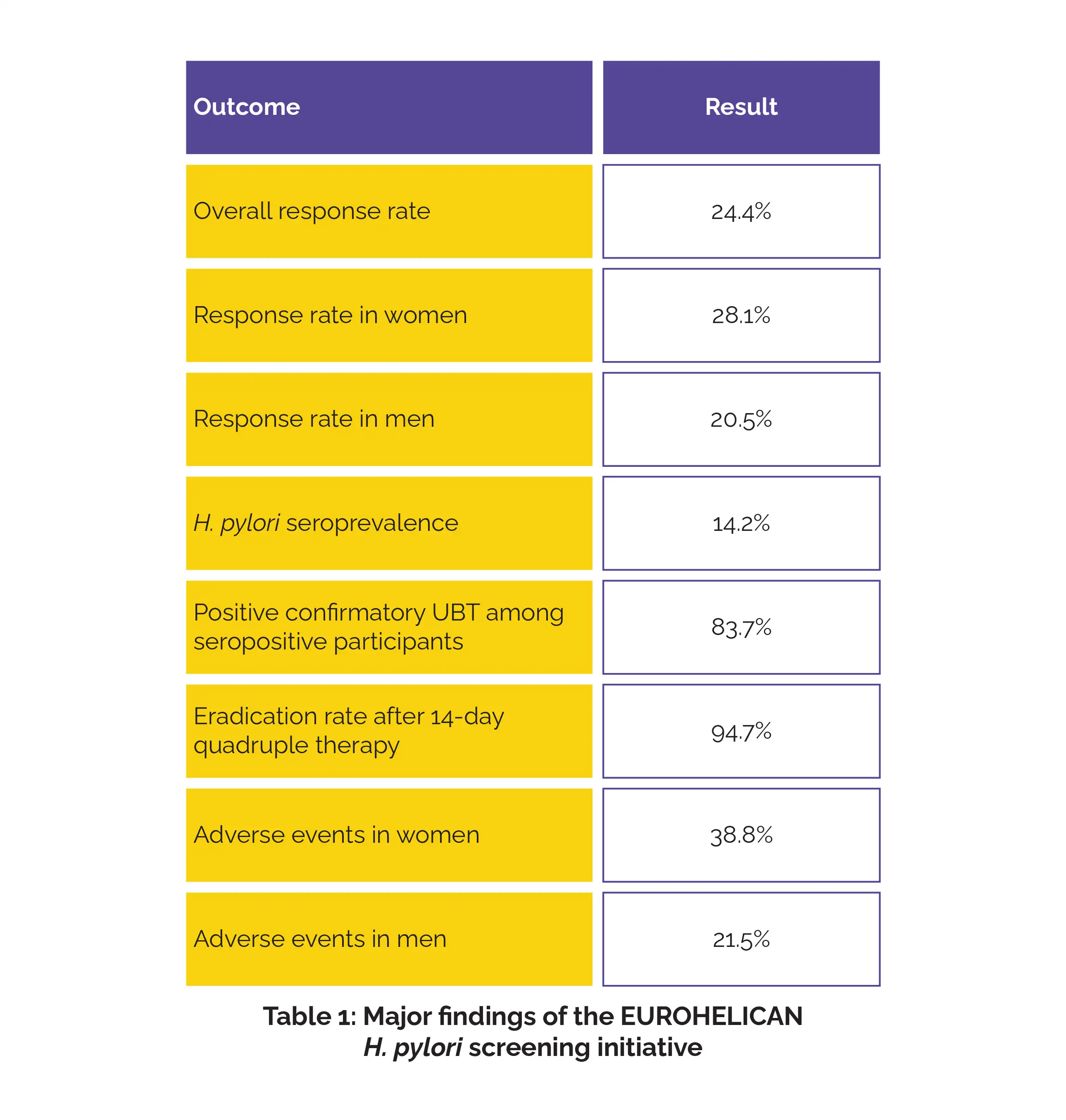
Rather than simply demonstrating excellent eradication rates, the EUROHELICAN investigators showed that a population-based screening pathway from invitation to diagnosis and treatment can be successfully implemented in routine clinical practice. The findings strengthen the case for incorporating organized H. pylori screening into preventive healthcare strategies for young adults, particularly in regions where minimizing the long-term burden of gastric cancer is a public health priority.
United European Gastroenterology Journal
EUROHELICAN—The First Helicobacter Pylori Screen-and-Treat Population-Based Study in Young Adults in Europe
Bojan Tepeš et al.















Comments (0)