

Categories
Change Password!
Reset Password!



Heart failure (HF) is a frequent cardiovascular (CV) complication of type 2 diabetes (T2D) and contributes substantially to morbidity in high-risk patients.
Oral semaglutide minimizes the risk of composite heart failure outcomes in those with type 2 diabetes and pre-existing heart failure, particularly those with preserved ejection fraction.
Heart failure (HF) is a frequent cardiovascular (CV) complication of type 2 diabetes (T2D) and contributes substantially to morbidity in high-risk patients. Although oral semaglutide has demonstrated CV disease (CVD) benefits in people with T2D, its effects on HF outcomes according to baseline HF status remain uncertain. Hence, the study explored the effects of oral semaglutide (glucagon-like peptide-1 [GLP-1] receptor agonist) on HF events, major adverse cardiovascular events (MACE), and safety in subjects with and without a history of HF at baseline.
The analysis drew on the SOUL randomized clinical trial, which enrolled 9,650 adults suffering from T2D and established atherosclerotic cardiovascular disease (ASCVD) and/or chronic kidney disease. The trial was conducted across 444 centres in 33 countries. Participants received once-daily oral semaglutide or placebo alongside standard care and were followed for a mean of 47.5 months. Researchers compared outcomes between participants with and without a history of HF at enrollment. The key outcome was a composite of HF hospitalization, urgent HF visit, or CVD death.
Among those with baseline HF, oral semaglutide reduced the risk of the composite HF outcome vs. placebo. This benefit was not noted in those without baseline HF. HF hospitalisation or urgent HF visits were also less frequent with oral semaglutide among those with baseline HF, while rates were similar between treatment groups in those without baseline HF (Table 1).
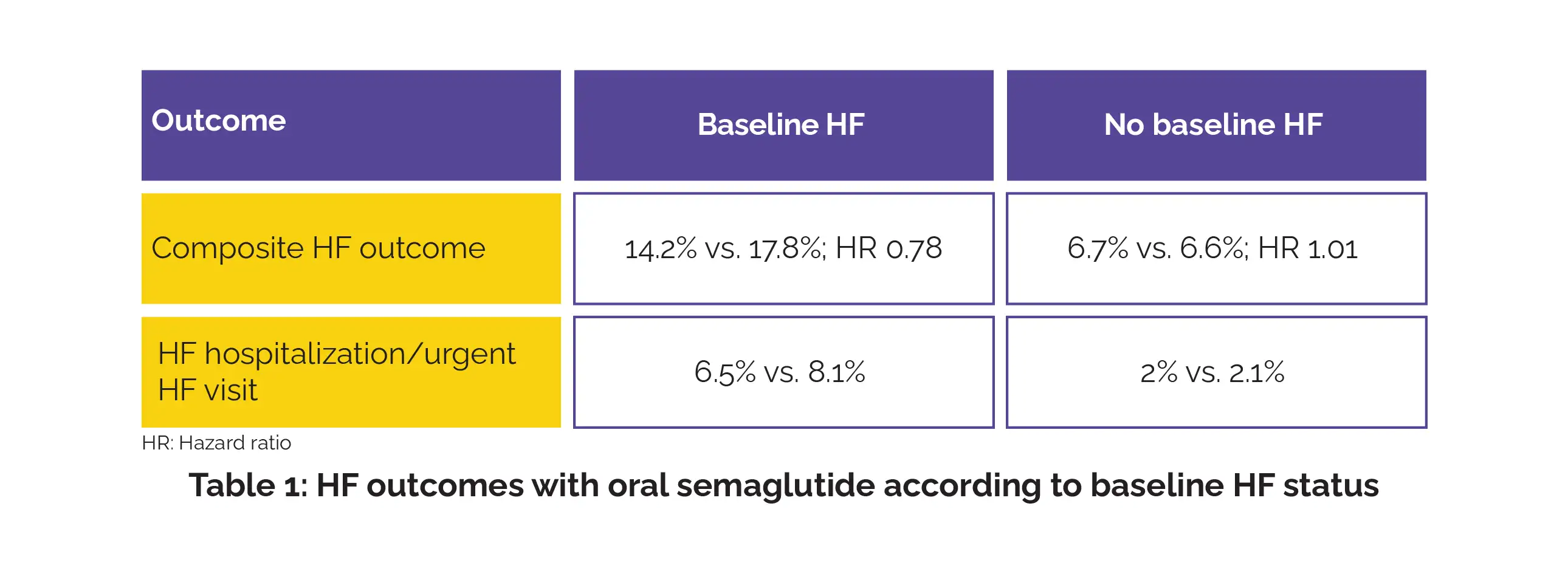
Among those with baseline HF, the treatment effect differed by HF phenotype. Oral semaglutide was associated with a substantially lower risk of the composite HF outcome in those with heart failure with preserved ejection fraction (HfpEF; HR 0.59), whereas no significant reduction was observed in those with heart failure with reduced ejection fraction (HfrEF; HR 0.98).
For MACE, oral semaglutide showed a consistent effect regardless of baseline HF status. The HR was 0.83 among those with HF and 0.86 among those without HF, with no significant treatment-effect heterogeneity. Safety findings were broadly comparable. Serious adverse events occurred in 594 (53.8%) participants receiving oral semaglutide and 642 (57.1%) receiving placebo.
The findings positioned baseline HF status as an important clinical context for the observed effect of oral semaglutide. Treatment was associated with fewer HF events among patients who already had HF, with the strongest reduction observed in HFpEF, while no significant HF benefit was seen in those without baseline HF. These findings supported further evaluation of oral semaglutide as a potential treatment option for HF in people with T2D.
JAMA Internal Medicine
Oral Semaglutide and Heart Failure Outcomes in Persons With Type 2 Diabetes
Rodica Pop-Busui et al.














Comments (0)