

Categories
Change Password!
Reset Password!



Vitamin D deficiency does not universally drive bacterial vaginosis risk, but targeted supplementation cuts infection persistence in high-deficiency populations.
A novel systematic review and meta-analysis is recasting the long-debated relationship between serum vitamin D status and bacterial vaginosis (BV). Dispelling the notion that vitamin D deficiency (VDD) acts as an umbrella driver for vaginal dysbiosis, the new findings reveal a striking, population-dependent interplay—one that advocates for precision supplementation over routine treatment.
BV stands as the single most common vaginal microbiome disruption among non-pregnant individuals of reproductive age. Marked by a steep decline in protective, lactic-acid-producing Lactobacillus species and an overgrowth of anaerobic pathogens, the condition poses persistent clinical challenges. Given vitamin D’s established role in mucosal immune homeostasis, epithelial barrier preservation, and antimicrobial peptide synthesis, researchers have long postulated a protective effect. However, previous syntheses generated conflicting conclusions, largely distorted by pooling pregnant cohorts and incomplete database searches.
The Observational Breakdown: A Baseline Disconnect
To clarify the baseline risk, Dongdong Yang and other investigators executed a comprehensive search across PubMed, Embase, Cochrane Library, Web of Science, and China National Knowledge Infrastructure (CNKI) spanning literature through January 2025. Evaluating 13 rigorous studies—comprising 9 observational data entries and 4 intervention trials—the team applied a random-effects meta-analysis utilizing restricted maximum likelihood (REML) estimation alongside Hartung–Knapp adjustments.
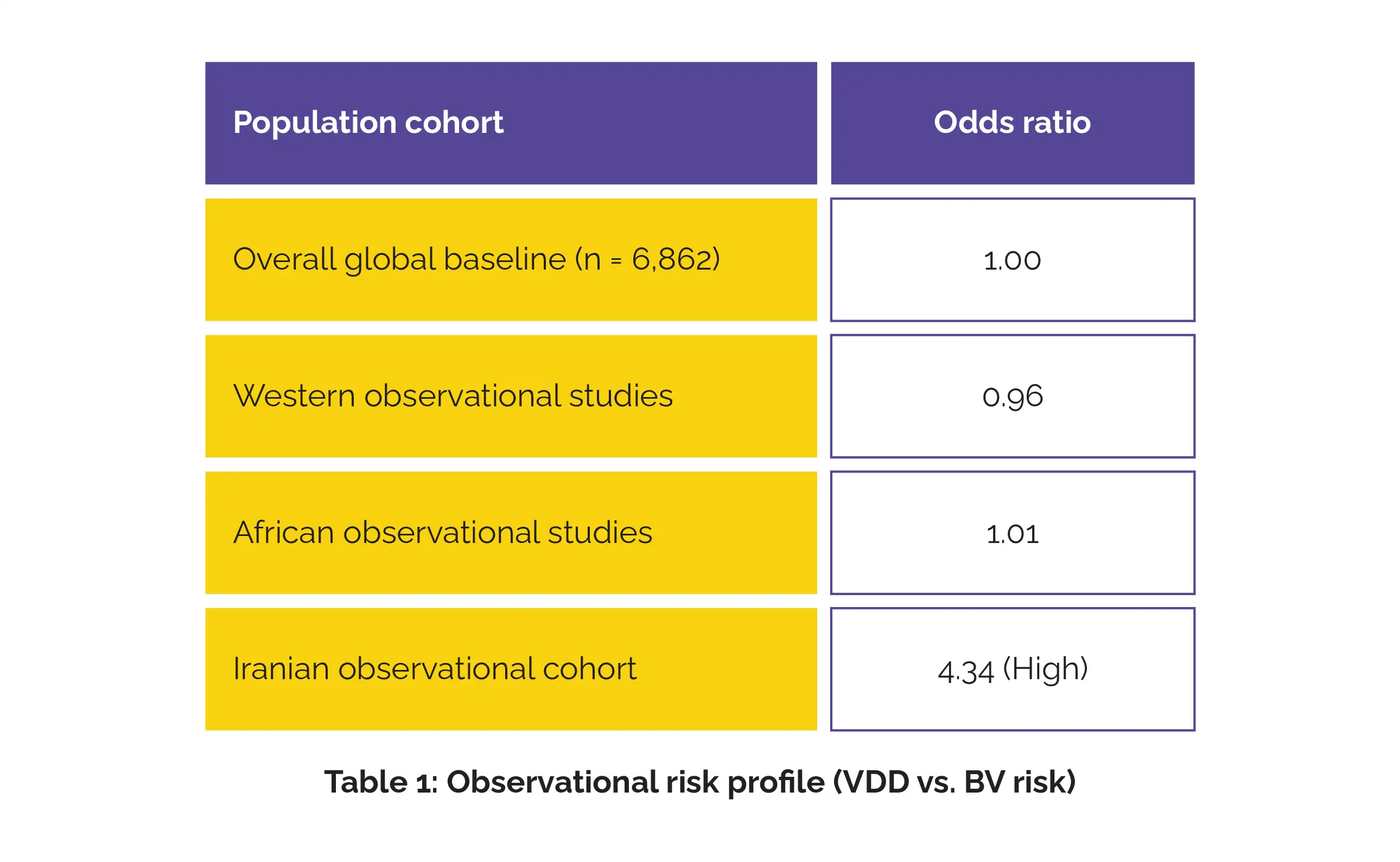
Analyzing observational entries (n = 6,862 across 7 entries from 5 studies) revealed no global link between VDD and BV susceptibility:
Crucially, striking regional divergence explained this variance. While observational cohorts in Western geographies and African regions yielded null associations, Iranian population data demonstrated a dramatic, positive correlation between VDD and active BV status (Table 1).
Intervention Insights: Eliminating the Outlier
When assessing intervention trials (n = 281), overall analysis initially signaled a non-significant protective trend towards diminished BV persistence:
However, sensitivity testing revealed that the high heterogeneity (I² = 85.7%) was driven almost entirely by a single null US trial. Isolating and removing this single outlier unlocked a statistically robust, highly homogenous therapeutic benefit across non-US clinical settings:
This adjusted 0.47 relative risk illustrated a 53% decrease in BV persistence among deficient non-pregnant women undergoing therapeutic supplementation in targeted populations.
Clinical Translation
Although GRADE criteria currently classify the overall certainty of evidence as very low—mandating caution and broader randomized controlled trials—the clinical trajectory is clear. Universal vitamin D dosing for unselected BV patients yields inconsistent outcomes. Instead, practice patterns must pivot towards targeted screening and precision therapy: identifying those with verified vitamin D deficiency (especially in high-prevalence regions) to improve treatment durability and prevent recurring dysbiosis.
European Journal of Obstetrics & Gynecology and Reproductive Biology
Association between vitamin D status and bacterial vaginosis in non-pregnant women of reproductive age: a systematic review and meta-analysis
Dongdong Yang et al.















Comments (0)