

Categories
Change Password!
Reset Password!



Adhesive capsulitis (frozen shoulder) is marked by persistent shoulder pain, progressive restriction of joint mobility, and functional disability.
Mobilization with movement + scapular stabilization exercises offer greater improvements in pain, shoulder range of motion, and functional disability than the Spencer technique + scapular stabilization in patients with adhesive capsulitis.
Adhesive capsulitis (frozen shoulder) is marked by persistent shoulder pain, progressive restriction of joint mobility, and functional disability. Physiotherapy remains the cornerstone of conservative care, with mobilization with movement and the Spencer technique being widely used manual therapy approaches. However, comparative evidence regarding their potency when combined with scapular stabilization exercises has remained limited. This study explored the relative efficacy of these two interventions in improving pain, shoulder mobility, and functional function.
In this randomized controlled trial, participants (aged 40–65 years) with shoulder pain lasting at least 3 months, passive external rotation restriction of more than 30% compared with the unaffected shoulder, and a visual analog scale (VAS) score ≥4 were enrolled. Patients with a history of shoulder fracture, dislocation, surgery, rotator cuff tear, neurological disorders, inflammatory joint disease, or recent corticosteroid injection were excluded.
The enrolled subjects were randomly assigned to:
Pain intensity was checked via VAS, functional disability via the shoulder pain and disability index (SPADI), and shoulder range of motion via a universal goniometer. Statistical analyses were performed utilizing Statistical Package for the Social Sciences (SPSS) version 26.0, employing paired and independent t-tests along with mixed analysis of variance (ANOVA).
Both groups illustrated remarkable improvements in pain, shoulder mobility, and functional disability following treatment (p<0.001). However, mobilization with movement elicited better improvements than the Spencer technique across all assessed outcomes, including pain reduction (Table 1), shoulder range of motion, and functional disability.
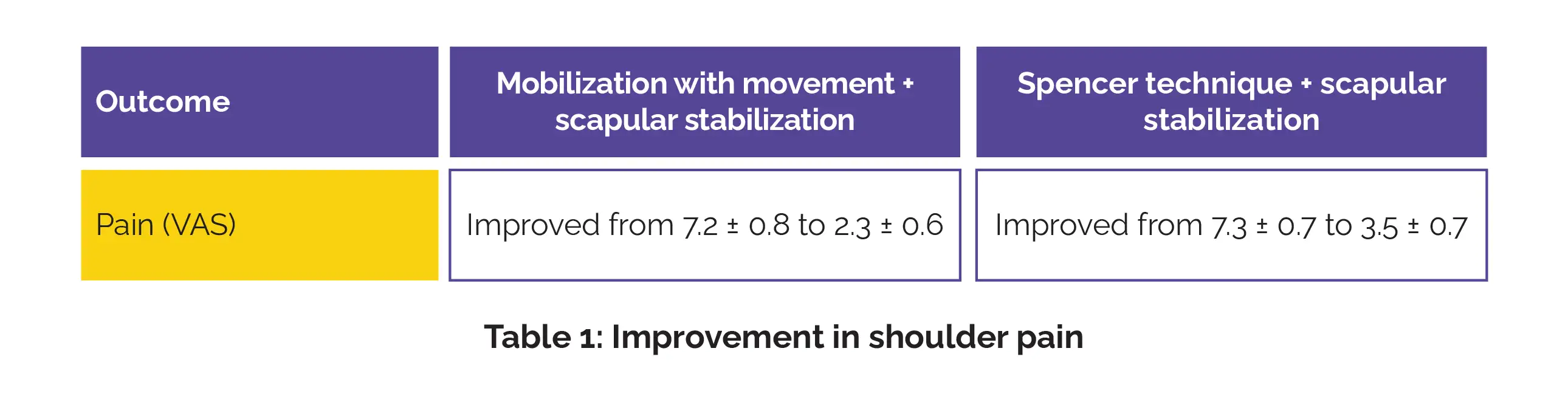
Although both interventions improved clinical outcomes in adhesive capsulitis, mobilization with movement delivered greater reductions in pain, larger gains in shoulder mobility, and better functional recovery than the Spencer technique when paired with scapular stabilization exercises.
The Healer Journal of Physiotherapy and Rehabilitation Sciences
Comparative Effects of Mobilization with Movement Versus Spencer Technique Combined with Scapular Stabilization Exercises on Pain, Range of Motion, and Functional Disability in Patients with Adhesive Capsulitis
Wagma Wajid et al.
















Comments (0)