

Categories
Change Password!
Reset Password!


Osteoarthritis (OA) is the most common joint disease worldwide, and the knee is the most frequently affected joint, accounting for the large majority of OA cases.
In adults with knee osteoarthritis (KOA), a four-week course of topical curcumin gel produces a modest but statistically significant reduction in knee pain while maintaining a favorable safety profile.
Osteoarthritis (OA) is the most common joint disease worldwide, and the knee is the most frequently affected joint, accounting for the large majority of OA cases. It causes cartilage breakdown, bone remodeling, and joint inflammation, leading to chronic pain, reduced mobility, and lower quality of life. Standard treatments — acetaminophen, oral or topical non-steroidal anti-inflammatory drugs (NSAIDs), and corticosteroid injections — offer only modest relief, and many patients cannot tolerate them or have coexisting conditions that rule them out.
Curcumin, a naturally occurring polyphenolic compound extracted from turmeric (Curcuma longa), possesses anti-inflammatory, antioxidant, and analgesic properties. Multiple clinical trials and meta-analyses have illustrated that oral curcumin can alleviate pain in KOA sufferers. However, its clinical utility is limited by poor oral bioavailability, and high doses may be associated with gastrointestinal discomfort or potential liver toxicity.
Topical or transdermal delivery could avoid these issues, but very little clinical research has tested this route. VAS-101 is an investigational topical curcumin gel using a proprietary transdermal delivery platform intended to bypass liver metabolism and improve absorption. Preclinical work showed measurable blood curcumin levels and reduced pain sensitivity after transdermal application, providing the rationale for testing it in humans with KOA.
Objective
This study aimed to evaluate the clinical efficacy, tolerability, and safety of a four-week course of topically applied VAS-101 vs. placebo gel for knee pain and related symptoms in adults with KOA.
(a) Study design
A 4-week, two-arm, parallel-group, randomized, double-blind, placebo-controlled trial was conducted. Randomization was performed in a 1:1 ratio via a computerized randomization calculator.
(b) Recruitment and study location
Recruitment took place between February and June 2025. The study was carried out at Clinical Research Australia, Perth, Western Australia.
(c) Inclusion criteria
(d) Exclusion criteria
(e) Sample size
A total of 60 participants were randomized (30 per group). The sample size was determined by a power calculation providing 80% power to detect a 15-point difference on a 100-point outcome scale (standard deviation 19), while allowing for a 10% dropout rate.
(f) Intervention and follow-up
(h) Outcomes
(i) Statistical analysis
Generalised linear mixed models (GLMM) compared groups on the full analysis set (FAS) and per protocol set (PPS), adjusting for baseline score, age, sex, BMI, and treatment-expectancy score, with sequential Bonferroni correction for multiple comparisons and a hierarchical testing order for secondary endpoints. Minimal clinically important difference (MCID), threshold 15.4 points) was analyzed with chi-square testing. Non-normally distributed medication-use data were analysed with Mann-Whitney U tests; safety data used repeated-measures ANOVA. Significance was defined as p ≤ 0.05 (two-sided).
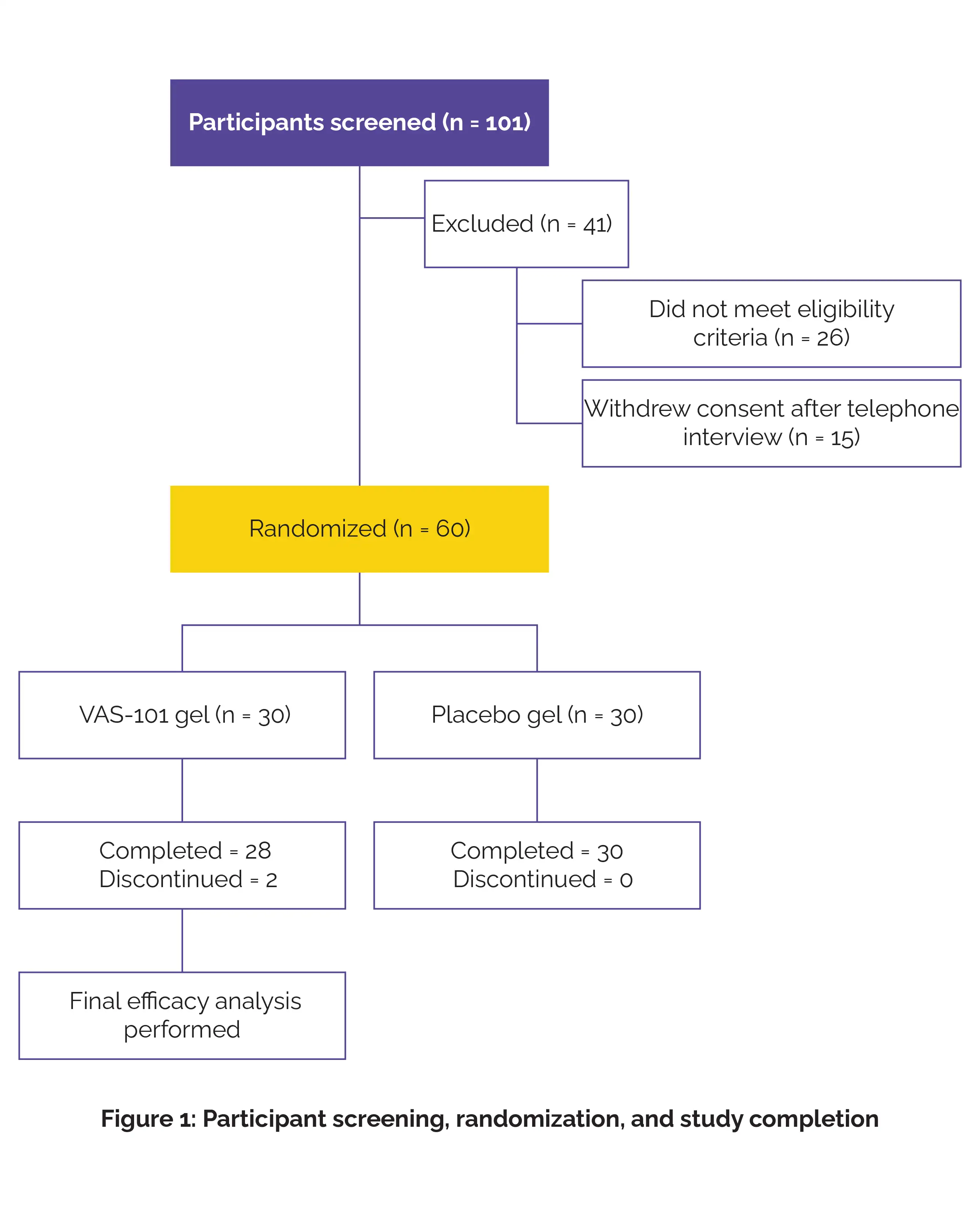
A total of 101 individuals were screened, of whom 60 participants met the eligibility criteria and were randomized. Thirty participants were assigned to the VAS-101 topical curcumin group and thirty to the placebo group. Two participants from the VAS-101 group discontinued the trial for reasons unrelated to treatment (Figure 1).
(a) Pain scores
(b) Other KOOS subscales
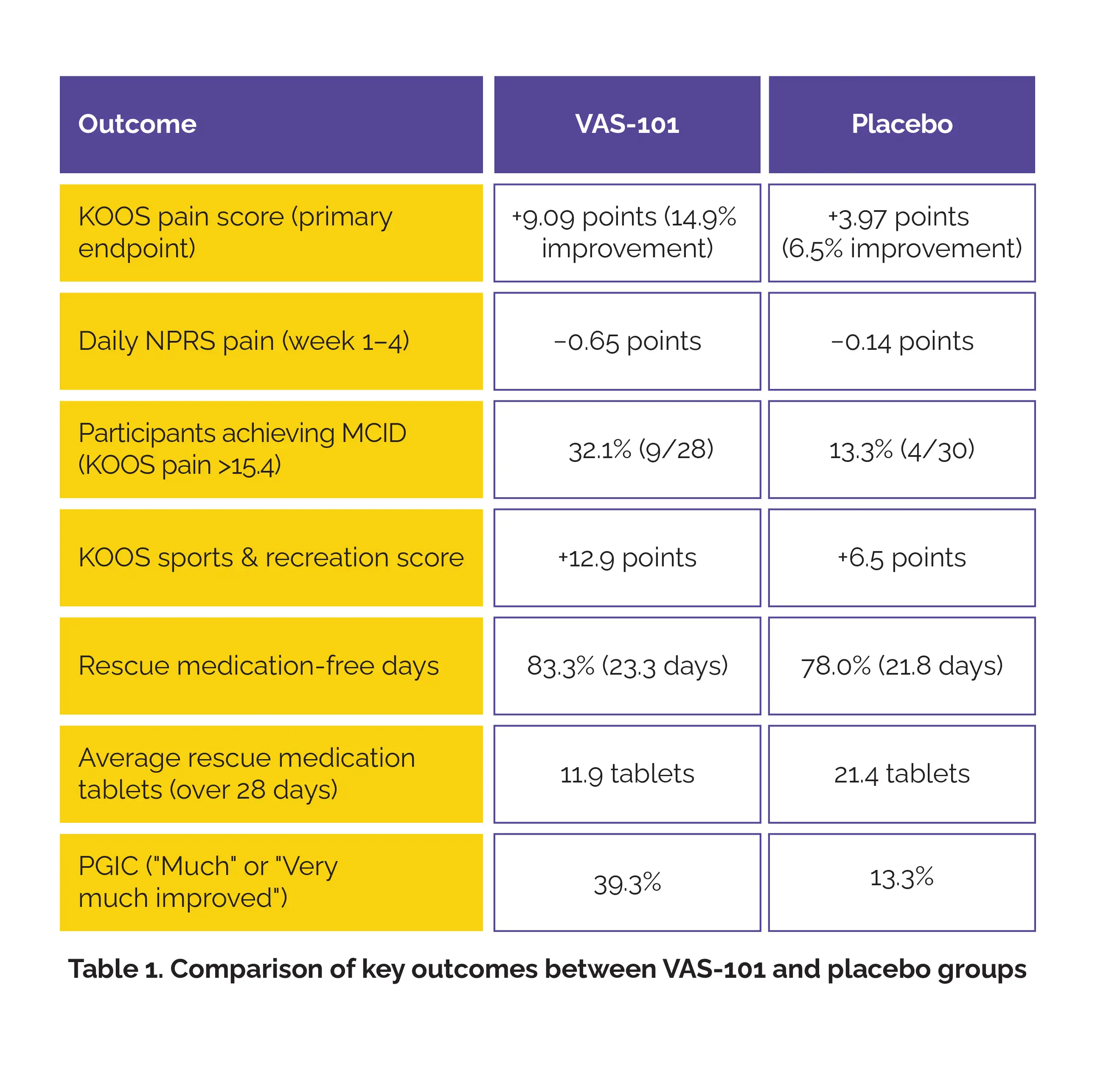
Participants treated with VAS-101 exhibited greater improvement in the KOOS sports and recreation subscale than placebo (12.9 vs. 6.5 points; β=6.41; d=0.57; p=0.046). However, this result did not satisfy the predefined hierarchical criteria for statistical significance. No prominent differences emerged for symptoms/stiffness, daily living, or quality-of-life subscales.
(c) Performance-based tests
No significant group differences were found on the Chair-Stand, Paced Walk, Timed Up-and-Go, or Six-Minute Walk tests.
(d) Rescue medication
(e) PGIC
On day 28, significantly more VAS-101 participants reported feeling "much" or "very much" improved (39.3% vs. 13.3%, p = 0.019). The key findings are summarized in Table 1:
(f) Blinding Assessment
Participant blinding was successfully maintained, as most participants either incorrectly identified their treatment assignment or remained unsure (57.1% in the VAS-101 group and 60% in the placebo group). Only one volunteer correctly identified therapeutic allocation based on gel color.
(g) Safety and Tolerability
The findings indicate that a low, conservative dose of topical curcumin gel applied every second day for four weeks produces measurable, self-reported pain relief in knee OA — consistent across two independent pain measures (KOOS pain subscale and daily NPRS). The effect size (d = 0.62) on the primary endpoint compares favorably with pooled effect sizes reported for topical NSAIDs (around 0.37) in prior meta-analyses. This suggests that topical curcumin may offer comparable short-term analgesic benefit, though direct comparison is limited by differences in trial duration and dosing schedules across studies.
Only one other trial has examined topical curcumin for knee OA, using a higher dose (1.5 mL twice daily for 6 weeks) and a non-colour-matched placebo, raising blinding concerns; the current study strengthens this evidence base with confirmed blinding and multiple validated outcome measures. Comparing this topical formulation with an earlier oral curcumin trial by the same investigative group, both showed remarkable KOOS pain improvements, with a numerically larger effect size for the topical route (0.62 vs. 0.39), though population differences make direct comparison difficult.
Despite the significant pain-score improvement, only about one-third of VAS-101 users achieved a clinically meaningful reduction (MCID), and no functional/performance gains were observed, suggesting the treatment provides modest, not universal, benefit. Exploratory findings — such as a correlation between negative treatment expectations and greater rescue medication use — point to psychological factors that may influence outcomes and warrant further study.
Topical VAS-101 gel, applied every other day for 28 days, provided a modest but statistically significant reduction in knee pain. The treatment was well-tolerated, with temporary skin staining as the only notable adverse effect. However, only about one-third of participants achieved clinically meaningful pain relief, and no improvements were observed in physical function. Larger, longer-term studies are required to confirm its clinical value before broader clinical adoption.
Frontiers in Pain Research
The effect of a topical curcumin formulation (VAS-101) on knee pain in adults with knee osteoarthritis: a randomised, double-blind, placebo-controlled study
Adrian L Lopresti et al.










Comments (0)