

Categories
Change Password!
Reset Password!



The SPOT web calculator uses baseline and 3-month KOOS-12 pain scores to predict whether patients are likely to experience improved or persistent pain over 12 months after orthobiologic treatment for knee osteoarthritis.
Pain after treatment for knee osteoarthritis (KOA) does not necessarily follow the same course in every patient. Some patients experience sustained improvement, while others continue to report substantial symptoms over time. The investigators explored these patterns using data from a multisite randomized controlled trial evaluating intra-articular orthobiologic treatments.
The analysis included patients who received stromal vascular fraction, autologous bone marrow aspirate concentrate, or umbilical cord tissue-derived mesenchymal stromal cells. Among 317 participants evaluated for pain patterns over 12 months, two clinically meaningful groups emerged. Approximately two-thirds of participants (66.6%) belonged to a group characterized by improving pain, while 3.4% showed a pattern of persistent pain.
What happens by month 3 matters
The team then asked whether pain information available early in follow-up could provide an indication of which trajectory a patient would subsequently follow. For this analysis, 295 participants had pain measurements available at both screening and month 3. A logistic regression model incorporated the baseline Knee Injury and Osteoarthritis Outcome Score-12 (KOOS-12) pain score together with the change in pain by month 3.
The model showed an area under curve (AUC) of 0.785 in the training dataset and 0.792 in the independent held-out test dataset, indicating that the combination of these early pain measures could discriminate between the two 12-month pain patterns. When tested at an optimal probability threshold of 0.656, the Symptom Prediction for Outcomes of Treatment (SPOT) algorithm delivered robust diagnostic stats in the independent test set (Table 1):
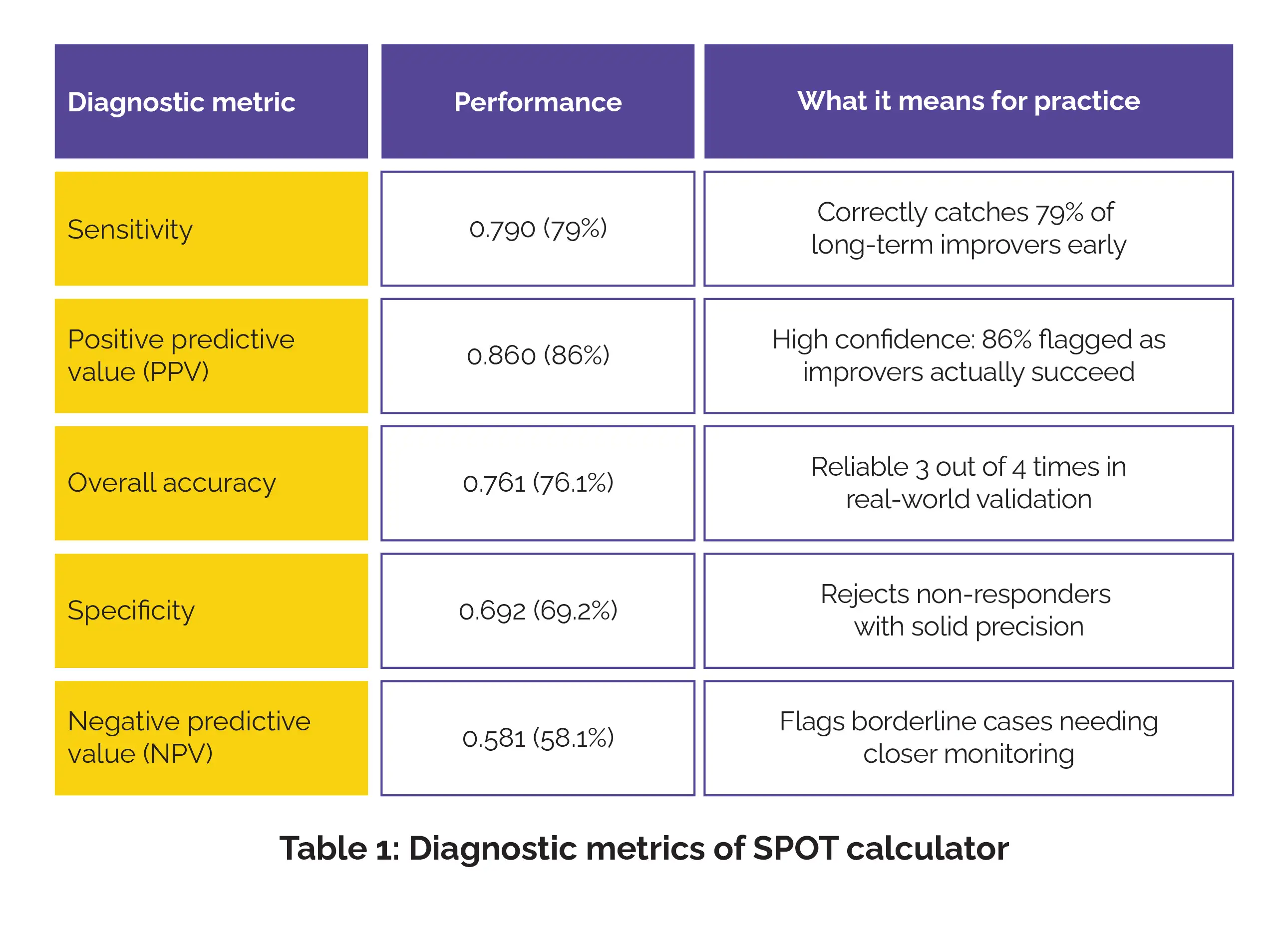
SPOT turns early pain data into a prediction
Rather than requiring extensive clinical information, SPOT relies on two KOOS-12 pain assessments (one obtained at screening and another at month 3). The resulting classification indicates whether the patient's subsequent 12-month course is more consistent with an improving or persistent pain pattern.
The researchers selected the two-group model for the calculator because of its clinical interpretability. Although a three-group statistical model illustrated a slightly lower Bayesian information criterion, its additional group represented only 2.5% of volunteers and was not retained for the clinical tool.
Why it matters
The SPOT calculator transforms early patient-reported data into actionable insights for follow-up care. Rather than waiting a full year to examine orthobiologic efficacy, clinicians can plug in KOOS-12 scores at the 90-day mark to pinpoint likely non-responders, pivot treatment strategies early, and set evidence-backed expectations.
Journal of Orthopaedic Research
SPOT: An Early Detection Tool for Predicting Pain Trajectories Following Intra-Articular Injections
Brittany L. Nelson et al.















Comments (0)