

Categories
Change Password!
Reset Password!



Probiotic supplementation modestly reduces pain frequency and intensity in children with disorders of gut–brain interaction, offering a safe adjunctive option alongside standard care.
Functional abdominal pain disorders (FAPDs), now classified as abdominal pain–related disorders of gut–brain interaction (AP-DGBIs), can cause recurrent abdominal symptoms without an identifiable organic cause. Probiotics have emerged as a microbiota-targeted option, but evidence of their clinical benefit in children has remained inconsistent.
Hence, a systematic review and meta-analysis published in 2026 brought together randomized evidence to examine whether probiotics offered meaningful benefits over placebo in pediatric AP-DGBIs. The analysis included 21 randomized controlled trials conducted between 2005 and 2025, comprising 1,899 children with irritable bowel syndrome, functional abdominal pain not otherwise specified, functional dyspepsia, or abdominal migraine diagnosed using Rome II–IV criteria.
Across the pooled evidence, probiotics produced modest reductions in pain intensity and weekly pain episodes compared with placebo. They also increased the likelihood of achieving complete symptom resolution (Table 1).
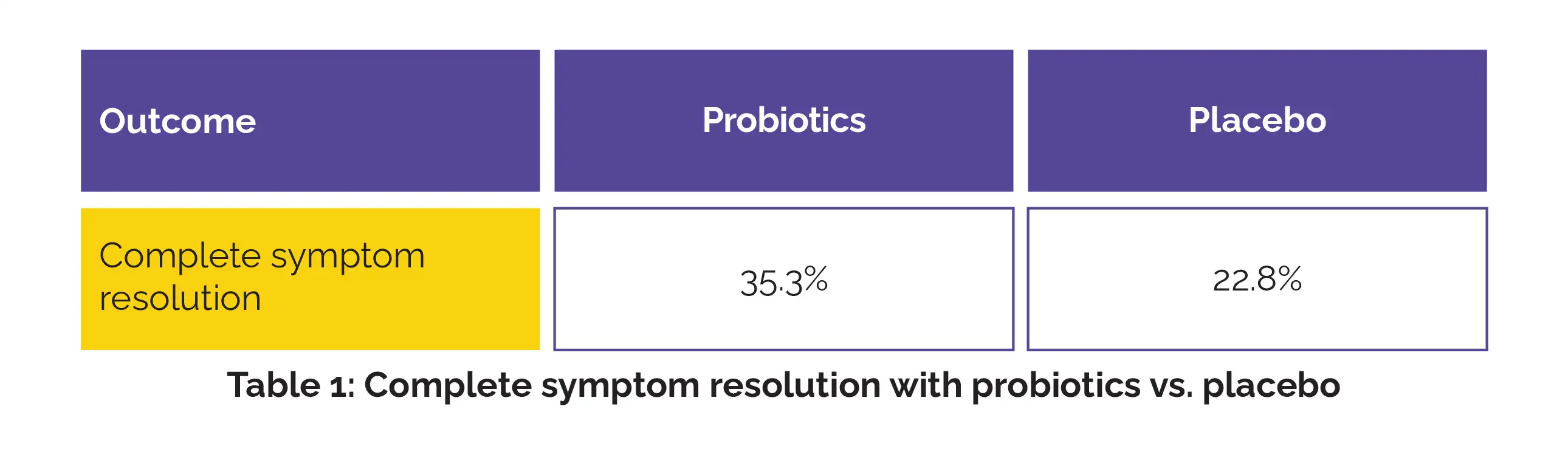
The meta-analysis established an NNT of 7 for complete symptom clearance. Probiotics led to modest decreases in both weekly pain frequency and overall pain intensity compared with placebo. When response rates were evaluated using author-defined thresholds for symptom improvement, probiotic supplementation did not exhibit a statistically significant difference vs. placebo.
The certainty of evidence ranged from low to moderate across outcomes, reflecting variation in the available trials and limiting confidence in the overall magnitude of benefit. The review also used network meta-analysis to compare probiotic interventions and assessed evidence quality using GRADE and CINeMA. The authors noted that differences in probiotic strains, doses, and treatment durations remain important gaps in the evidence base.
Overall, the findings indicated that probiotics could offer modest symptom relief for children with AP-DGBIs, but the evidence did not establish a consistent treatment response across all outcome definitions. The findings were reported as being in line with the 2025 European and North American Societies for Pediatric Gastroenterology, Hepatology and Nutrition (ESPGHAN/NASPGHAN) guidelines, with larger standardized trials needed to clarify which probiotic strains, doses, and treatment durations are most appropriate.
European Journal of Pediatrics
Probiotics in pediatric functional abdominal pain disorders: a systematic review and meta-analysis
Nour Balasan et al.









Comments (0)