

Categories
Change Password!
Reset Password!


Ketorolac is commonly used perioperatively in primary total hip arthroplasty (THA), either intravenously or via periarticular infiltration analgesia (PAI).
Perioperative ketorolac use during primary total hip arthroplasty does not increase the risk of postoperative acute kidney injury, regardless of administration route or baseline chronic kidney disease status.
Ketorolac is commonly used perioperatively in primary total hip arthroplasty (THA), either intravenously or via periarticular infiltration analgesia (PAI). While beneficial for pain control, concerns remain about its potential to trigger acute kidney injury (AKI), specifically in those with chronic kidney disease (CKD). The study evaluated the connection between perioperative ketorolac use and postoperative AKI, stratified by administration route and baseline renal function.
A retrospective analysis was conducted on 7,211 inpatient THAs performed between 2011 and 2021. AKI was defined according to the Kidney Disease: Improving Global Outcomes (KDIGO) criteria. Multivariable logistic regression analyses explored the link between perioperative ketorolac use and in-hospital AKI, adjusting for clinical covariates and demographic data. Subgroup analyses were conducted for volunteers with (15%) and without (85%) preexisting CKD. Ketorolac was administered perioperatively in 35% of cases:
The median cumulative dose was 30 mg (range, 15 to 90 mg). The mean age of the cohort was 66 years, the mean body mass index (BMI) was 31, and 51% of the patients were women.
AKI occurred in 3.4% of cases. Perioperative ketorolac use did not raise this risk, while preexisting CKD and several other patient and perioperative factors did.
(a) Ketorolac does not increase AKI risk
Ketorolac use was not associated with an increased risk of AKI (odds ratio [OR] 0.8), regardless of administration route (all ORs less than 1). In those without CKD, ketorolac use was linked with a decreased likelihood of AKI (OR 0.6), while in those with CKD it was not linked with an increased or decreased risk (OR 1.1)
(b) Preexisting CKD and other factors drive AKI risk
CKD was an independent risk factor for AKI (OR 4.1). Additional independent risk factors included intraoperative transfusion, new-onset atrial fibrillation, history of hypertension, male sex, and elevated BMI (Table 1).
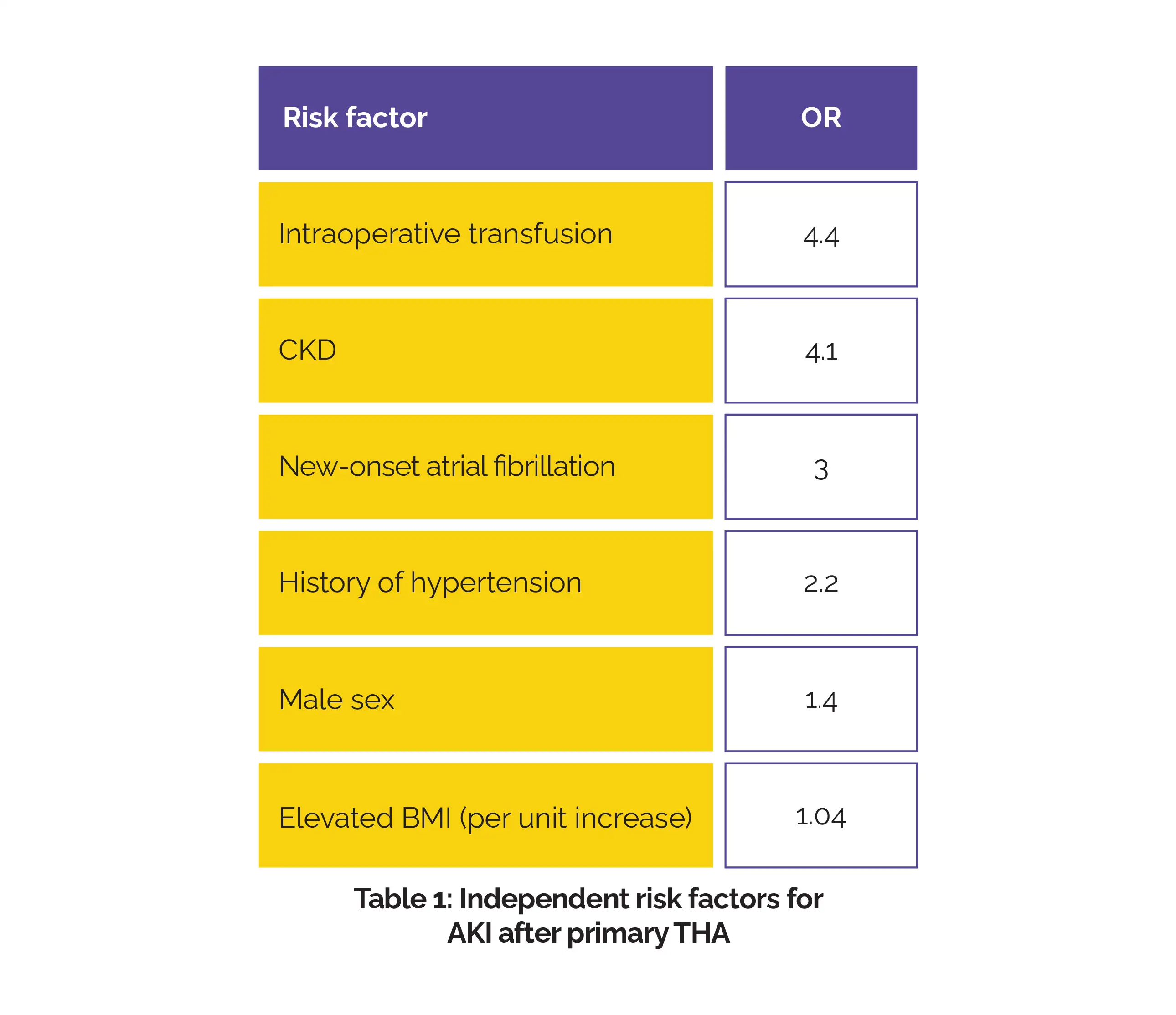
Perioperative ketorolac use did not raise the chances of postoperative AKI, regardless of administration route. Risk factors for AKI included history of hypertension, preexisting CKD, male sex, elevated BMI, and requirement for intraoperative transfusion.
The Journal of Arthroplasty
Safety of Ketorolac in Primary Total Hip Arthroplasties: An Analysis of Over 7,000 Cases
Nils Meissner et al.














Comments (0)