

Categories
Change Password!
Reset Password!



The biological footprint of fibromyalgia may extend beyond pain processing pathways, as researchers uncover notable differences in tissue mechanics and pressure sensitivity.
Fibromyalgia (FM) continues to challenge clinicians and researchers alike, as the biological mechanisms driving its persistent pain remain only partially understood. While the condition is widely associated with abnormal pain processing within the central nervous system, increasing attention has turned toward the possibility that changes within muscles and soft tissues may also influence symptom severity.
Ultrasound strain elastography (SEL), a non-invasive imaging technique capable of assessing tissue mechanical behavior, has emerged as a potential tool for exploring these peripheral changes. Seeking to better understand this relationship, researchers compared pain sensitivity and tissue deformation patterns in women with FM and healthy controls at established tender-point sites.
The team examined 84 women in a cross-sectional study conducted at a rehabilitation center in Málaga, Spain. The cohort comprised 42 females diagnosed with FM and 42 healthy controls. Participants underwent bilateral testing at 13 standardized tender-point regions, with investigators measuring pressure pain thresholds (PPT) and assessing tissue deformation through ultrasound SEL. Comparative statistical analyses were subsequently carried out to identify significant differences between women with FM and those without the condition.
The analysis revealed clear differences in both pain sensitivity and tissue mechanical behavior between women with FM and healthy controls, although the magnitude of tissue-related changes varied across anatomical locations (Table 1).
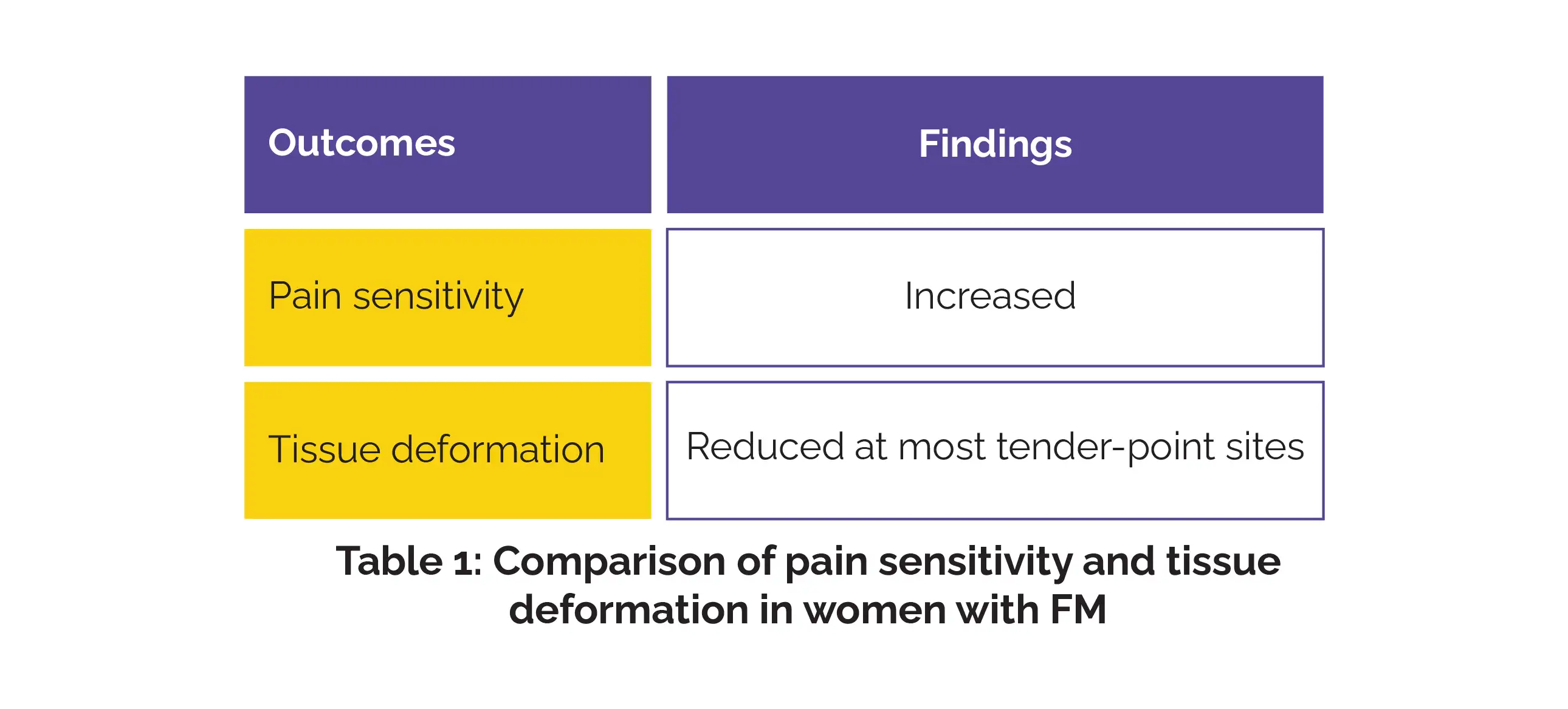
Overall, women with FM demonstrated heightened pain sensitivity and site-specific differences in tissue deformation, although these tissue alterations were not consistently observed across all anatomical regions. The study suggested that FM involves both increased pain sensitivity and localized tissue changes.
Diagnostics
Differences in Pressure Pain Threshold and Strain Elastography Between Women with and Without Fibromyalgia: A Cross-Sectional Study
María Aguilar-García et al.















Comments (0)