

Categories
Change Password!
Reset Password!



Higher fetal fraction significantly predicts increased risk of birthweight discordance and selective fetal growth restriction in twin pregnancies.
Twin pregnancies carry a higher risk of selective fetal growth restriction (sFGR) and birthweight discordance, which contribute to higher perinatal mortality and morbidity. Early identification of high-risk pregnancies remains challenging. This retrospective cohort study aimed to determine whether fetal fraction (FF) obtained from cell-free fetal DNA (cffDNA) screening correlated with birthweight differences and predicted birthweight discordance and sFGR in twin pregnancies.
Data were analyzed from 224 twin pregnancies that underwent cffDNA aneuploidy screening between 2018 and 2021. Both dichorionic and monochorionic twin pregnancies were included. The FF values and neonatal birthweights were obtained from medical records. Analysis showed a positive association between FF and inter-twin birthweight differences.
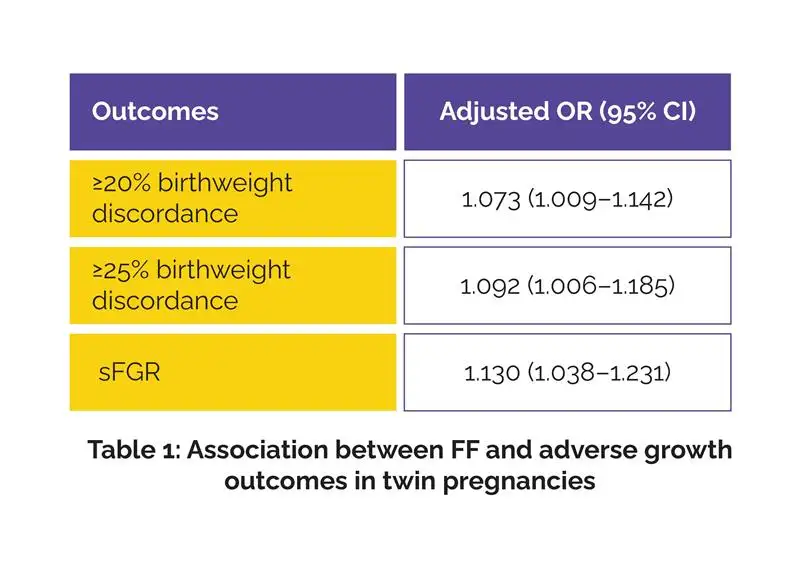
The adjusted regression coefficient was β=0.365 with a 95% confidence interval (CI) of 0.122 to 0.608. For every 1% increase in FF, the difference in birthweight between twins increased by 0.365%. Higher FF levels were independently associated with increased risks of adverse growth outcomes (Table 1):
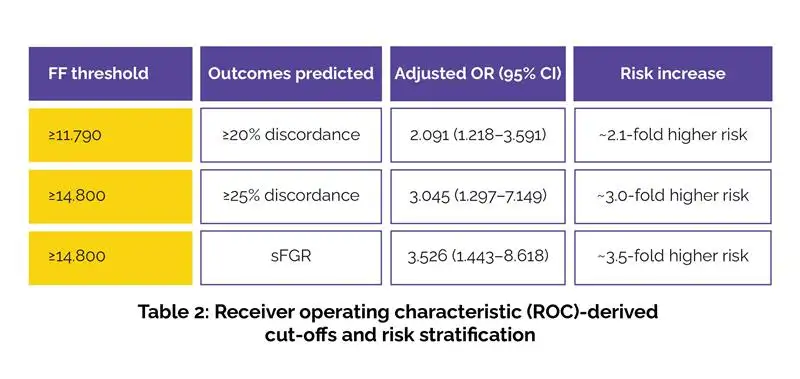
Notably, pregnancies with FF ≥11.790 had a considerably increased likelihood of ≥20% discordance compared to those below this threshold, while FF ≥14.800 identified a subgroup at markedly elevated risk for both severe discordance and sFGR (Table 2).
Thus, FF, a routinely available parameter from prenatal cffDNA screening, emerges as a cost-neutral, accessible biomarker for identifying high-risk twin pregnancies. Its integration into clinical workflows could enable earlier surveillance, targeted monitoring, and better prenatal counselling, ultimately helping mitigate adverse perinatal outcomes.
International Journal of Women’s Health
Association of Increased Fetal Fraction with Birthweight Discordance and Selective Fetal Growth Restriction: A Retrospective Study
Renyi Hua et al.















Comments (0)