

Categories
Change Password!
Reset Password!



Conservative management is as effective as laparoscopic cholecystectomy for short-term outcomes in uncomplicated symptomatic gallstone disease while being less costly.
According to the findings of a randomized controlled trial (C-GALL), conservative management provides similar short-term quality-of-life outcomes to laparoscopic cholecystectomy in uncomplicated symptomatic gallstone disease, with lower healthcare costs and no difference in quality-adjusted life years (QALYs).
The study, conducted across 20 secondary care centers in the UK, enrolled 434 adults (aged over 18 years) with uncomplicated symptomatic gallstones. In total, 2,667 patients were assessed for eligibility, and 434 were randomly assigned to get either conservative management (n=217) or laparoscopic cholecystectomy (n=217). Those in the conservative management group were monitored without surgery unless symptoms worsened.
In contrast, the cholecystectomy group underwent laparoscopic removal of the gallbladder. By 18 months, 25% of the conservative management group (54 subjects) and 67% of the surgery group (146 subjects) had received surgery. The primary endpoint was quality of life, estimated via the short form 36 (SF-36) bodily pain domain over 18 months. The mean SF-36 bodily pain score was comparable for the conservative and the surgery group (Table 1):
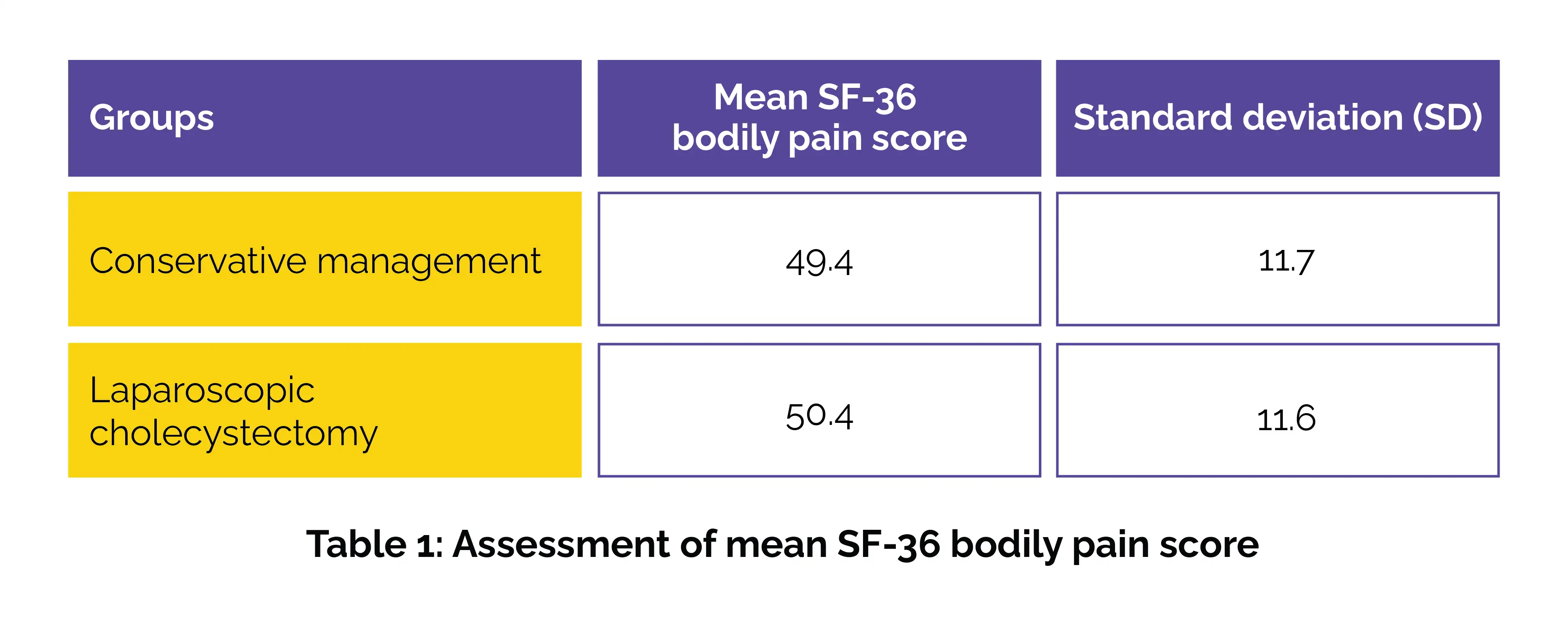
There was no vital difference in the area under the curve for bodily pain scores (mean difference 0.0; 95% confidence interval -1.7 to 1.7). Secondary outcomes encompassed healthcare costs and QALYs. Conservative management was less expensive, with a mean cost difference of -£1,033 (-$1,334; -€1,205; 95% credible interval -£1,413 to -£632), while QALYs were comparable between the two groups (mean difference -0.019; 95% credible interval -0.06 to 0.02).
The study concludes that, in the short term (up to 18 months), laparoscopic surgery provides no additional benefit over conservative management for uncomplicated symptomatic gallstones. Thus, conservative management is cost-effective and must be viewed as a viable alternative to surgery. The researchers advocate further long-term studies to determine lifetime cost-effectiveness and to identify which people are most likely to benefit from surgery.
The BMJ
Effectiveness of conservative management versus laparoscopic cholecystectomy in the prevention of recurrent symptoms and complications in adults with uncomplicated symptomatic gallstone disease (C-GALL trial): pragmatic, multicentre randomised controlled trial
Irfan Ahmed et al.














Comments (0)