

Categories
Change Password!
Reset Password!


The perimenopause (menopausal transition) and postmenopausal period can coincide with alterations in mood, sleep, and psychological well-being. Saffron (Crocus sativus L.) has illustrated potential antidepressant and sleep-linked benefits in prior clinical studies.
Daily supplementation with standardized saffron extract (28 mg/day) reduces depressive symptoms, lowers daytime sleep-related impairment, and boosts self-esteem in perimenopausal and postmenopausal women (aged 50–70 years) experiencing low mood and poor sleep.
The perimenopause (menopausal transition) and postmenopausal period can coincide with alterations in mood, sleep, and psychological well-being. Saffron (Crocus sativus L.) has illustrated potential antidepressant and sleep-linked benefits in prior clinical studies. But, its impact in those experiencing both low mood and poor sleep remains insufficiently established.
Its potential influence on self-esteem and skin ageing also warrants investigation. Hence, this study determined the influence of standardised saffron extract in older women.
This 12-week, randomized controlled trial recruited 86 women (aged 50–70 years) with low mood and self-reported poor sleep. Volunteers were randomly assigned in a 1:1 ratio to get saffron extract 28 mg/day or placebo. Alteration in the depression subscale of the Depression, Anxiety and Stress Scale–21 (DASS-21) was the key outcome ascertained.
Secondary outcomes included sleep disturbance and sleep-related impairment, assessed via the Patient-Reported Outcomes Measurement Information System (PROMIS) Sleep scales; self-esteem, assessed using the Rosenberg Self-Esteem Scale; self-rated physical appearance; and facial skin age estimated via an artificial intelligence (AI)-based application.
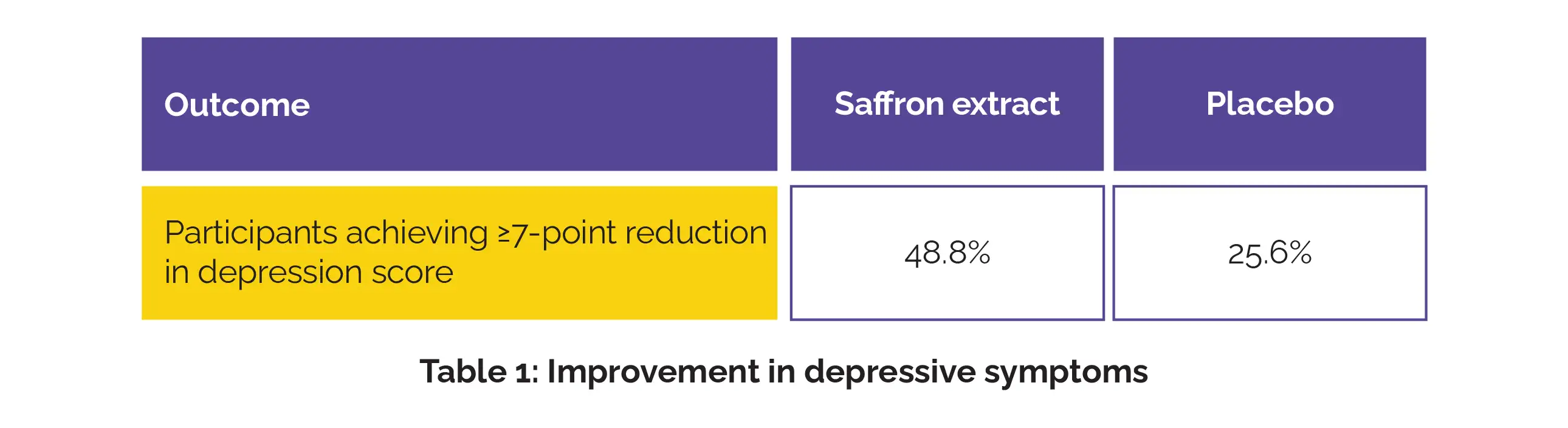
Of the 86 volunteers, 79 were postmenopausal and 7 were perimenopausal. Compared with placebo, saffron supplementation substantially reduced depressive symptoms (adjusted mean difference: 2.37). Women receiving saffron extract exhibited a clinically meaningful reduction of ≥7 points in depression scores (Table 1):
Saffron use also improved self-esteem (adjusted mean difference: 1.43) and sleep-related impairment (adjusted mean difference: 2.99). However, no pivotal between-group differences were noted in AI-estimated facial skin age, sleep disturbance, or self-rated physical appearance. Supplementation showed good tolerability, with no serious adverse events reported.
A 12-week regimen of standardized saffron extract yielded clinically meaningful reductions in depressive symptoms among women with mood and sleep disturbances. It also improved self-esteem and daytime sleep-related functioning. However, it didnot markedly impact nocturnal sleep disturbance or objective/subjective markers of skin appearance.
Frontiers in Nutrition
The effects of a saffron extract (Affron®) on mood, sleep, self-esteem, and exploratory measures of physical appearance in women aged 50 to 70 years experiencing low mood and poor sleep: a randomised, double-blind, placebo-controlled trial
Adrian L. Lopresti et al.








Comments (0)