

Categories
Change Password!
Reset Password!



Current American and European clinical practice guidelines classify oral anticoagulation (OAC) as a Class IIa recommendation for those presenting with non-valvular atrial fibrillation (AF) who carry an intermediate risk of stroke.
For atrial fibrillation with intermediate stroke risk, direct oral anticoagulant therapy is beneficial to minimize the 24-month composite risk of stroke, systemic embolism, major bleeding, or cardiovascular death vs. no anticoagulation.
Current American and European clinical practice guidelines classify oral anticoagulation (OAC) as a Class IIa recommendation for those presenting with non-valvular atrial fibrillation (AF) who carry an intermediate risk of stroke. Despite widespread adoption, high-level evidence supporting this practice from prospective randomized controlled trials has remained limited. This study evaluated whether initiating direct oral anticoagulant (DOAC) therapy offers superior clinical protection over no anticoagulation in this specific moderate-risk patient cohort.
A multicenter, open-label, randomized superiority trial was conducted across medical centers in South Korea.
A total of 1,803 patients underwent randomization (902 assigned to DOAC therapy; 901 assigned to no anticoagulation). Across the trial cohort, the mean age was 60.4 years, and 23.7% were women. At 24 months, the occurrence of the primary endpoint event is depicted in Table 1:
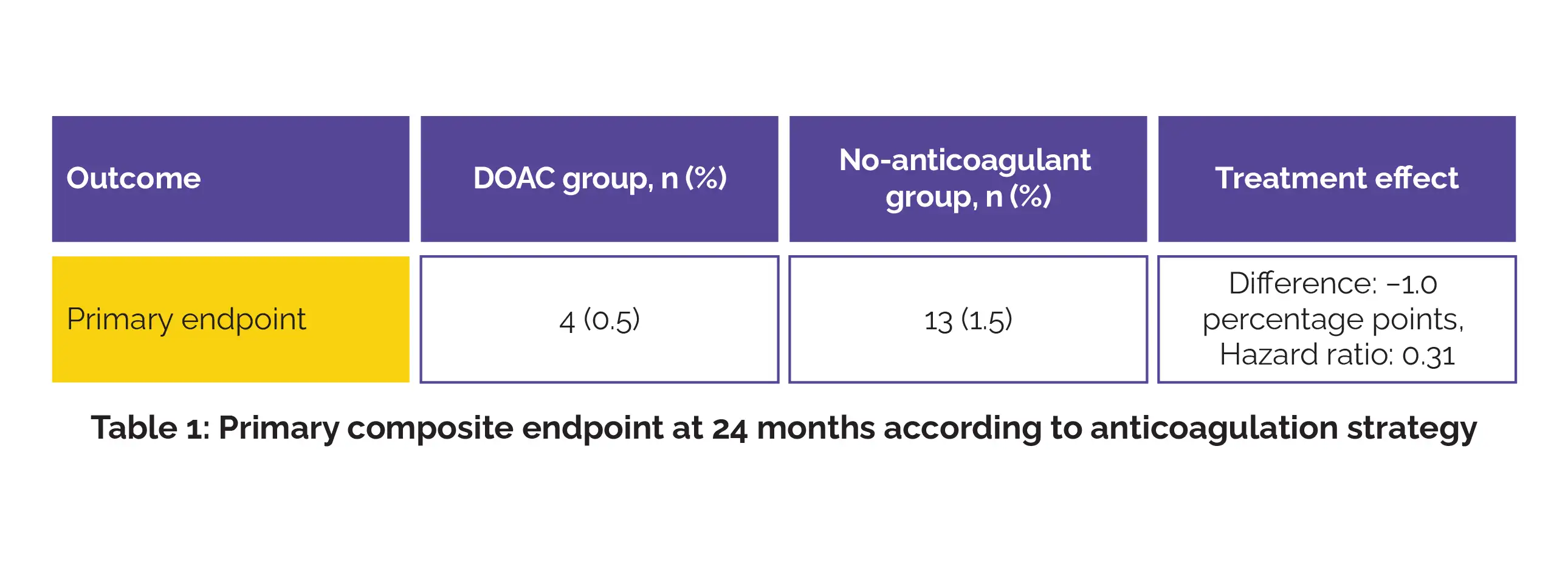
Stroke was also less frequent with DOAC therapy, occurring in 0.3% of patients compared with 1.1% receiving no anticoagulation. The incidences of systemic embolism and major bleeding were similar between groups. No CV deaths occurred in either group. Serious adverse events were noted in 8.9% of the DOAC group and 9.3% of the no-anticoagulation group.
For the management of AF and intermediate stroke risk (CHA₂DS₂-VASc score of 1 in men and 2 in women), DOAC therapy showed a favorable benefit–risk profile, reducing the composite risk of stroke, systemic embolism, major bleeding, or cardiovascular death over 24 months vs. no anticoagulation.
Daehoon Kim et al.















Comments (0)