

Categories
Change Password!
Reset Password!



Upadacitinib 15 mg once daily sustains clinical and skin responses through 152 weeks in patients with psoriatic arthritis previously exposed to one TNFi, with early pain improvement predicting long-term minimal disease activity.
For psoriatic arthritis (PsA) sufferers, the end of a tumor necrosis factor inhibitor (TNFi) does not necessarily mean the end of effective treatment. Novel long-term findings from SELECT-PsA 2 show that switching to the Janus kinase (JAK) inhibitor upadacitinib can deliver sustained disease control for approximately 3 years after exposure to one prior TNFi.
The post-hoc analysis included 195 patients with PsA who had received one prior TNFi. Among the participants, 90 were assigned to once-daily upadacitinib 15 mg, while 105 received placebo; those initially assigned to placebo transitioned to upadacitinib at week 24. Efficacy was checked via the American College of Rheumatology (ACR20/50/70) responses, minimal disease activity (MDA), Psoriasis Area and Severity Index (PASI75/90) responses and pain, while safety was evaluated through week 152.
Early separation in joint response
By week 24, upadacitinib produced substantially greater clinical responses than placebo (Table 1):
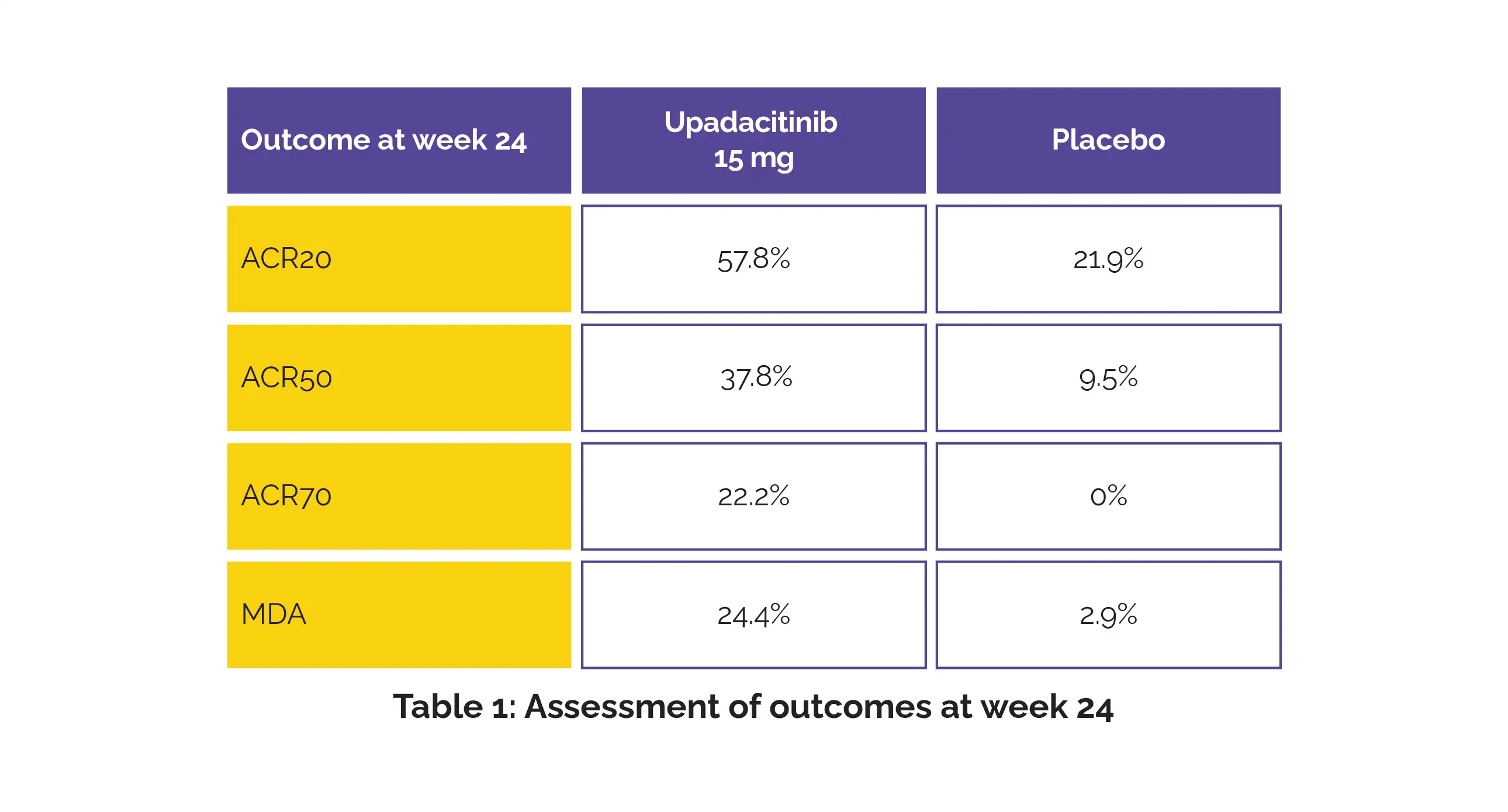
Importantly, these responses were maintained or improved through week 152, indicating durable control in those previously exposed to one TNFi.
Skin benefits persist after switching
The benefit was not restricted to musculoskeletal manifestations. Those who switched from placebo to upadacitinib at week 24 attained sustained PASI75 and PASI90 responses, with improvements maintained across different anatomical regions. Notably, upadacitinib's potency was generally consistent regardless of the duration of previous TNFi exposure, based on sensitivity analyses and analyses by tertiles of prior TNFi exposure.
Could early pain response predict long-term control?
One of the more clinically interesting findings involved pain. Patients with lower pain scores at weeks 2 and 12 were more likely to achieve MDA at week 152. This finding suggests that an early improvement in pain may yield a useful indicator of subsequent long-term disease control, although the analysis was post-hoc and the finding should be interpreted accordingly.
No new safety signals after 3 years
Across the 152-week follow-up period, no novel safety signals were identified. Overall, upadacitinib illustrated sustained efficacy and an acceptable safety profile in PsA sufferers who had exposure to one prior TNFi.
Why does this matter?
Around 30%–40% of patients may fail first-line biologic therapy, leaving clinicians with a pivotal treatment-sequencing decision. While switching to another mechanism is advocated when treatment targets are not attained, data on JAK inhibitors in TNFi-experienced PsA remain limited.
The SELECT-PsA 2 analysis therefore adds long-term evidence that upadacitinib 15 mg once daily can maintain joint, skin, and overall disease-control responses after one prior TNFi, irrespective of the duration of previous TNFi exposure. The connection between early pain improvement and later MDA achievement also raises the possibility of using early treatment response to help examine longer-term outcomes.
RMD Open
Efficacy and safety of upadacitinib in patients with psoriatic arthritis and exposure to one anti-TNF: post hoc analysis of SELECT-PsA 2
Laura C Coates et al.















Comments (0)