

Categories
Change Password!
Reset Password!



Cardiovascular risk remains an important concern in people with overweight or obesity, particularly those suffering from established atherosclerotic cardiovascular disease (ASCVD).
In people with overweight or obesity, established ASCVD, and no diabetes, using semaglutide is linked with lower risks of major adverse cardiovascular events than tirzepatide.
Cardiovascular risk remains an important concern in people with overweight or obesity, particularly those suffering from established atherosclerotic cardiovascular disease (ASCVD). Semaglutide and tirzepatide are increasingly used for weight management, but comparative real-world evidence on their cardiovascular outcomes in people without diabetes is limited. The study compared the potency of semaglutide vs. tirzepatide in reducing major adverse cardiovascular events (MACE) in this population.
This retrospective, observational cohort study used data from the Komodo Research Database. It included patients aged ≥45 years with overweight or obesity, established ASCVD, and no diabetes who initiated semaglutide or tirzepatide between May 13, 2022, and January 31, 2025. Propensity score matching was employed to balance baseline characteristics between treatment groups. The key outcomes ascertained were:
Time to first cardiovascular event was analysed using Cox proportional hazards models.
After propensity score matching, 10,625 subjects were included in each group. Semaglutide (glucagon‐like peptide‐1 [GLP‐1] receptor agonist) use was associated with a significantly lower risk of both rMACE-3 and rMACE-5 vs. tirzepatide (Table 1).
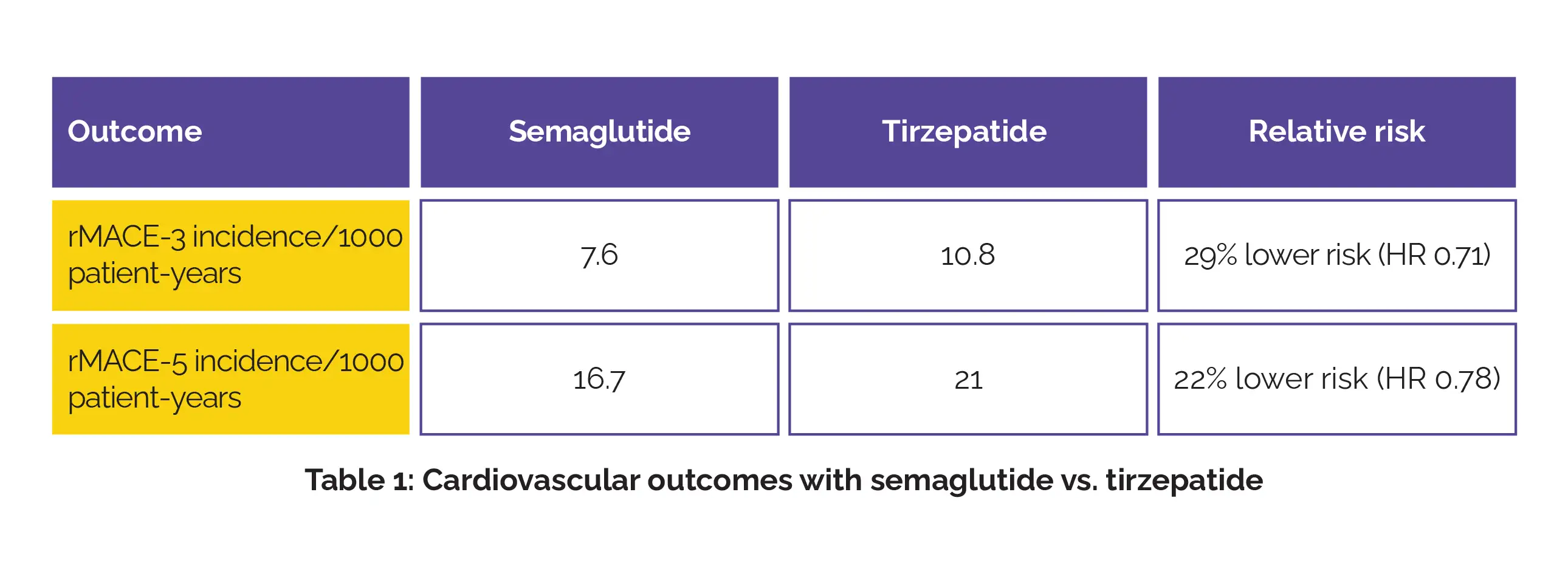
In the secondary per-protocol analysis, which included patients censored after treatment discontinuation, semaglutide remained associated with a lower risk of rMACE-3 (HR 0.43) and rMACE-5 (HR 0.57) compared with tirzepatide.
Among patients with overweight or obesity and established ASCVD without diabetes, treatment with semaglutide was linked with an early and greater reduction in the risk of both 3-point and 5-point revised MACE compared to tirzepatide. These real-world observational data offer valuable clinical insights supporting the cardioprotective benefits of semaglutide in non-diabetic secondary prevention settings.
Diabetes, Obesity and Metabolism
Semaglutide and tirzepatide effects on cardiovascular outcomes in people with overweight or obesity in the real world (STEER)
Lauren Wilson et al.












Comments (0)