

Categories
Change Password!
Reset Password!



Intranasal corticosteroids (INCS) are a cornerstone of allergic rhinitis (AR) management, but symptom persistence remains a clinical challenge for some patients.
Adding an intranasal H1 antihistamine to an intranasal corticosteroid improves nasal and ocular symptom control in allergic rhinitis, whereas adding an oral antihistamine offers no clear advantage.
Intranasal corticosteroids (INCS) are a cornerstone of allergic rhinitis (AR) management, but symptom persistence remains a clinical challenge for some patients. Combining an H1 antihistamine (AH) with an INCS is therefore widely used to provide broader symptom control. However, whether this strategy consistently delivers benefits beyond INCS alone—and whether the route of antihistamine administration matters—remains clinically relevant.
Hence, this systematic review and meta-analysis determined the efficacy and safety of combining AH with INCS compared with INCS monotherapy in AR.
Researchers searched Medline and Embase for randomized controlled trials (RCTs) comparing AH-INCS combination therapy with INCS alone in patients with AR. The key endpoints ascertained were:
Objective measures of nasal patency and adverse events were the secondary endpoints ascertained.
The analysis included 16 RCTs involving 4,026 patients. Compared with INCS, AH-INCS significantly improved nasal and ocular symptoms, with the benefit primarily observed with intranasal AH-INCS rather than oral combinations. However, disease-specific quality of life, nasal inspiratory flow, and adverse events did not differ markedly between treatments (Table 1).
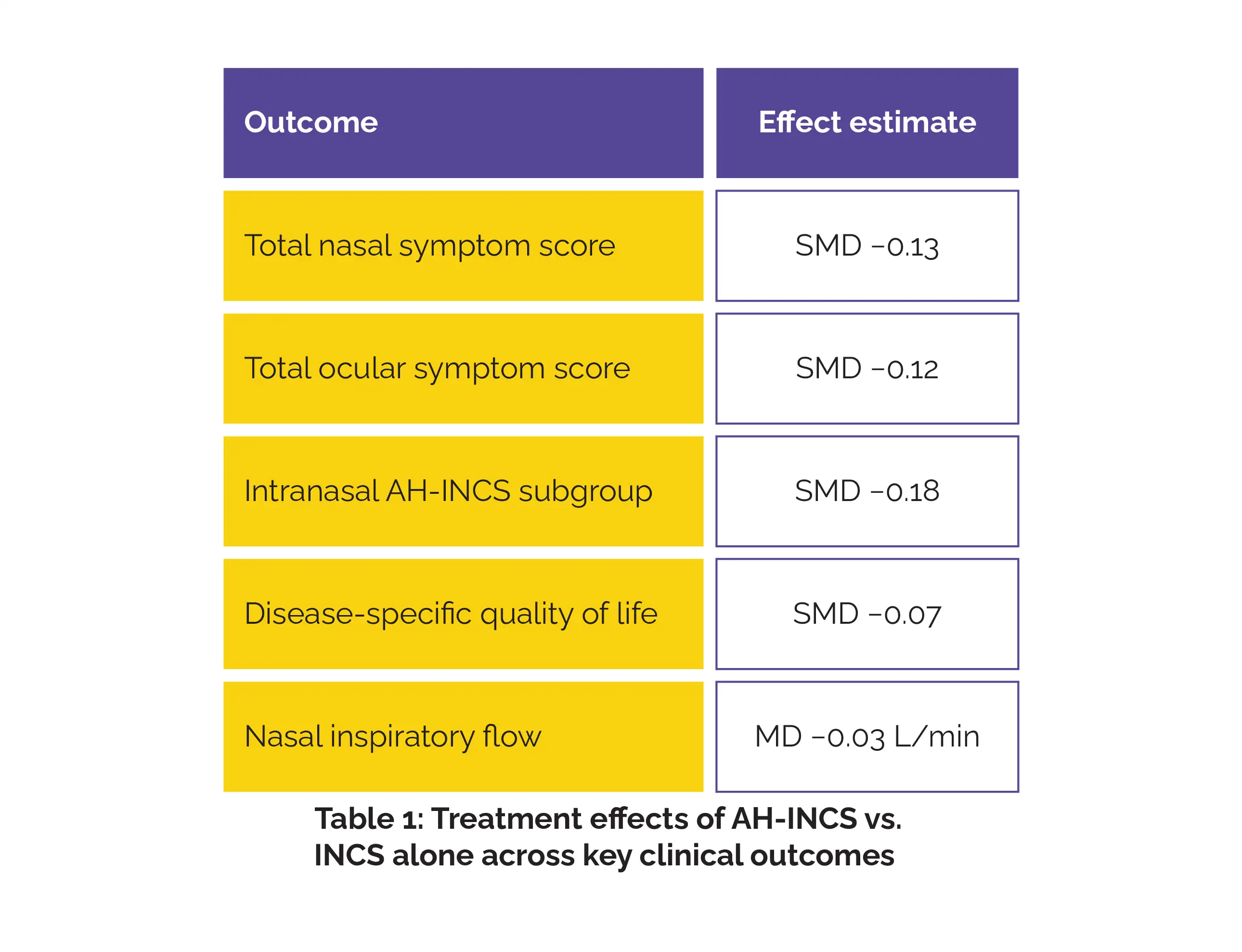
This meta-analysis suggests that the route of antihistamine administration may be clinically important when intensifying AR treatment. Adding an intranasal H1 antihistamine to an INCS provides additional relief of nasal and ocular symptoms without a significant increase in adverse events.
In contrast, simply adding an oral antihistamine to an INCS does not appear to provide meaningful additional benefit. These findings therefore support intranasal combination therapy rather than oral antihistamine add-on therapy when greater symptom control is needed beyond INCS monotherapy.
International Forum of Allergy & Rhinology
Effects of H1 antihistamine addition to intranasal corticosteroid for allergic rhinitis: a systematic review and meta-analysis
Kachorn Seresirikachorn et al.















Comments (0)