

Categories
Change Password!
Reset Password!



Paracetamol is widely used for the management of acute and postoperative pain, but the optimal single oral dose remains debated.
Oral paracetamol 1000 mg offers greater acute and postoperative pain relief than 500 mg and 650 mg without increasing adverse events.
Paracetamol is widely used for the management of acute and postoperative pain, but the optimal single oral dose remains debated. Differences between 500 mg, 650 mg, and 1000 mg doses may influence the extent of pain relief without producing equivalent changes in safety. Evaluating the dose–response relationship is therefore fundamental for optimizing analgesic efficacy while maintaining an appropriate benefit–risk balance.
The study aimed to systematically assess the efficacy and safety of different oral paracetamol doses in adults with acute or postoperative pain, with particular emphasis on dose–response relationships and the overall benefit–risk balance.
The investigators conducted a systematic evidence synthesis of studies issued in English between 2000 and 2026. Relevant evidence was identified through searches of PubMed/MEDLINE, Google Scholar, the Cochrane Library, ScienceDirect, and ResearchGate. Eligible publications included randomized controlled trials (RCTs), systematic reviews, and meta-analyses assessing the potency of oral paracetamol 500 mg, 650 mg, or 1000 mg.
Data on ≥50% pain relief, total pain relief over 4-6 hours (TOTPAR), summed pain intensity difference (SPID), adverse events, and hepatic safety markers were extracted. The dose–response relationship was explored using a descriptive Emax/Hill model. Based on the available pooled evidence, approximate number needed to treat (NNT), number needed to harm (NNH), and overall benefit–risk estimates were subsequently extracted.
The evidence base included four RCTs and one systematic review/meta-analysis. A dose-related increase in pain relief was noted with paracetamol, with the 1000 mg dose showing the strongest analgesic effect (Table 1).
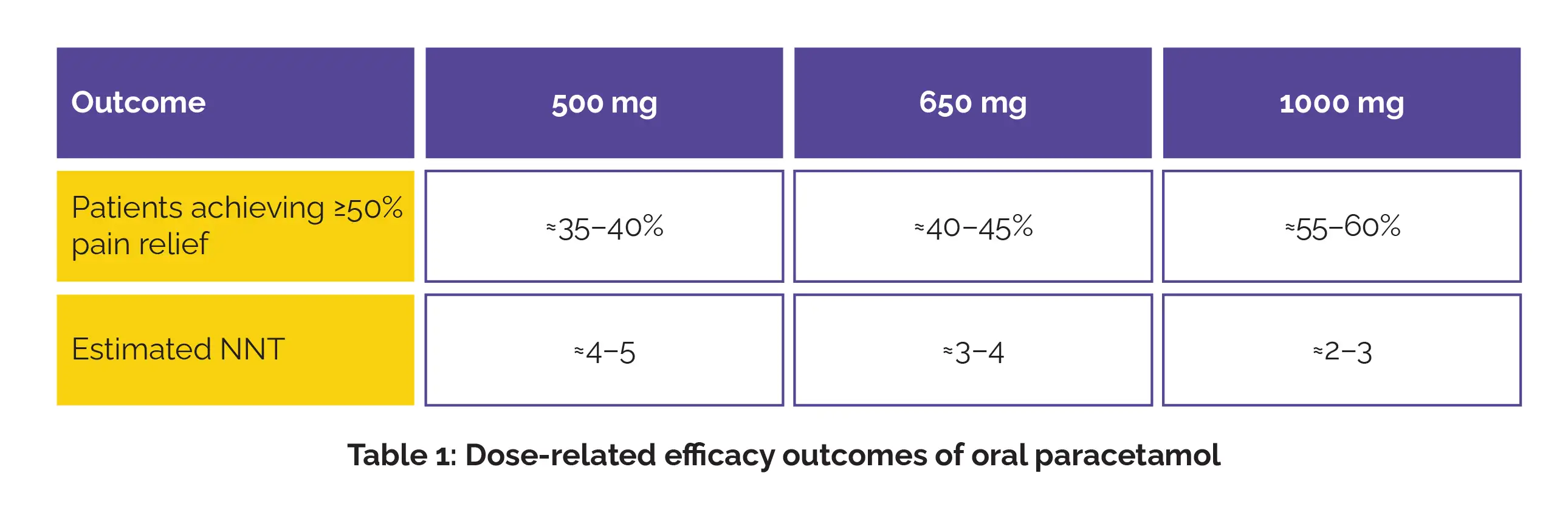
Adverse events remained relatively uncommon and were broadly comparable across doses, occurring in approximately 6–9% of participants. Importantly, the evidence did not identify a clear increase in hepatotoxicity with single-dose or short-term use. The 500 mg produced an effect close to the ED50 (50% effective dose), 650 mg approached the upper portion of the dose–response curve, and 1000 mg was near the predicted maximum analgesic response.
Among the doses evaluated, oral paracetamol 1000 mg offered the greatest pain relief without increasing short-term adverse events and had the most favorable overall benefit–risk profile.
International Journal of Medical and Pharmaceutical Research
Dose–Response Analysis and Benefit–Risk Assessment of Paracetamol (500 mg, 650 mg, and 1000 mg) for Acute and Postoperative Pain: A Systematic Evidence Synthesis with Emax Modeling
Aljouri Alzahrani et al.
















Comments (0)