

Categories
Change Password!
Reset Password!



Determining the appropriate time to re-evaluate patients after periodontal therapy may influence treatment planning and the identification of sites requiring further intervention.
Re-evaluation at 3 or 6 months after periodontal therapy produces comparable clinical and patient-reported outcomes in stage III/IV periodontitis.
Determining the appropriate time to re-evaluate patients after periodontal therapy may influence treatment planning and the identification of sites requiring further intervention. This randomized clinical trial scrutinized whether re-evaluation 3 or 6 months after steps 1–2 of periodontal therapy affected clinical outcomes, patient-reported oral health-related quality of life, and achievement of the Endpoints of Treatment (EoT) in patients with stage III/IV periodontitis.
The trial enrolled 40 participants, who were allocated to either re-evaluation at 3 months (control) or 6 months (test) following steps 1–2 of periodontal therapy. The primary endpoint was the number of teeth achieving the EoT, defined as a periodontal site with probing pocket depth (PPD) <6 mm, or a PPD of 4 or 5 mm without bleeding on probing. Secondary outcomes included changes in clinical periodontal parameters and oral health-linked quality of life checked via the 14-item Oral Health Impact Profile (OHIP-14).
The timing of re-evaluation did not considerably impact the proportion of teeth or periodontal sites achieving the EoT. Similarly, patient-reported oral health-related quality of life was equivalent between the two groups (Table 1).
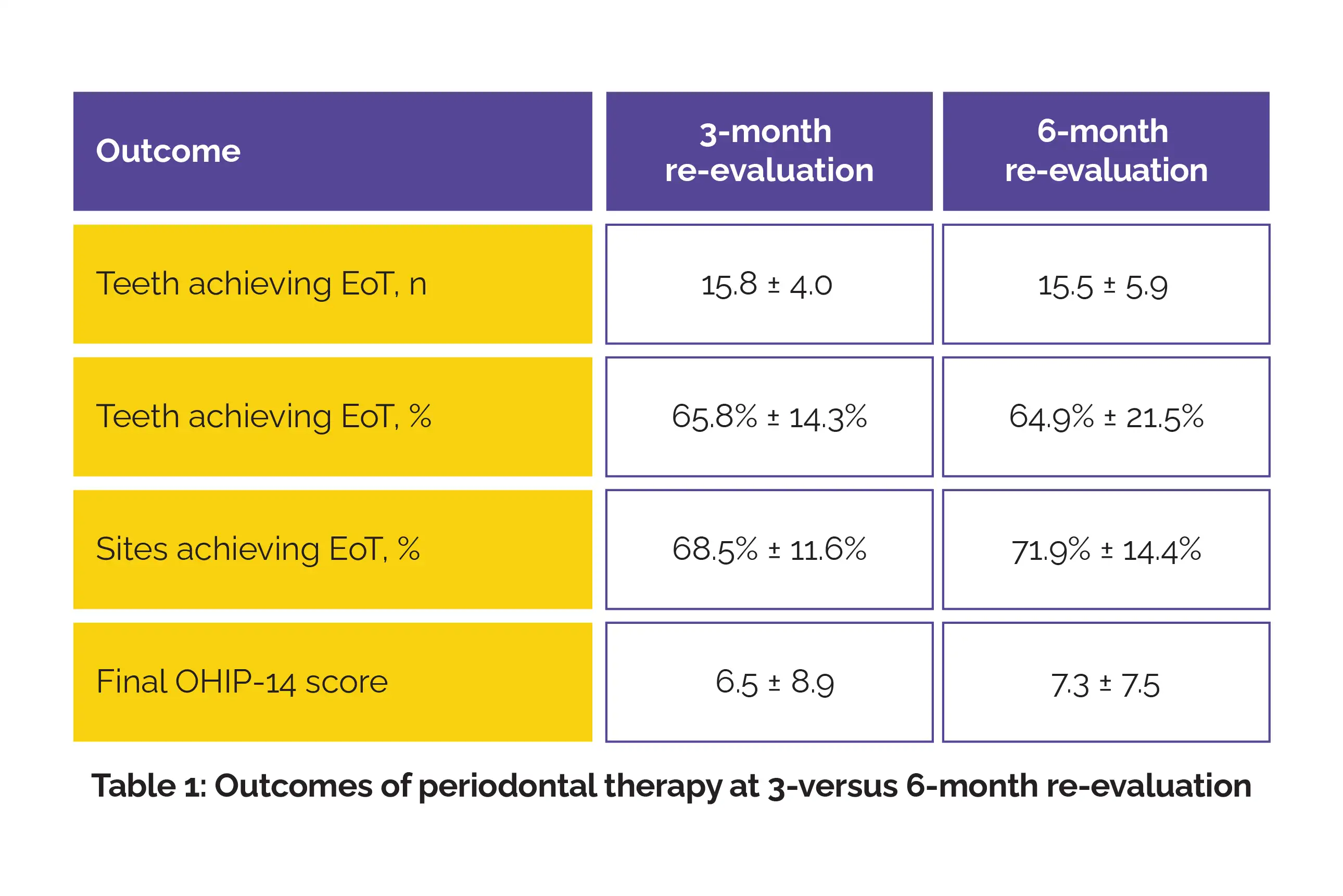
No statistically significant differences were noted between the 3- and 6-month groups for these outcomes. The likelihood of residual periodontal pockets at re-evaluation was linked with several baseline and site-level characteristics:
Re-evaluation at 3 or 6 months after steps 1–2 of periodontal therapy resulted in similar clinical and patient-centered outcomes. Non-surgical periodontal therapy often did not achieve the EoT at sites associated with intrabony defects, whereas sites characterized predominantly by horizontal bone loss more frequently reached EoT. Hence, anatomical characteristics and baseline periodontal condition of individual sites may be more important determinants of residual disease than whether re-evaluation occurs at 3 or 6 months.
Journal of Periodontal Research
Timing of Re-Evaluation After Periodontal Therapy: A Randomized Clinical Trial
Walter Castelluzzo et al.















Comments (0)