

Categories
Change Password!
Reset Password!



Near-zero fluoroscopy pulmonary vein isolation achieves a median fluoroscopy time of 26 seconds with <1% complications while maintaining strong 12-month rhythm control in atrial fibrillation.
A streamlined near-zero fluoroscopy workflow for atrial fibrillation (AF) catheter ablation dramatically reduces radiation exposure while maintaining high procedural efficiency, safety, and long-term rhythm control, according to results from the prospective SHORT LOOK registry.
Catheter ablation, particularly pulmonary vein isolation (PVI), remains the foundation of rhythm control in paroxysmal and persistent AF. However, conventional fluoroscopy-guided procedures expose patients and electrophysiology staff to cumulative radiation. While fluoroscopy-free techniques using intracardiac echocardiography (ICE) or non-fluoroscopic tracking systems (NCTS) exist, their cost and complexity have limited widespread adoption in Europe.
The SHORT LOOK study evaluated whether near-zero fluoroscopy ablation can be achieved using widely available technology—specifically advanced 3D electroanatomical mapping (CARTO3, J&J MedTec) combined with an ultra-low-dose fluoroscopy protocol, without adjunctive tools. The investigator-initiated, single-center prospective registry enrolled 450 consecutive patients undergoing first-time PVI for AF. All procedures used the CARTO3 3D mapping system and an ultra-low-dose fluoroscopy workflow. No ICE or non-fluoroscopic tracking systems were employed. Patients were followed for 12 months.
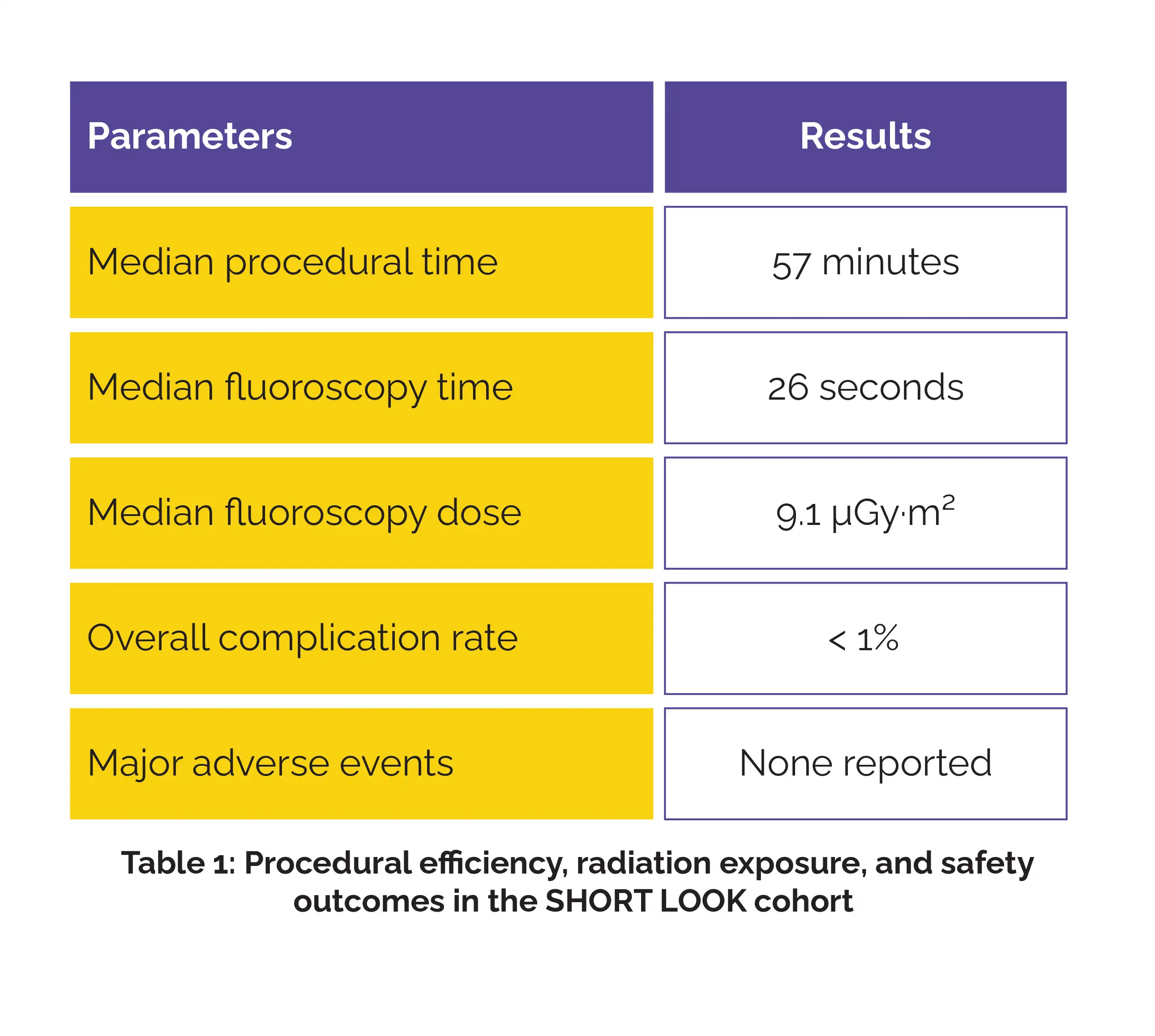
The key effectiveness endpoint was median fluoroscopy time, and the key safety endpoint was a composite of procedure-related death or cardiovascular, neurological, or vascular complications. Secondary endpoints included one-year freedom from atrial arrhythmia (>30 seconds), procedural duration, radiation dose, and quality-of-life improvement measured by Euro quality of life-visual analog scale (EQ-VAS). The cohort (n = 450) illustrated high procedural efficiency with minimal radiation exposure and excellent safety outcomes (Table 1).
At follow-up, sustained rhythm control was observed (Table 2):

Health-related quality of life improved substantially from baseline. When compared with a historical cohort treated using NCTS, the streamlined workflow attained similarly low fluoroscopy times and radiation doses. The SHORT LOOK study confirms that a streamlined near-zero fluoroscopy strategy for first-time PVI is both safe and efficient.
With a median fluoroscopy time of just 26 seconds and a radiation dose of 9.1 µGy·m², this approach minimizes radiation exposure without compromising procedural success. Importantly, the workflow requires no ICE or adjunctive tracking systems, making it practical and scalable for modern electrophysiology laboratories. The findings support broader adoption of advanced 3D mapping–guided, ultra-low-dose fluoroscopy protocols to enhance safety in AF ablation.
Journal of Cardiovascular Electrophysiology
Near-Zero-Fluoroscopy Ablation of Atrial Fibrillation Without ICE or Non-Fluoroscopic Tracking Systems: Findings From the SHORT LOOK Registry
Martin Borlich et al.














Comments (0)