

Categories
Change Password!
Reset Password!



Rheumatoid arthritis (RA), a chronic autoimmune inflammatory disorder, is marked by persistent synovial inflammation, progressive joint destruction, pain, and functional impairment.
Curcumin (key bioactive polyphenol extracted from turmeric/Curcuma longa) is beneficial to improve disease activity, inflammatory markers, pain, and joint outcomes in rheumatoid arthritis.
Rheumatoid arthritis (RA), a chronic autoimmune inflammatory disorder, is marked by persistent synovial inflammation, progressive joint destruction, pain, and functional impairment. Despite advances in disease-modifying therapies, many people continue to experience inadequate symptom control or treatment-linked adverse effects, prompting interest in complementary therapeutic strategies.
Curcumin possesses well-documented antioxidant and anti-inflammatory powers. However, previous clinical studies evaluating curcumin in RA have produced inconsistent findings. This systematic review and meta-analysis was carried out to explore curcumin's potency for RA management.
Researchers systematically searched PubMed, Embase, the Cochrane Library, and Web of Science for eligible placebo-controlled randomized clinical trials. Trial quality was assessed via the Cochrane Risk of Bias Tool. The Grading of Recommendations Assessment, Development and Evaluation (GRADE) framework was utilized to check the certainty of evidence. Meta-analysis was executed via Review Manager version 5.3. Overall, 6 randomized placebo-controlled studies involving 244 subjects with RA met the inclusion criteria.
Curcumin improved clinical and inflammatory outcomes in RA. Treatment with curcumin was linked with better American College of Rheumatology (ACR) 20 response, reduced disease activity (Disease Activity Score-28, DAS-28), lower inflammatory markers including erythrocyte sedimentation rate (ESR) and C-reactive protein (CRP), and improvements in pain severity (VAS score), tender joint count, swollen joint count, and rheumatoid factor levels (Table 1).
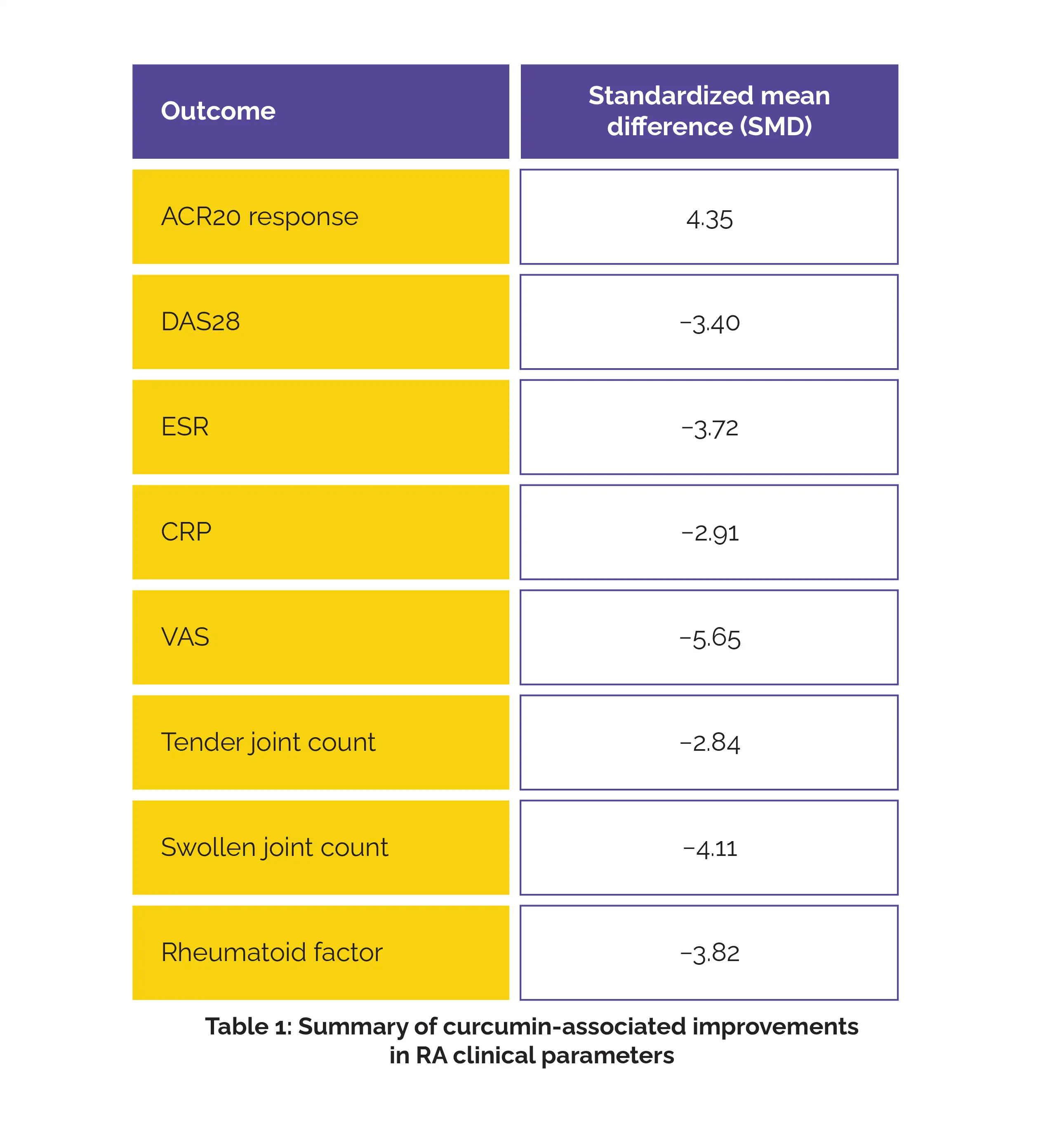
However, the certainty of evidence was rated very low for most outcomes and low for RF reduction.
Curcumin exhibited potential as an adjunctive therapy for RA by improving disease activity, pain, inflammation, and joint symptoms. However, limited study numbers and low-certainty evidence highlight the need for larger, well-designed clinical trials to confirm its efficacy and safety.
Frontiers in Immunology
Curcumin for the clinical treatment of rheumatoid arthritis: a systematic review and meta-analysis of placebo-controlled randomized clinical trials
Yihua Fan et al.















Comments (0)