

Categories
Change Password!
Reset Password!


Chronic insomnia frequently coexists with obstructive sleep apnea (OSA), creating diagnostic challenges in clinical practice.
Wrist-worn home sleep apnea testing (Watch-PAT) exhibits high specificity and good diagnostic performance for evaluating obstructive sleep apnea in chronic insomnia.
Chronic insomnia frequently coexists with obstructive sleep apnea (OSA), creating diagnostic challenges in clinical practice. Although home sleep apnea testing offers a convenient alternative to laboratory-based sleep assessment, its accuracy in chronic insomnia sufferers remains insufficiently explored. This study explored the diagnostic performance of the wrist-worn Watch-PAT 200 device in detecting sleep apnea using attended polysomnography (PSG) as the reference standard.
This prospective comparative study consecutively enrolled adults with suspected OSA and chronic insomnia. In total, 50 volunteers underwent simultaneous single-night Watch-PAT 200 monitoring and attended overnight PSG. Six were excluded because of technical failures (n=4) or recordings lasting less than 4 hours (n=2), leaving 44 volunteers for analysis. Watch-PAT 200, a wrist-worn home sleep apnea testing (HSAT) device, evaluated respiratory events, sleep duration, and sleep stages alongside laboratory-based PSG.
Apnea–hypopnea index (AHI), total sleep time, rapid eye movement (REM) sleep duration, sleep latency, wake after sleep onset (WASO), and oxygen saturation parameters were compared.
Utilizing specificity, sensitivity, receiver operating characteristic (ROC) curves, area under the curve (AUC), Bland–Altman analysis, and intraclass correlation coefficients, the diagnostic precision was monitored.
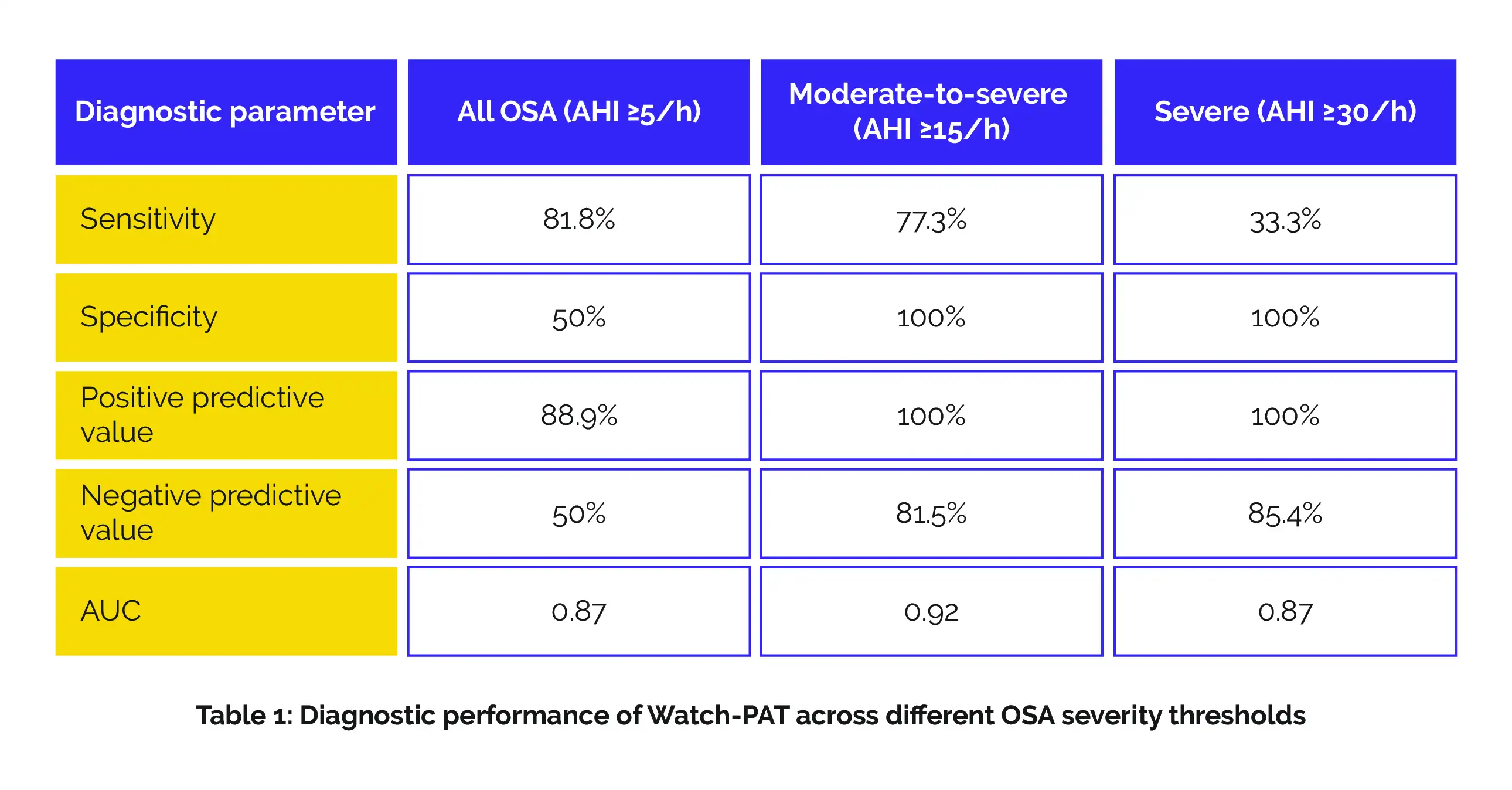
Among 44 volunteers (41% women; mean age 49.1 ± 12.7 years), Watch-PAT illustrated good diagnostic performance when compared to PSG. At an AHI threshold of ≥15 events/hour, sensitivity was 77.3%, specificity was 100%, and the AUC was 0.92. Clinically relevant diagnostic agreement with PSG was noted in 36 volunteers (82%).
The diagnostic performance of WatchPAT varied across OSA severity categories, with the highest sensitivity noted for detecting all OSA and the highest specificity for moderate-to-severe and severe OSA, as summarized in Table 1.
Watch-PAT also overestimated total sleep time by 19.9 minutes and REM sleep duration by 37.2 minutes, while underestimating wake after sleep onset (45.3 vs. 64.3 minutes on PSG). Sleep latency and REM sleep duration exhibited poor agreement with PSG (intraclass correlation coefficients: 0.27 and 0.25, respectively).
Watch-PAT maintains robust specificity and acceptable overall diagnostic performance for identifying moderate-to-severe OSA in patients battling chronic insomnia, offering a reliable alternative when in-laboratory testing is inaccessible. However, since the device systematically overestimates total sleep time and REM duration, clinicians must interpret automated sleep architecture and duration metrics with caution during clinical decision-making.
Frontiers in Neurology
Performance of wrist-worn home sleep apnea testing (watch-PAT) among individuals with chronic insomnia: a comparative study with polysomnography
Chuan Shi et al.














Comments (0)