

Categories
Change Password!
Reset Password!



Rebamipide combined with tegoprazan significantly accelerates post-ESD gastric ulcer healing and improves scar quality in comparison with tegoprazan monotherapy.
Managing gastric ulcers that develop after endoscopic submucosal dissection (ESD) remains a clinical challenge, with no universally accepted standard therapy. New evidence now suggests that combining rebamipide with tegoprazan offers remarkable advantages over tegoprazan monotherapy in promoting faster and higher-quality ulcer healing following ESD.
The prospective, randomized, multicenter study was conducted across 5 tertiary hospitals. A total of 140 patients with 141 gastric epithelial neoplasm lesions who underwent ESD were enrolled. Volunteers were randomly assigned to:
Ulcer size, healing stage, and scar quality were systematically evaluated at 4 weeks and 8 weeks post-procedure. Analysis sets were as follows:
These analyses ensured robust evaluation of treatment efficacy. At 4 weeks, the ulcer healing rate was markedly higher in the combination group compared with the monotherapy group. Multivariate analysis confirmed that combination therapy independently predicted superior healing, with an odds ratio of 2.28. By 8 weeks, patients receiving rebamipide + tegoprazan were far more likely to develop a flat ulcer scar, indicating improved mucosal regeneration and high-quality healing (Table 1).
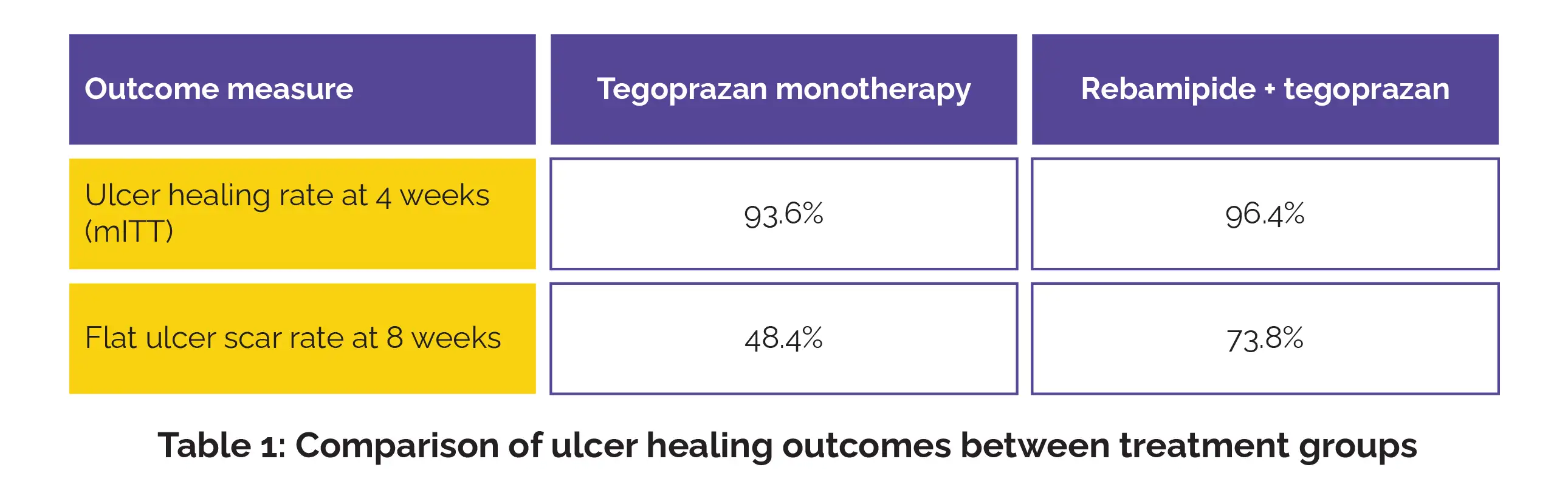
The findings indicate that adding rebamipide, a mucosal protective agent, to tegoprazan, a potassium-competitive acid blocker (P-CAB), enhances both the speed of ulcer healing and the quality of post-ESD scar formation. This dual approach appears to address both acid suppression and mucosal regeneration, which are critical for optimal post-ESD recovery.
Scientific Reports
Comparison of rebamipide and tegoprazan combination therapy and tegoprazan monotherapy for ESD induced gastric ulcers a randomized multicenter study
Young Joo Yang et al.











Comments (1)