

Categories
Change Password!
Reset Password!



Guselkumab maintains clinical remission in up to 74% of patients with ulcerative colitis through 92 weeks, with nearly all patients in remission remaining corticosteroid-free for at least 8 weeks.
Maintaining long-term remission while avoiding corticosteroid exposure is an important goal in ulcerative colitis (UC) management. Offering encouraging long-term evidence, the findings from the QUASAR long-term extension (LTE) study show that guselkumab (interleukin-23 inhibitor) sustains clinical remission through 92 weeks, with nearly all patients remaining corticosteroid-free for at least 8 weeks.
The study, led by Gary R. Lichtenstein et al., explored the long-term potency of guselkumab in patients with UC who responded to intravenous (IV) induction therapy. At maintenance week 0 (M-0), subjects were randomly allocated in a 1:1:1 ratio to get:
Those completing the maintenance week 44 (M-44) visit could enter the LTE and continue their assigned intervention. Following unblinding after the M-44 analyses, placebo recipients discontinued treatment and were excluded from LTE efficacy analyses. Clinical remission at maintenance week 92 (M-92) was the key efficacy endpoint, while safety was assessed between M-44 and M-92.
Of 378 subjects randomly allocated to guselkumab at M-0, 329 (87%) entered the LTE. Among 303 subjects without maintenance dose adjustments (100 mg q8w, n = 155; 200 mg q4w, n = 148), 287 (95%) completed treatment through M-92.
Key results
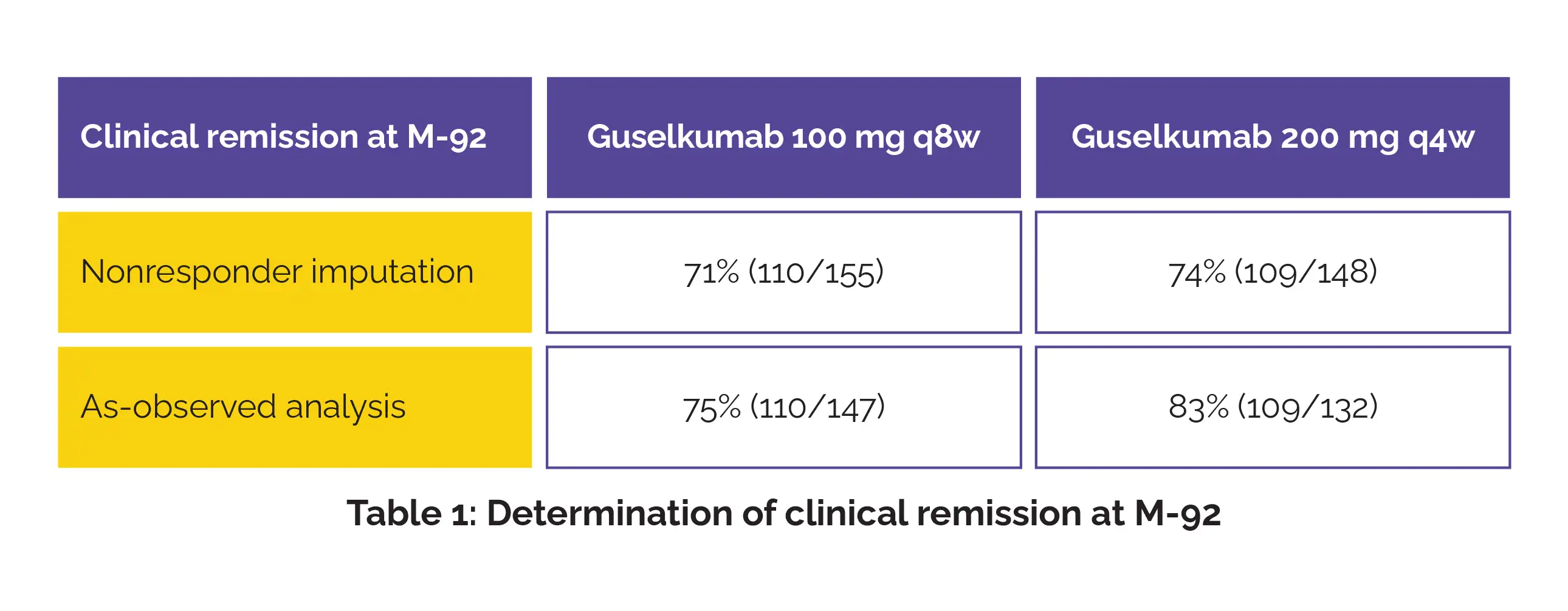
Overall, guselkumab use yielded sustained clinical remission through 92 weeks in UC sufferers who respond to IV induction therapy. Both maintenance regimens exhibited durable efficacy, high treatment completion, and a consistent safety profile, with nearly all patients in remission remaining corticosteroid-free for at least 8 weeks.
American Journal of Gastroenterology
Efficacy and Safety of Guselkumab for Ulcerative Colitis Through Week 92 of the QUASAR Long-Term Extension Study
Gary R. Lichtenstein et al.














Comments (0)