

Categories
Change Password!
Reset Password!



GLP-1 RAs safely reduce body weight and glycated hemoglobin in liver transplant recipients without compromising graft function or immunosuppressive therapy.
Gaining weight after a liver transplant may seem like a sign of recovery, but post-transplant weight gain and metabolic dysfunction can escalate cardiovascular (CV) morbidity, allograft steatosis, and potentially minimize long-term survival. Now, findings from a multicenter international study suggest that GLP-1 RAs may offer a useful approach to tackling these metabolic challenges in liver transplant recipients.
Researchers carried out a multicenter retrospective cohort study across 4 international centers, evaluating adult liver transplant recipients who received GLP-1 RAs between January 1, 2010, and June 30, 2025. Regular GLP-1 RA users were compared with matched non-users based on age, sex, obesity, diabetes status, transplant year, and center.
The key outcome was the alteration in body weight 1 year after GLP-1 RA exposure. Secondary outcomes included glycemic and lipid profiles, kidney and allograft function, immunosuppression effects, major adverse cardiovascular events (MACE), and adverse effects. Longitudinal analyses employed linear mixed models with multiple imputation.
Weight and glycemic measures improved
Among 104 GLP-1 RA users, 68.3% started treatment for diabetes. Subcutaneous semaglutide was the most commonly used agent, at a median dose of 0.82 ± 0.46 mg weekly. After treatment, patients experienced noticeable reductions in body weight, body mass index (BMI), and glycated hemoglobin (HbA1c), as illustrated in Table 1. Lipid parameters also exhibited modest improvement.
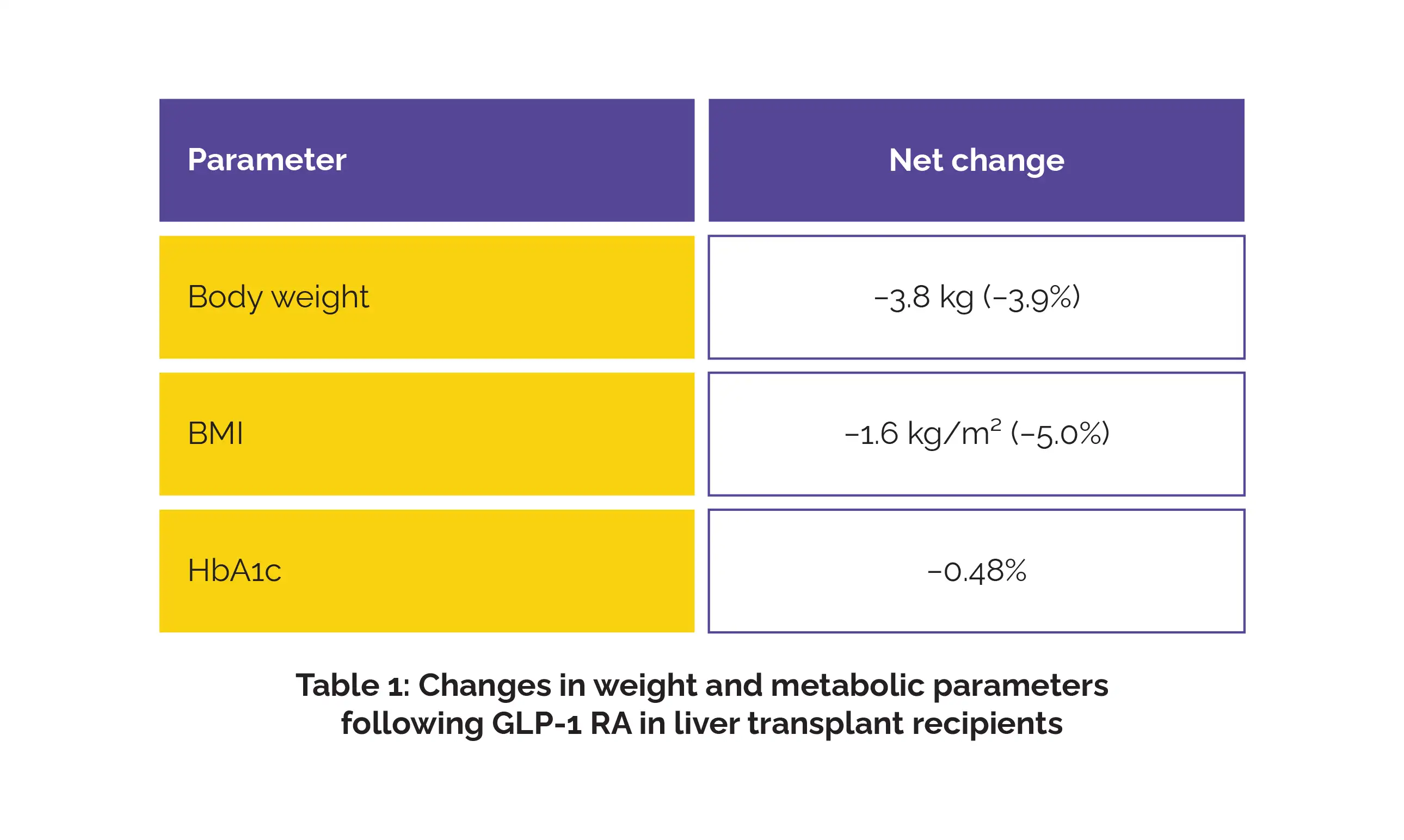
Benefits remained evident against matched non-users
The matched analysis included 80 GLP-1 RA users and 116 non-users. Compared with non-users, GLP-1 RA-treated patients attained:
These metabolic benefits were not accompanied by evidence of increased transplant-related or CV risk.
Allograft function and immunosuppression remained stable
A key finding was the absence of apparent adverse effects on the transplanted liver. Liver function tests and immunosuppression trough levels remained stable. Furthermore, GLP-1 RA use was not linked with an increased risk of allograft dysfunction, T-cell–mediated rejection, or MACE. No treatment-limiting adverse events were reported.
What does this mean for post-transplant weight management?
The results position GLP-1 RAs as a potentially valuable option for addressing the difficult combination of post-transplant weight gain, diabetes, and metabolic dysfunction in liver transplant recipients.
Liver Transplantation
Safety, tolerability, and efficacy of GLP-1 receptor agonists (GLP-1 RA) in the management of post–liver transplant weight gain: A multicenter, observational study
Mohammad Qasim Khan et al.












Comments (0)