

Categories
Change Password!
Reset Password!



Basophil activation testing using aspirin at 1.25 mg/mL exhibits high specificity (91.2%) and moderate sensitivity (55.3%), establishing its viability as a safe, complementary confirmatory tool for diagnosing NSAID cross-intolerance.
Nonsteroidal anti-inflammatory drugs (NSAIDs) depict the second most common trigger of drug-induced hypersensitivity reactions globally, following β-lactam antibiotics. Establishing an accurate diagnosis for cross-intolerance to NSAIDs remains a major hurdle in clinical allergology. Traditional skin testing yields limited diagnostic utility, while the gold-standard drug provocation test is resource-heavy, time-consuming, and carries an inherent risk of provoking severe, life-threatening allergic reactions.
To address these safety concerns and diagnostic gaps, a validation study executed by researchers in Vietnam evaluated the diagnostic utility of the basophil activation test (BAT)—an ex vivo flow cytometric assay—as a safer surrogate diagnostic method. The case-control study enrolled 38 patients previously diagnosed with NSAID cross-intolerance (confirmed via detailed clinical history and drug provocation test when indicated) alongside 34 healthy controls.
Researchers measured basophil activation markers—specifically CD63 and CD203c expression—via flow cytometry after challenging patient blood samples with two distinct NSAIDs at two concentrations:
As summarized below in Table 1, ASA at 1.25 mg/mL yielded the strongest overall performance across the tested conditions.
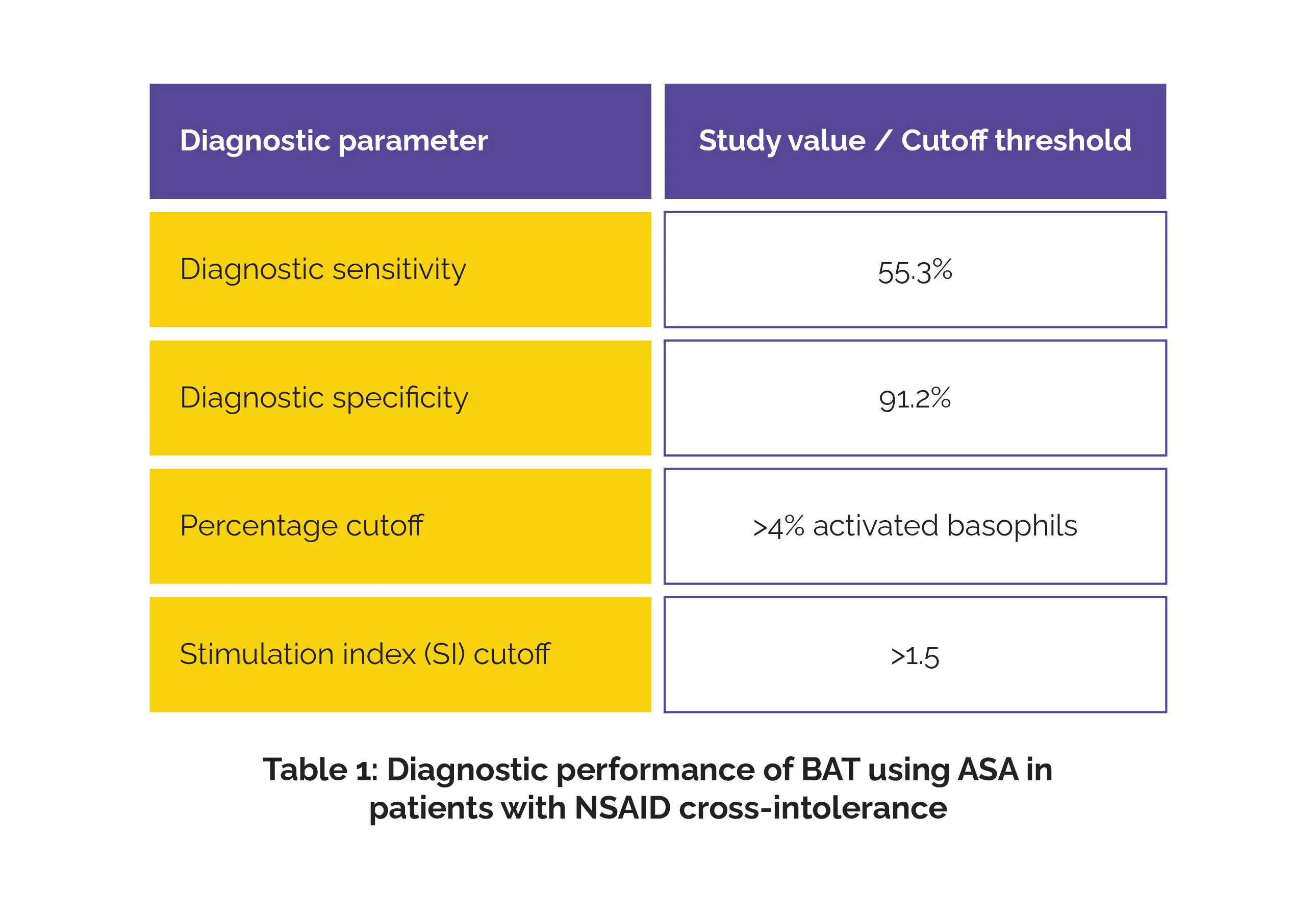
The study confirms that BAT offers high specificity alongside moderate sensitivity, positioning it as a high-yield complementary rule-in diagnostic tool. Because of its high specificity, a positive BAT result can help confirm cross-intolerance in high-risk individuals without subjecting them to physical drug challenges. However, clinical investigators emphasize key limitations:
Anh Quynh Nguyen et al.












Comments (0)