

Categories
Change Password!
Reset Password!



An AI-generated cetirizine-derived ligand demonstrates stronger predicted binding to both histamine H1 and H2 receptors than cetirizine, with favorable pharmacokinetic and toxicity profiles.
What if a familiar antihistamine could be redesigned to act on two histamine receptors instead of one? A new computational drug-design study suggests that artificial intelligence (AI) may help make this possible.
Cetirizine is a widely used second-generation antihistamine that primarily blocks the histamine H1 receptor (HRH1) and is commonly used to tackle allergic conditions such as allergic rhinitis, urticaria, and other allergic manifestations. However, histamine also exerts effects through the histamine H2 receptor (HRH2), creating interest in compounds capable of interacting with both receptor subtypes.
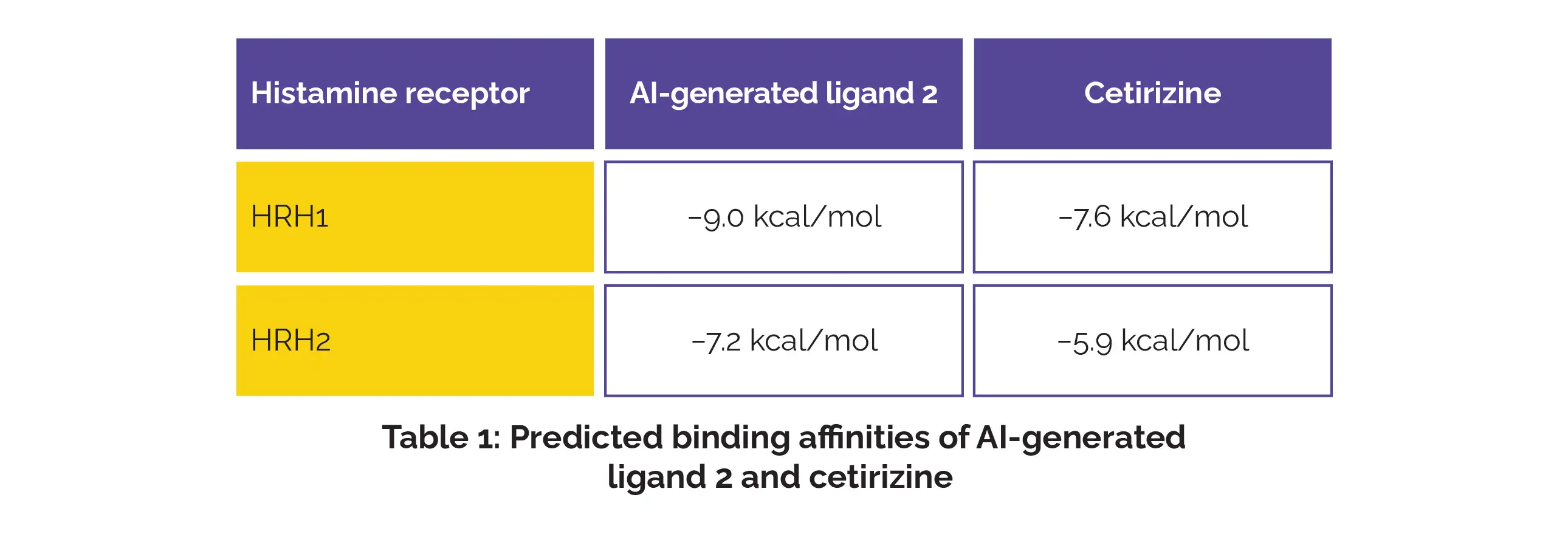
These more negative docking scores indicated stronger predicted receptor-binding affinity for ligand 2 at both targets. The computational assessment also produced encouraging pharmacokinetic signals. The AI-generated ligands portrayed good lipophilicity and gastrointestinal (GI) absorption, while showing no violations of Lipinski’s Rule of Five. Importantly, ADMET predictions indicated lower toxicity than cetirizine, adding another favorable feature to the lead compounds' computational profile.
Molecular dynamics simulations yielded additional support, showing stable binding and favorable interactions between the AI-generated lead and both HRH1 and HRH2 receptors. These results highlight how AI-driven molecular optimization could be utilized to modify established drug scaffolds and identify candidates with broader receptor-targeting profiles. A cetirizine-derived molecule capable of engaging both H1 and H2 histamine receptors could potentially offer a novel strategy for investigating allergic diseases in which signaling through multiple histamine receptors is relevant.
ChemistrySelect
AI-Driven Optimization of Cetirizine-Derived Ligands Targeting Histamine H1 and H2 Receptors: A Computational Drug Design Study
Muhammad Naveed et al.














Comments (0)