

Categories
Change Password!
Reset Password!



Semaglutide offers greater long-term economic value than resmetirom for patients with noncirrhotic MASH, with cardiovascular risk reduction further enhancing its cost-effectiveness.
With more therapies entering the metabolic dysfunction-associated steatohepatitis (MASH) treatment landscape, clinicians are increasingly faced with a different question: not simply which drug improves liver disease, but which delivers the greatest overall value over time. A new economic evaluation tackled this question by comparing the long-term impact of semaglutide and resmetirom alongside standard care in patients with F2–F3 fibrosis.
Rather than relying on short-term treatment costs, investigators projected the clinical and economic consequences of each strategy over 5 and 10 years. The simulation incorporated efficacy data from pivotal phase 3 trials together with healthcare costs, quality-of-life measures, disease progression, and healthcare resource utilization. Additional analyses explored how cardiovascular risk reduction and model uncertainty influenced the overall value of each treatment.
The comparison given in Table 1 revealed that both therapies represented economically reasonable treatment strategies, but they achieved value through different strengths. Resmetirom exhibited slightly greater projected reductions in advanced liver complications and liver-related mortality, whereas semaglutide consistently illustrated the stronger overall economic profile. Its advantage became even more pronounced when cardiovascular benefits were incorporated, highlighting the broader health gains captured by the model.
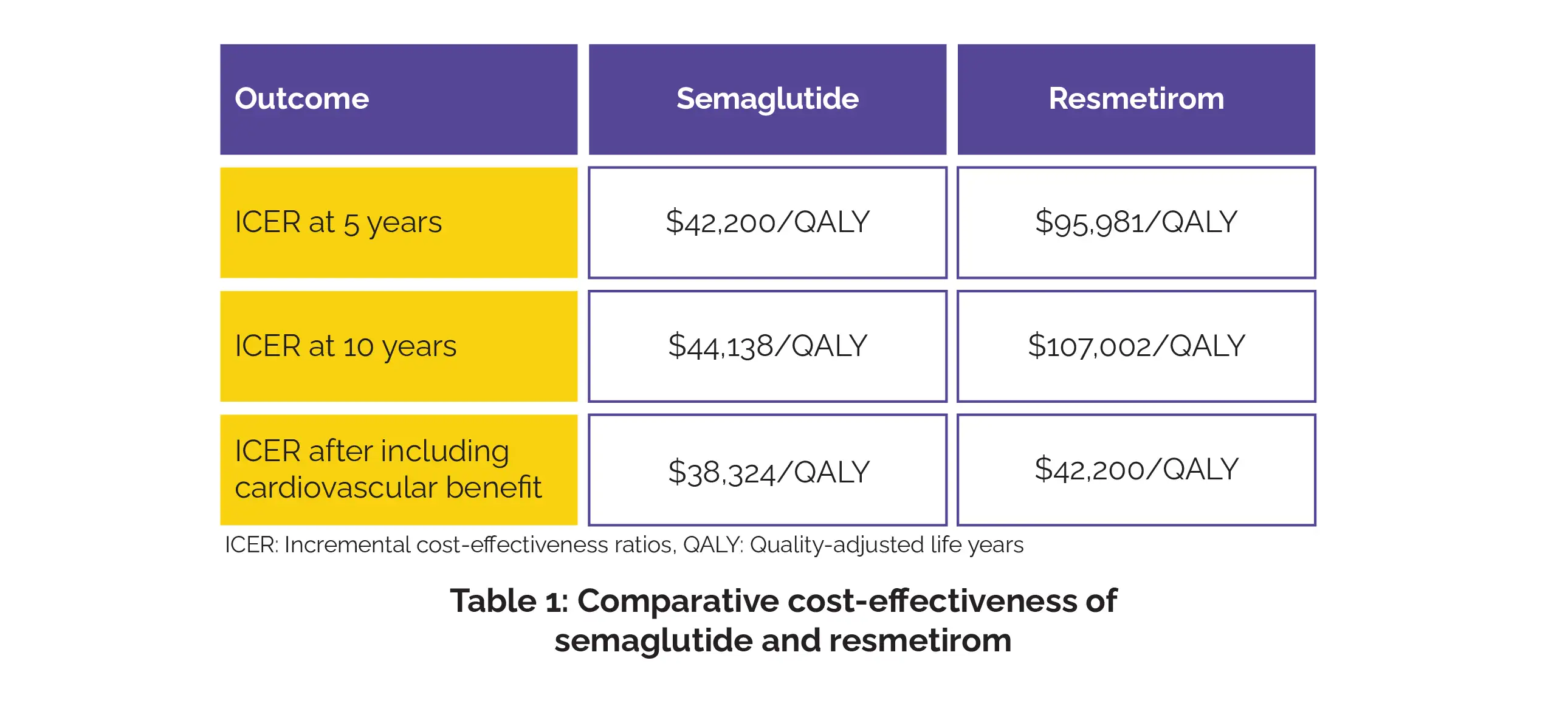
Importantly, semaglutide remained the preferred strategy across multiple sensitivity analyses, indicating that its economic advantage persisted despite changes in willingness-to-pay thresholds and other model assumptions. This consistency strengthens confidence that the findings are unlikely to depend on a single modelling scenario.
For clinicians and healthcare decision-makers, the analysis shifts the conversation beyond efficacy alone. While both approved therapies appear to provide good value for treating noncirrhotic MASH, semaglutide emerged as the option that delivers a more favorable balance between long-term costs and overall health outcomes, particularly when its cardiovascular benefits are considered alongside liver-specific effects.
Cost Effectiveness and Resource Allocation
Semaglutide versus resmetirom for noncirrhotic MASH with moderate to advanced fibrosis: a costeffectiveness analysis
Basile Njei et al.














Comments (0)