

Categories
Change Password!
Reset Password!


Helicobacter pylori (H. pylori) infection is a primary driver of chronic gastritis, peptic ulcers, and gastric cancer, yet the success of standard triple therapy is steadily declining due to rising antibiotic resistance, particularly to clarithromycin.
Fourteen-day tegoprazan-based triple therapy achieves non-inferior Helicobacter pylori eradication with a favorable safety profile compared with lansoprazole-based therapy.
Helicobacter pylori (H. pylori) infection is a primary driver of chronic gastritis, peptic ulcers, and gastric cancer, yet the success of standard triple therapy is steadily declining due to rising antibiotic resistance, particularly to clarithromycin. Tegoprazan, a novel potassium-competitive acid blocker (P-CAB), offers more rapid, potent, and sustained acid suppression compared to proton pump inhibitors (PPIs), which is essential for stabilizing acid-labile antibiotics and enhancing their bactericidal efficacy.
This phase III clinical trial aimed to determine the efficacy and safety of 14-day triple therapy using two different doses of tegoprazan (50 mg and 100 mg) in comparison to a standard lansoprazole-based regimen.
Investigators conducted a randomized controlled trial across 19 referral hospitals. Treatment-naïve adults with confirmed H. pylori infection were randomly segregated to the following groups:
The primary endpoint was the eradication rate within the modified intention-to-treat (mITT) population, determined by a 13C-urea breath test performed four to eight weeks after treatment completion. Additionally, the study performed genotypic analysis for clarithromycin resistance using 23S rRNA point mutation testing to assess outcomes in resistant subgroups.
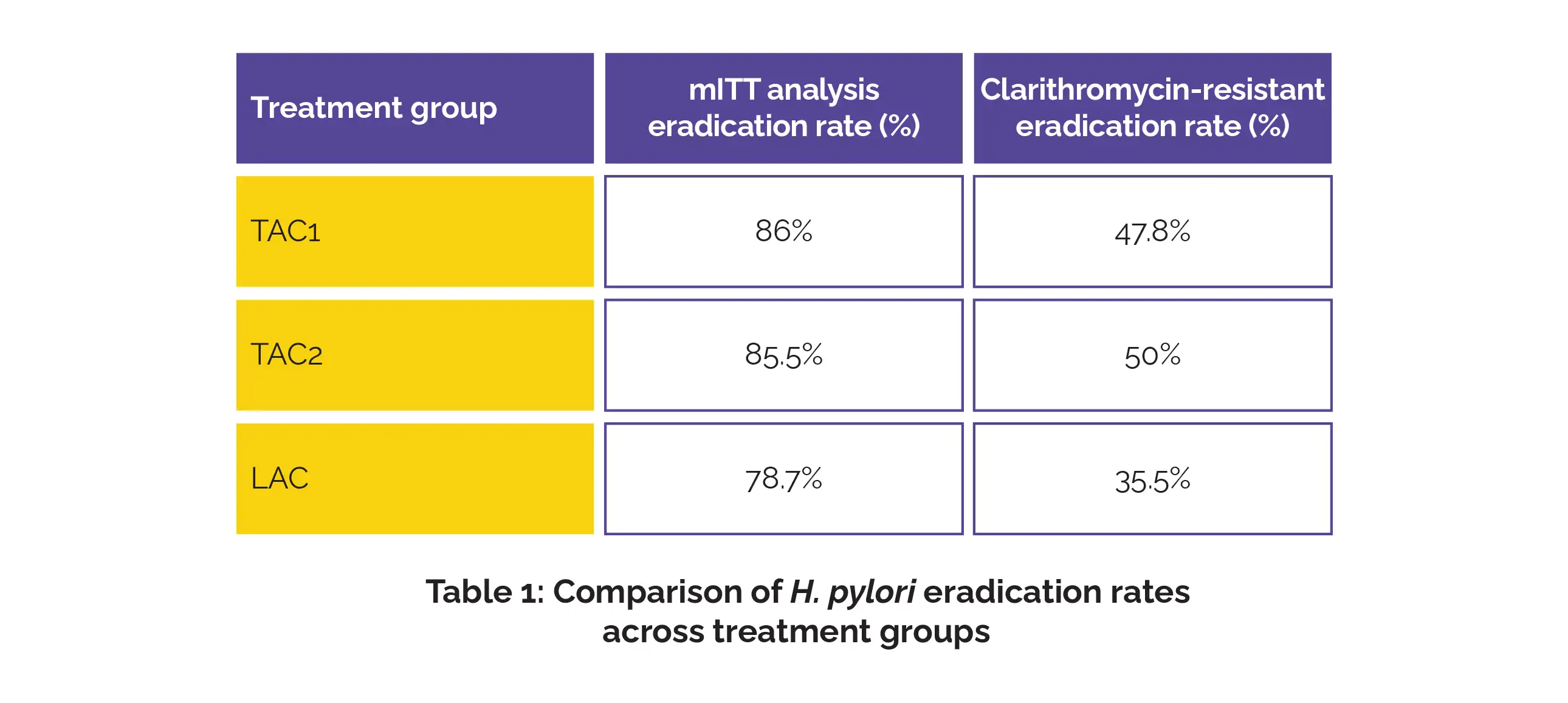
The study randomized 382 patients, with 372 included in the final mITT efficacy. Statistical analysis confirmed that both tegoprazan-based doses were non-inferior to the lansoprazole-based therapy. In patients with clarithromycin-resistant strains, tegoprazan-based therapies showed numerically higher eradication success (Table 1).
The safety profile remained comparable across all treatment arms; diarrhea and taste disorders were the most frequently reported adverse events. Notably, no severe drug-linked adverse events occurred, and the therapies were generally well-tolerated by participants.
The 14-day tegoprazan-based triple therapy established itself as a viable and effective first-line option for H. pylori eradication, consistently exceeding the 80% clinical efficacy threshold. This P-CAB-based approach offered superior acid inhibition that supported antibiotic performance even in a landscape of increasing resistance. While both doses demonstrated similar efficacy in a 14-day schedule, the study solidified the role of tegoprazan as a safe, potent alternative to traditional PPIs for improving patient outcomes in gastric health.
Helicobacter
Tegoprazan‐Based Triple Therapy for Helicobacter pylori Eradication: A Phase III Multicenter Randomized Clinical Trial
Jae Yong Park et al.














Comments (0)