

Categories
Change Password!
Reset Password!


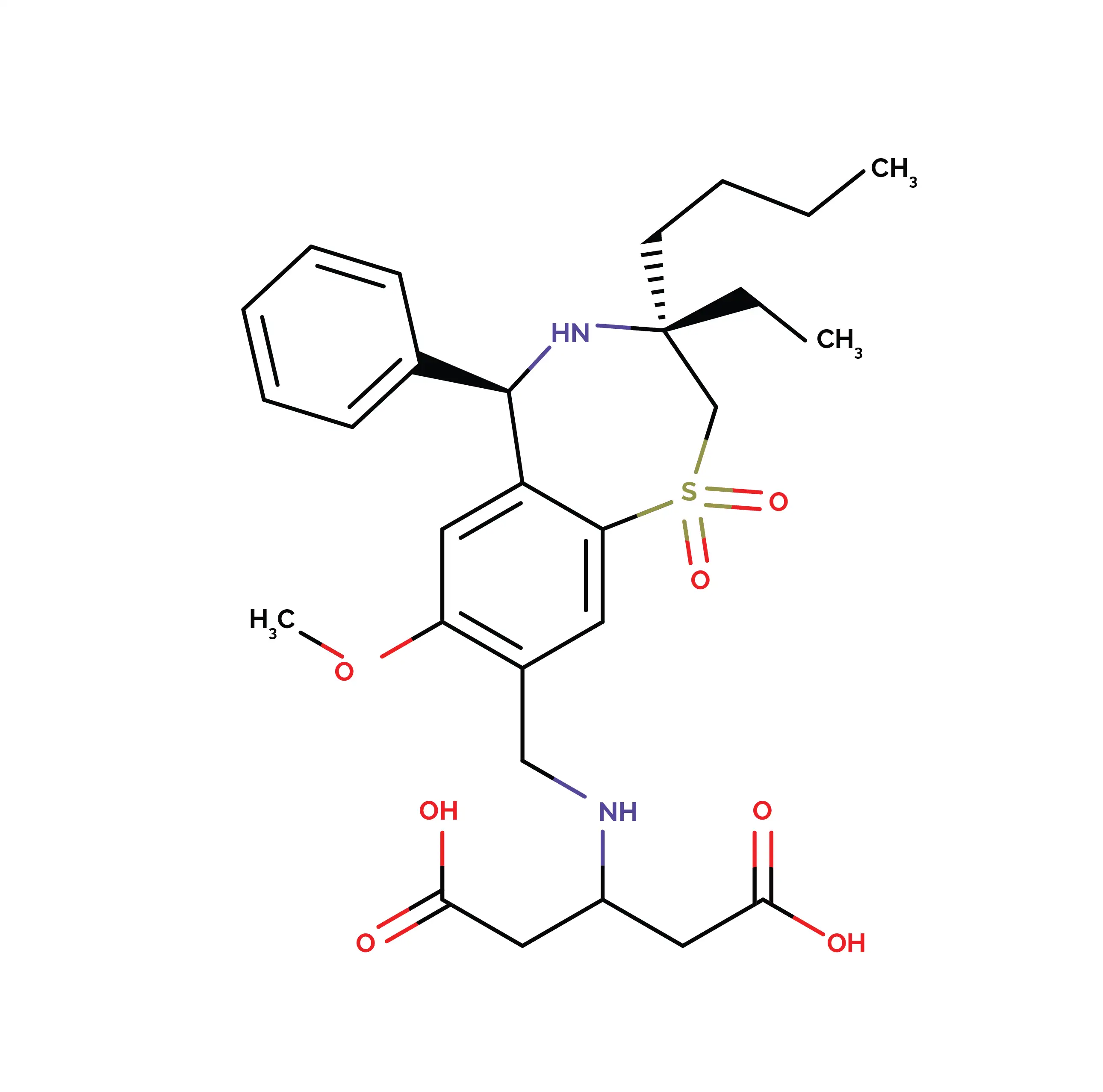
Linerixibat, an ileal bile acid transporter (IBAT) inhibitor, is approved by the Food and Drug Administration (FDA) in 2026 for cholestatic pruritus linked with primary biliary cholangitis (PBC).
Linerixibat, an ileal bile acid transporter (IBAT) inhibitor, is approved by the Food and Drug Administration (FDA) in 2026 for cholestatic pruritus linked with primary biliary cholangitis (PBC).[1,2]
Its primary mechanism involves potent and selective suppression of the apical sodium-dependent bile acid transporter (ASBT/IBAT), thereby preventing the reabsorption of approximately 95% of bile acids that would normally return to the liver.[3]
Pharmacological Class: IBAT inhibitors
It is indicated for the management of PBC-related cholestatic pruritus in adult patients.[1]
Bile acids are important mediators of cholestatic itching (pruritus). They are synthesized from cholesterol into primary bile acids, mainly cholic acid and chenodeoxycholic acid, which undergo bacterial conversion in the intestine and are subsequently reabsorbed and transported back to the liver. In cholestasis, disrupted bile flow can lead to bile acid accumulation, potentially contributing to persistent itching.[4]
Linerixibat selectively inhibits the ASBT on the luminal membrane of ileal enterocytes, preventing the reabsorption of conjugated and unconjugated bile acids into the portal circulation. This increases fecal bile acid excretion, depletes the bile acid pool, and reduces systemic bile acids and other potential pruritogens that accumulate in cholestatic diseases such as PBC. The resulting reduction in systemic bile acids is thought to decrease activation of TGR5 receptors and other sensory neurons involved in itch transmission.
Reduced bile acid return to the liver also relieves feedback inhibition of cholesterol 7 alpha-hydroxylase (encoded by cytochrome P450 Family 7 Subfamily A Member 1 [CYP7A1]), increasing the conversion of hepatic cholesterol into new bile acids and further reducing systemic lipid levels.[3]
Adults: 40 mg twice daily
Note: Take at least 30 minutes before food or beverages (except water). Not established for use in children.[1]
None[1]
Bile Acid Binding Resin Interaction
To minimize potential drug interaction, linerixibat should be given at least 4 hours before or after bile acid binding resins. In vitro evidence indicates that these resins may bind linerixibat within the intestine, potentially diminishing IBAT inhibition.[1]
The most common adverse reactions are:
(a) Liver Test Elevations
(b) Diarrhea
(c) Fat-Soluble Vitamin (FSV) Deficiency
Bleeding: Bleeding may occur more commonly with linerixibat. If bleeding develops, temporarily stop treatment and assess for FSV deficiency. Treatment can be restarted after the deficiency has been corrected, vitamin levels have stabilized, and bleeding has stopped.
Bone health: Given the potential association between IBAT inhibitors and bone fractures, regular assessment of bone health and maintenance of adequate FSV levels are recommended.[1]
1. In a study led by Hirshfield G et al., linerixibat provided rapid and sustained relief of cholestatic pruritus in patients with PBC and moderate-to-severe pruritus. At week 24, the Worst Itch Numerical Rating Scale (WI-NRS) improved significantly vs. placebo (least-squares mean change: −2.86 vs −2.15; adjusted mean difference: −0.72), with benefits evident as early as week 2 (−1.78 vs −1.07; adjusted mean difference: −0.71). Linerixibat also reduced pruritus-related sleep interference (−2.77 vs. −2.24; adjusted mean difference: −0.53).
By week 24, treatment was associated with higher rates of pruritus improvement across all thresholds: ≥2-point (68% vs. 64%), ≥3-point (56% vs. 43%), and ≥4-point reductions (41% vs. 29%). The proportion reporting very much improved pruritus was also higher (55% vs. 37%), as was the complete absence of pruritus (21% vs. 9%). Diarrhea was the main expected treatment-related adverse effect.[5]
2. According to the findings of the phase 3 GLISTEN trial, linerixibat provides a statistically significant and clinically meaningful reduction in pruritus, with benefits appearing early and accompanied by favorable changes in several bile-acid and pruritus-related biomarkers.
Overall, 238 patients with PBC and moderate-to-severe pruritus were recruited. After 24 weeks, linerixibat markedly reduced itch severity compared with placebo, with a mean WI-NRS improvement of −2.86 versus −2.15, respectively, representing a treatment difference of 0.72 points.
Treatment also produced remarkable changes in several biomarkers associated with bile acid metabolism and itch, including7-alpha-hydroxy-4-cholesten-3-one (C4), fibroblast growth factor-19 (FGF-19), total serum bile acids, autotaxin, and interleukin-31 (IL-31). These effects appeared as early as week 4 and generally persisted during treatment. Reductions in total serum bile acids and IL-31 were associated with improvements in itching, although the individual correlations were relatively weak.[4]
1. Linerixibat. FDA Label. Available from:
https://www.accessdata.fda.gov/drugsatfda_docs/label/2026/220295Orig1s000lbl.pdf
2. Hoofnagle JH. Linerixibat. [Updated 2026 May 1]. In: LiverTox: Clinical and Research Information on Drug-Induced Liver Injury [Internet]. Bethesda (MD): National Institute of Diabetes and Digestive and Kidney Diseases; 2012. Available from: https://www.ncbi.nlm.nih.gov/books/NBK622606/
3. Linerixibat. DrugBank [DB11729]. Available from:
https://go.drugbank.com/drugs/DB11729
4. Impact of Linerixibat on Pharmacodynamic Biomarkers and Mediators of Cholestatic Pruritus in PBC in the Phase 3 GLISTEN Study. Gastroenterol Hepatol (N Y). 2025 Dec;21(12 Suppl 10):6-7.
5. Hirschfield GM, Bowlus CL, Jones DJ, Kremer AE, Mayo MJ, Tanaka A, et al. Linerixibat significantly improves cholestatic pruritus in primary biliary cholangitis: Results of the pivotal phase 3 GLISTEN trial. Zeitschrift für Gastroenterologie. 2025 Sep;63(08):KV-106.











Comments (0)