

Categories
Change Password!
Reset Password!



Psoriasis, a chronic inflammatory disease, has been related to heightened risk of osteoporosis.
A validated nomogram uses six clinical factors to identify patients with psoriasis at higher risk of osteoporosis and may support targeted bone-density screening.
Psoriasis, a chronic inflammatory disease, has been related to heightened risk of osteoporosis. However, clinicians have limited practical tools for identifying patients with psoriasis who are most likely to have reduced bone mineral density. This study therefore sought to develop and validate a predictive nomogram for estimating osteoporosis risk in psoriasis.
This retrospective cohort study included 639 patients with psoriasis. Osteoporosis was identified based on dual-energy X-ray absorptiometry (DXA) T-score of ≤−2.5. Volunteers were randomly assigned in a 7:3 ratio to a training cohort (n=447) and a validation cohort (n=192). Potential predictors of osteoporosis were initially assessed using univariate analysis and subsequently evaluated using multivariable logistic regression. These variables were incorporated into a nomogram, which was assessed via the concordance index (C-index), decision curve analysis, and calibration curves.
Osteoporosis was identified in 75 of 639 patients (11.7%). Multivariate logistic regression analysis identified six independent factors linked with osteoporosis in patients with psoriasis. Advanced age, longer disease duration, psoriatic arthritis, vitamin D deficiency, and systemic corticosteroid use were connected with higher osteoporosis risk, whereas male sex was connected with lower odds of osteoporosis. Among the evaluated factors, vitamin D deficiency illustrated the strongest association with osteoporosis (Table 1).
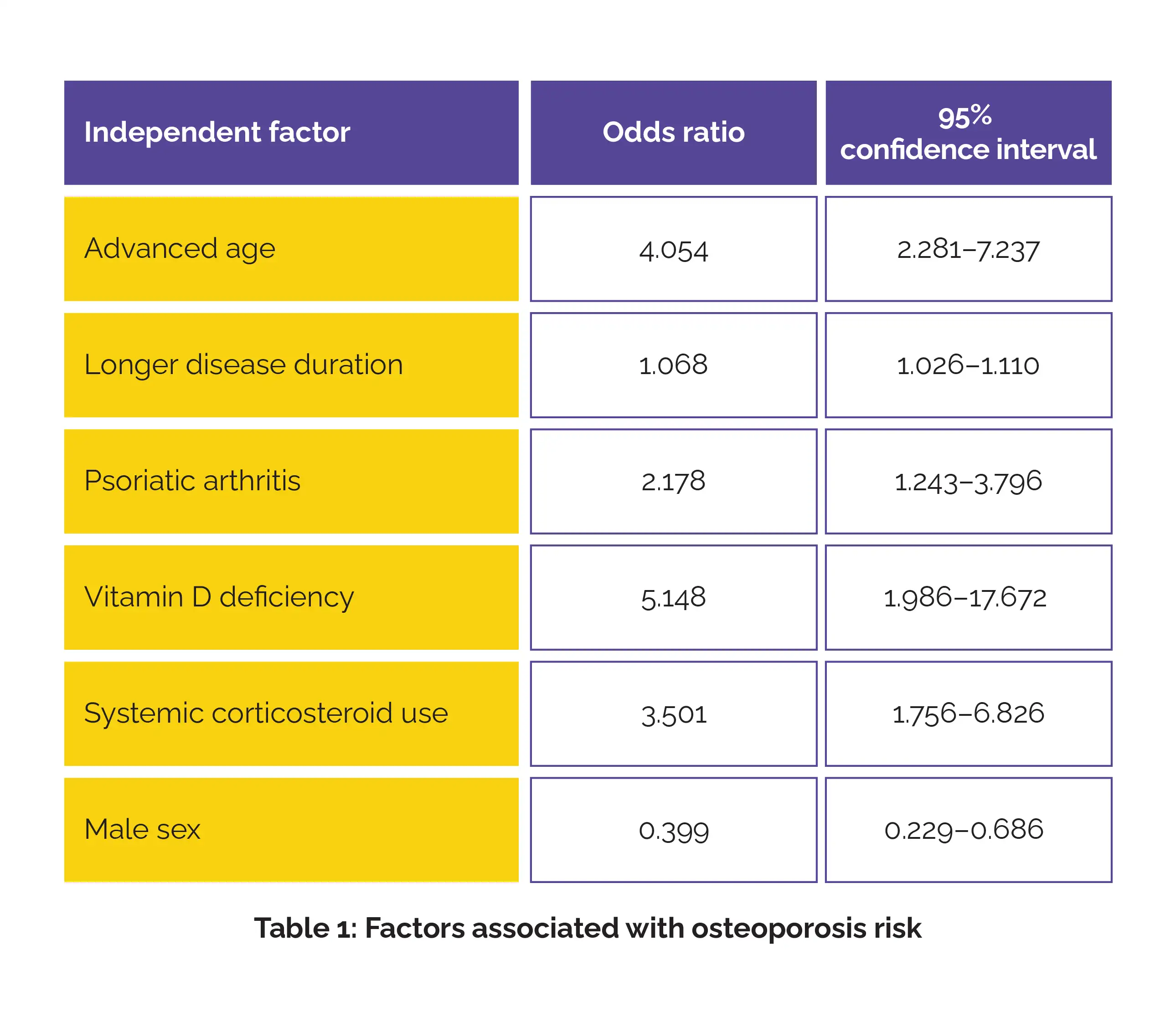
The resulting nomogram illustrated good discriminatory performance, with an area under the curve of 0.824 in the training cohort and 0.771 in the validation cohort. Calibration curves illu good agreement between the predicted and observed probabilities of osteoporosis. Decision curve analysis further illustrated the potential clinical utility of the nomogram, supporting its use for identifying those who may benefit from DXA screening and preventive interventions.
A predictive nomogram incorporating age, sex, psoriasis duration, psoriatic arthritis, vitamin D deficiency, and systemic corticosteroid usage demonstrated good performance for estimating osteoporosis risk in psoriasis sufferers. The model may help clinicians recognize patients who warrant closer bone health assessment and facilitate more targeted DXA screening and preventive interventions.
Frontiers in Medicine
Development and validation of a predictive nomogram for osteoporosis in patients with psoriasis
Zhilong Wang et al.















Comments (0)