

Categories
Change Password!
Reset Password!



Curcumin delivers greater symptom relief and stronger cytokine modulation than triamcinolone in patients with oral submucous fibrosis.
Could curcumin offer a better way to tackle oral submucous fibrosis (OSF)? New clinical findings suggest it may. In a retrospective study, curcumin not only improved key clinical symptoms but also favorably shifted inflammatory and fibrotic cytokine levels compared with triamcinolone.
Researchers evaluated 110 patients with OSF. Patients received either curcumin (n=54) or triamcinolone (n=56) for 4 weeks. The investigators assessed overall clinical response, pain, mouth opening, mucosal lesion size, and serum levels of interferon-gamma (IFN-γ), tumor necrosis factor-alpha (TNF-α), and transforming growth factor-beta 1 (TGF-β1).
At 4 weeks, curcumin demonstrated a superior overall response compared with triamcinolone. The lower visual analog scale (VAS) score indicated greater pain relief, while the larger mouth opening and smaller lesion area pointed towards broader clinical improvement. Curcumin markedly increased IFN-γ and reduced the levels of the profibrotic cytokine TGF-β1 and the proinflammatory cytokine TNF-α when compared with triamcinolone (Table 1).
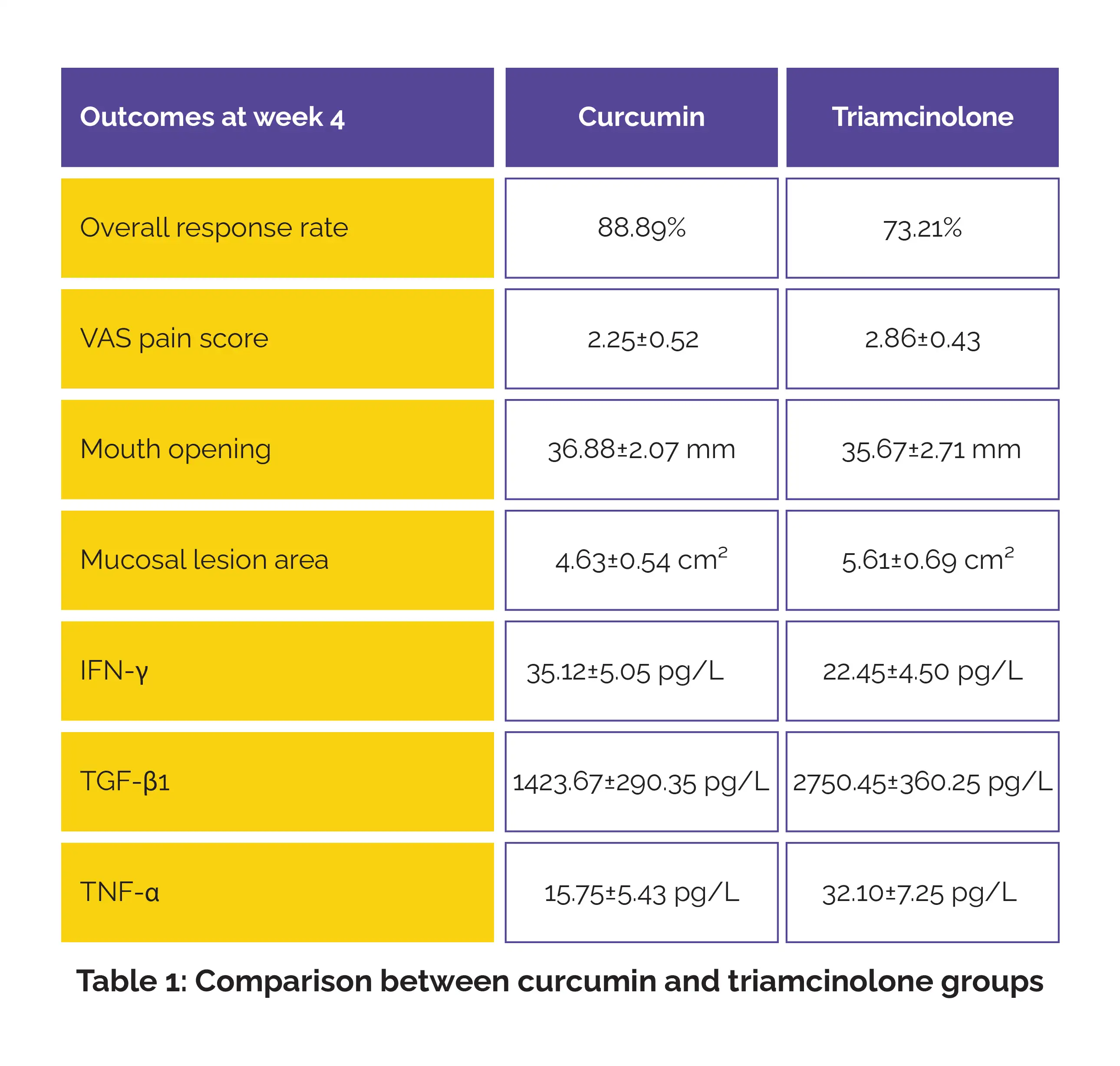
Overall, curcumin may exert therapeutic effects in OSF through coordinated upregulation of IFN-γ and suppression of TGF-β1 and TNF-α, potentially addressing both inflammatory and fibrotic pathways. The authors therefore identified curcumin as a promising alternative therapeutic approach to corticosteroid treatment for OSF.
Medicine (Baltimore)
Clinical efficacy of curcumin in treating oral submucous fibrosis and dynamic analysis of associated cytokines
Juanhua Chai et al.










Comments (0)