

Categories
Change Password!
Reset Password!



Vasomotor symptoms (VMS), including night sweats and hot flashes, are among the most common and distressing symptoms experienced during menopause.
GS1-144 (a new neurokinin 3 receptor antagonist) remarkably reduces the burden of moderate-to-severe vasomotor symptoms in postmenopausal women while maintaining a reassuring safety profile.
Vasomotor symptoms (VMS), including night sweats and hot flashes, are among the most common and distressing symptoms experienced during menopause. Neurokinin 3 receptor (NK3R) antagonists have emerged as a promising non-hormonal approach by targeting the hypothalamic pathways implicated in thermoregulation. This study determined the efficacy and safety of the novel selective NK3R antagonist GS1-144 in postmenopausal Chinese women suffering from moderate-to-severe VMS.
In this randomized phase 2 trial, women aged 40–64 years with moderate-to-severe VMS were enrolled. Volunteers were randomly assigned (1:1:1:1) to receive:
Treatment continued for 12 weeks. The mean change from baseline in the frequency and intensity of VMS at weeks 4 and 12 were the co-primary outcomes ascertained. Safety was checked via treatment-emergent adverse events (TEAEs) and liver safety monitoring.
Among 276 randomized participants, 271 (98.2%) completed 4 weeks and 258 (93.5%) completed 12 weeks of treatment. GS1-144 significantly reduced the frequency and severity of VMS compared with placebo, with the 30 mg twice-daily regimen showing consistent benefits at both time points and the 60 mg once-daily regimen showing remarkable improvements by week 12 (Table 1).
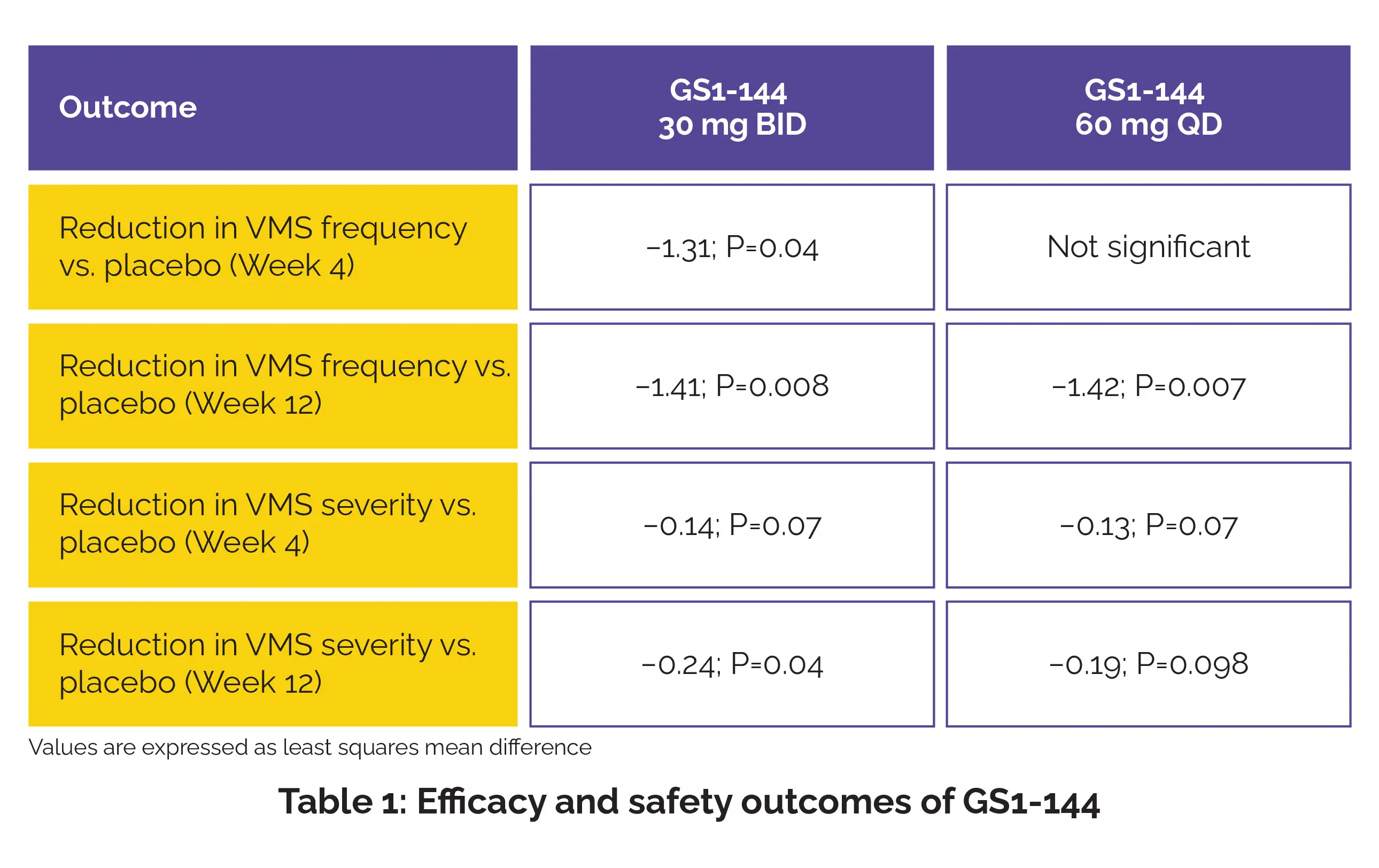
Overall, TEAEs occurred in 67.6% (140/207) of women receiving GS1-144 compared with 62.3% (43/69) in the placebo group. Importantly, no liver safety risks were observed in women treated with GS1-144.
GS1-144 successfully reduced both the frequency and severity of menopausal VMS and demonstrated good overall tolerability throughout the study. The absence of liver safety signals further strengthened its potential as a safe and effective non-hormonal intervention for postmenopausal women experiencing bothersome VMS.
Menopause
Efficacy and safety of GS1-144, a novel neurokinin 3 receptor antagonist, for moderate-to-severe vasomotor symptoms associated with menopause in Chinese women: a randomized, double-blind, placebo-controlled phase 2 trial
Yaping Wang et al.















Comments (0)