

Categories
Change Password!
Reset Password!


High-dose omeprazole enhances post-endoscopic outcomes by reducing recurrent bleeding without compromising safety.
Bleeding peptic ulcers remain one of the leading causes of non-variceal upper gastrointestinal hemorrhage and continue to impose a substantial burden on emergency care. Although endoscopic hemostasis sucessfully controls active bleeding, recurrent hemorrhage remains a major concern, making optimal acid-suppressive therapy essential for maintaining clot stability and improving patient outcomes.
The investigators compared the clinical potency of high-dose and low-dose intravenous omeprazole administered after successful endoscopic hemostasis to determine their impact on rebleeding, recovery, and treatment safety. Patients with endoscopically treated bleeding peptic ulcers were retrospectively assigned according to the intravenous omeprazole regimen received after hemostasis.
Outcomes during 30-day follow-up included recurrent bleeding, changes in hemoglobin and hematocrit, transfusion requirements, recovery time, length of hospitalization, and treatment safety. Patients receiving high-dose intravenous omeprazole demonstrated superior bleeding control and clinical recovery following endoscopic hemostasis. The primary efficacy outcomes are summarized below in Table 1.
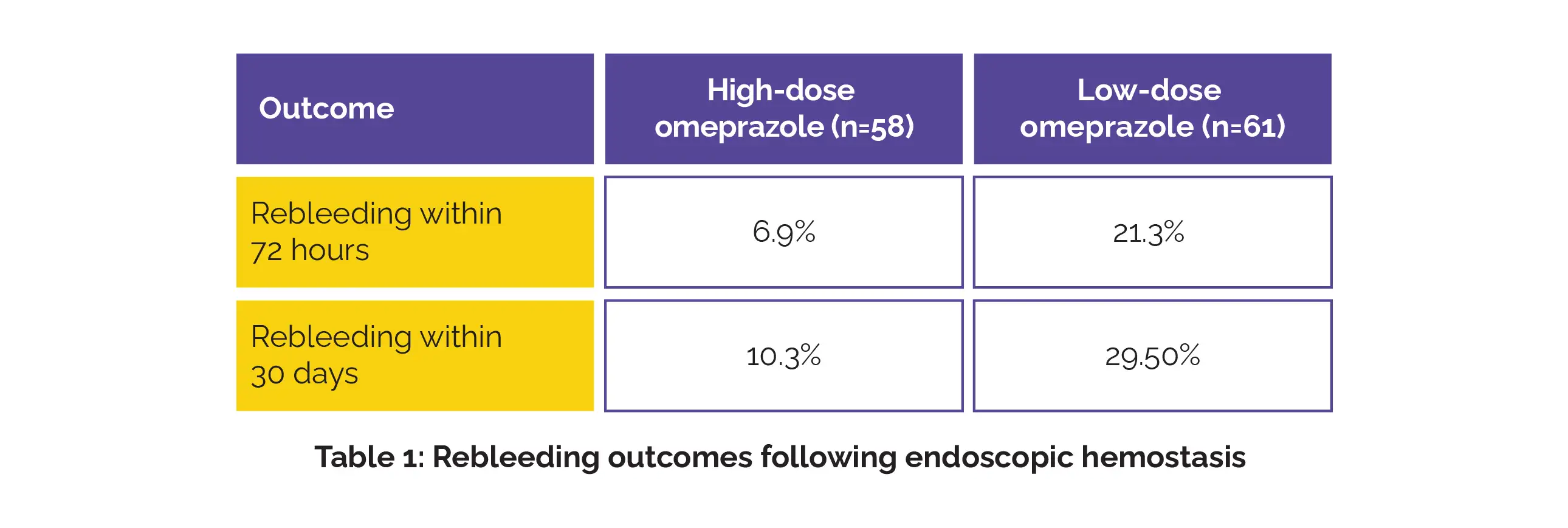
Beyond reducing recurrent bleeding, the high-dose regimen produced greater improvements in hemoglobin and hematocrit levels, lowered blood transfusion requirements, achieved earlier bleeding control and hemodynamic stabilization, and shortened hospital stay when compared with the low-dose regimen. Importantly, treatment-related adverse events occurred at similar rates in both the groups.
Thus, high-dose omeprazole combined with endoscopic hemostasis provides superior hemostatic stability, accelerates clinical recovery, and substantially minimizes short-term rebleeding in patients with bleeding peptic ulcers without compromising safety.
Medicine (Baltimore)
Efficacy of omeprazole combined with endoscopic hemostasis in the treatment of patients with bleeding peptic ulcers
Xiaozhu Fan et al.















Comments (0)