

Categories
Change Password!
Reset Password!



For both mother and fetus, gestational diabetes mellitus (GDM) is a major pregnancy-related complication that poses significant health risks.
The nimesulide–paracetamol combination provides superior pain relief to ketorolac and remains non-inferior to diclofenac–paracetamol and aceclofenac–paracetamol in acute pain management.
For both mother and fetus, gestational diabetes mellitus (GDM) is a major pregnancy-related complication that poses significant health risks. This study compared the efficacy and safety of 4 analgesic regimens in adults with acute painful conditions.
In this randomized, prospective, open-label clinical trial, patients aged ≥18 years with acute pain—including low back pain, musculoskeletal injuries, tendinitis, tenosynovitis, bursitis, sprains, strains, migraine, dental pain, dental procedures, and post-operative pain—were enrolled. A total of 600 participants were randomized to get a fixed-dose combination (FDC) of :
NP, DP, and AP were given twice daily, while Kt was given three times daily. Pain reduction and safety outcomes (cardiovascular, gastrointestinal, hepatic, and renal parameters) were assessed on days 7 and 14.
At day 7, the mean reduction in numerical rating scale (NRS) pain scores is depicted in Table 1:
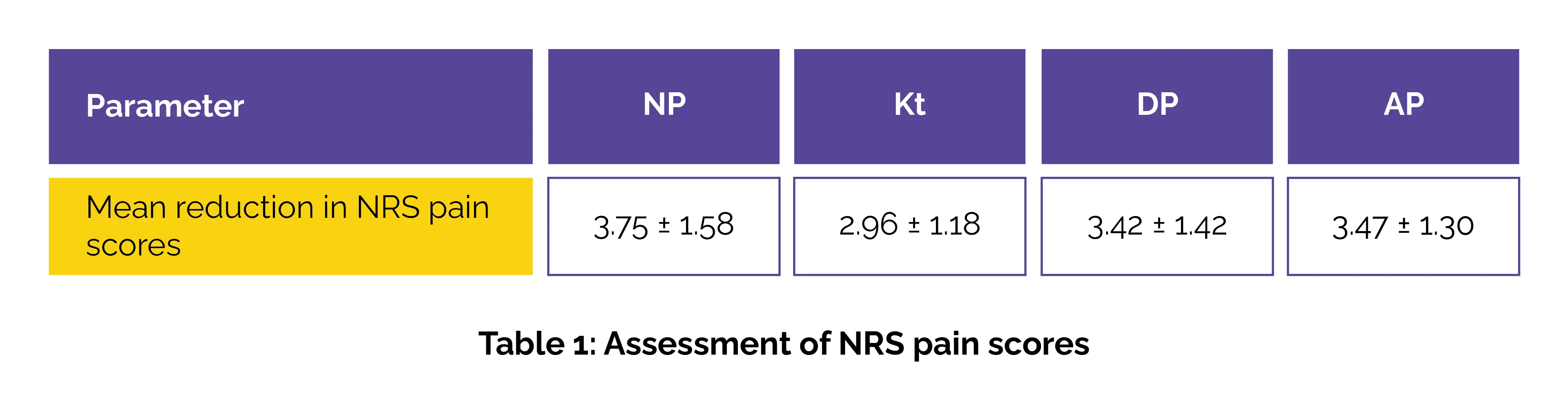
NP illustrated substantially greater pain relief when compared with Kt (p < 0.001) and depicted non-inferiority to both DP and AP on days 7 and 14. Non-inferiority was confirmed as the lower bound of the 95% confidence interval for pain-score changes exceeded the predefined margin of −1.0. All treatments were generally well-tolerated; however, the DP group reported a considerably higher number of adverse events than the NP group (32 vs. 14). Common adverse effects included nausea, gastritis, and abdominal pain across all groups. Liver and renal function remained largely unchanged, except for elevated serum creatinine noted in the DP cohort.
The FDC of nimesulide and paracetamol offered superior pain relief when compared with ketorolac and was non-inferior to diclofenac–paracetamol and aceclofenac–paracetamol combinations in mitigating acute pain. Its tolerability profile was comparable to ketorolac and more favorable than that of the diclofenac–paracetamol and aceclofenac–paracetamol regimens.
Cureus
A Comparative Analysis of the Efficacy and Safety of Nimesulide/Paracetamol Fixed-Dose Combination With Other NSAIDs in Acute Pain Management: A Randomized, Prospective, Multicenter, Active-Controlled Study (the SAFE-2 Study)
Sandip Patil et al.















Comments (0)