

Categories
Change Password!
Reset Password!



School health staff are familiar with SMART therapy and support its use in children with asthma, but emphasize the need for clear communication from prescribing providers.
Pediatric asthma management increasingly relies on streamlined pharmacologic strategies that improve adherence and reduce exacerbations. Single Maintenance and Reliever Therapy (SMART) integrates controller and reliever functions into a single inhaler regimen and has shown superior clinical outcomes compared with traditional dual-inhaler approaches. Despite its evidence base, real-world implementation is inconsistent, particularly in school environments where medication administration and day-to-day symptom management depend heavily on school health staff as frontline caregivers.
Reseachers aimed to critically assess school health staff perceptions, preparedness, and operational challenges in implementing SMART therapy for children with asthma within school-based healthcare systems. A descriptive convergent mixed-methods design was employed, on the basis of Consolidated Framework for Implementation Research. Data collection was done from school health staff via structured surveys and semi-structured interviews.
Quantitative data were checked via descriptive statistical methods to determine familiarity, experience, and perceived feasibility of SMART therapy. Qualitative interview data were processed using rapid thematic analysis to extract implementation barriers, facilitators, and system-level requirements influencing adoption in school settings. School health staff showed strong acceptance of SMART therapy and consistently emphasized structured communication and standardized clinical guidance as essential for safe school-based implementation (Table 1).
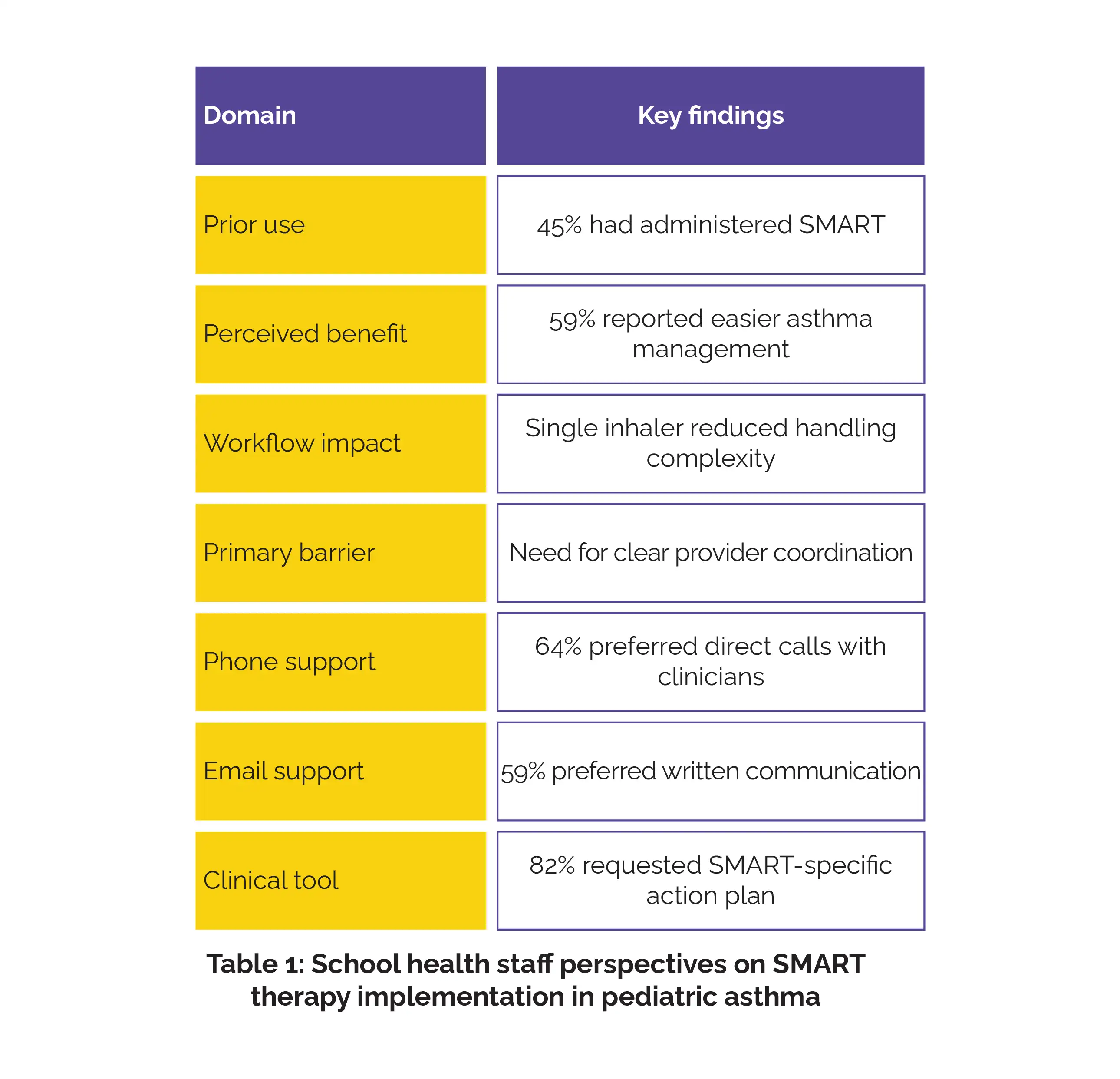
The study concluded that school health staff were generally knowledgeable, receptive, and operationally prepared to support SMART therapy in pediatric asthma care. However, successful implementation was hindered by systemic communication gaps between healthcare providers and school systems.
Pediatric Pulmonology
School Health Staff Perspectives on the Implementation of Single Maintenance and Reliever Therapy (SMART) for Children with Asthma
Melissa Goulding et al.















Comments (0)