

Categories
Change Password!
Reset Password!



Non-traumatic knee osteoarthritis is associated with lower physical activity, higher pain scores, and worse functional performance compared with post-traumatic osteoarthritis.
A new analysis from the Technology, Exercise Programming, and Activity Prescription for Enhanced Mobility (TEAM) Study highlights crucial differences between patients with knee osteoarthritis (OA) based on injury history.
Researchers conducted this cross-sectional study to compare clinical characteristics, physical activity levels, and functional performance between individuals with mild-to-moderate knee OA with and without a history of previous knee injury. The analysis included 262 adults divided into two groups:
Demographic variables, radiographic OA features, medical history, and prior sport participation were recorded. Clinical outcomes were examined via the knee injury and osteoarthritis outcome score (KOOS), the arthritis self-efficacy questionnaire, and the intermittent and constant osteoarthritis pain (ICOAP) questionnaire. Physical activity was objectively measured using a smartphone application that tracked daily step counts, while self-reported activity was assessed with the global physical activity questionnaire.
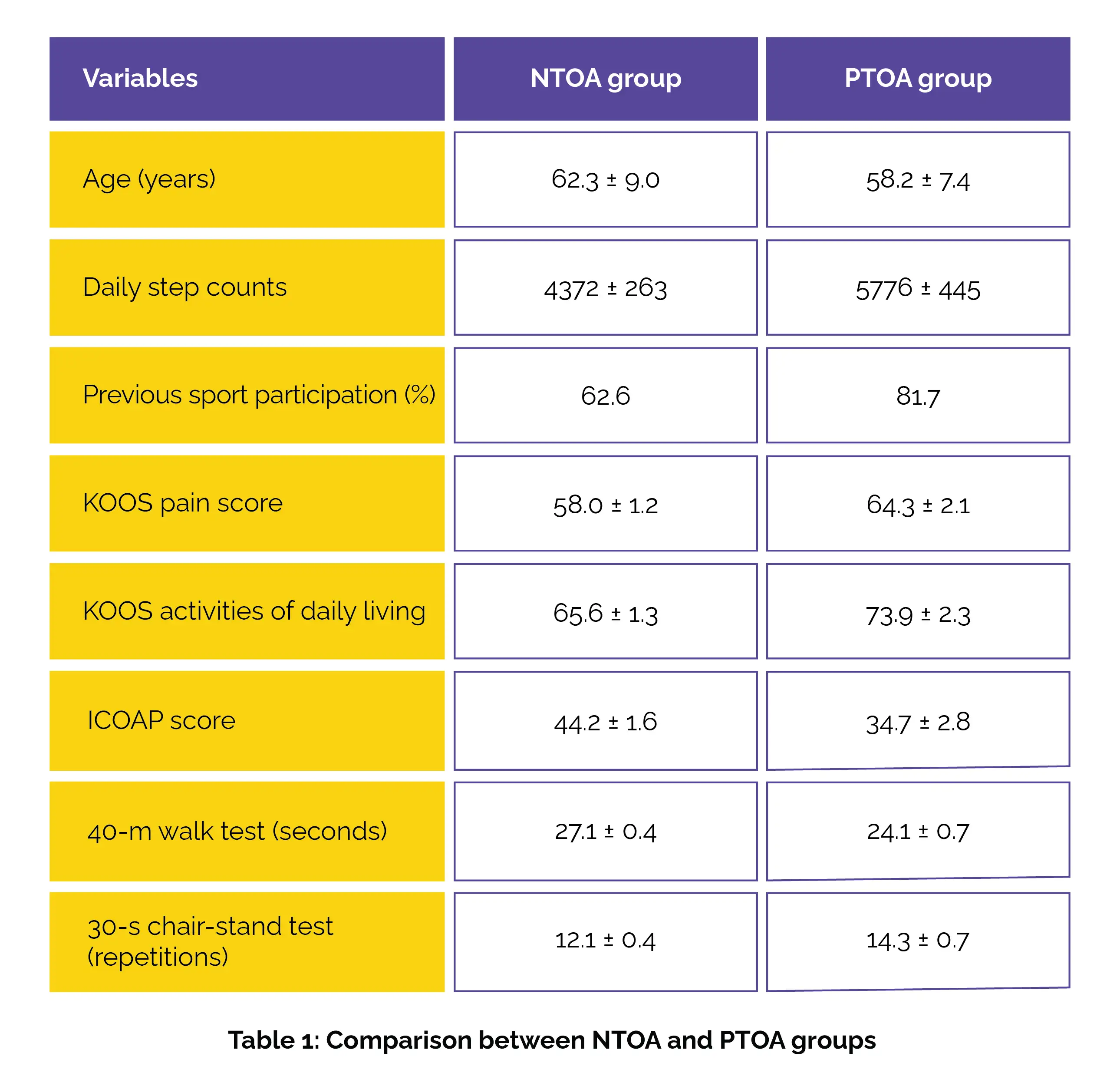
Functional performance was checked via the 30-second chair-stand test and the 40-meter walk test. Importantly, there were no significant differences between groups in anthropometric measurements, sex distribution, radiographic OA severity scores, comorbid conditions, smoking status, or alcohol consumption. Patients in the NTOA arm were older than those in the PTOA arm. They demonstrated lower average daily step counts and had lower rates of previous sports participation.
Symptom burden and functional outcomes differed markedly. The NTOA group reported lower KOOS pain scores and lower KOOS activities of daily living scores. They also had higher ICOAP pain scores, indicating greater OA-related pain. On performance testing, NTOA participants required more time to complete the 40-meter walk and completed fewer repetitions during the 30-second chair-stand test (Table 1).
Overall, despite comparable structural disease severity and similar health and lifestyle profiles, patients with non-traumatic knee OA exhibited lower physical activity levels, greater pain, and poorer functional performance than those with post-traumatic OA. These findings suggest that targeted physical activity and rehabilitation interventions may be particularly beneficial for individuals with NTOA, who appear to carry a higher symptom burden and reduced mobility independent of age and sex.
Osteoarthritis and Cartilage Open
Clinical characteristics and physical activity levels of patients with knee osteoarthritis with and without a previous knee injury: A cross-sectional study
Richard E. Magony et al.















Comments (0)