

Categories
Change Password!
Reset Password!



In women suffering from stress urinary incontinence, integration of constipation care into tele-supervised pelvic floor muscle training boosts bladder function outcomes.
A new study highlights functional constipation as a critical yet often overlooked barrier to successful pelvic floor muscle training (PFMT) in women with stress urinary incontinence (SUI)—and shows that addressing bowel health can improve outcomes in tele-rehabilitation settings.
This randomized controlled trial was conducted to investigate whether adding constipation management to tele-supervised PFMT improved continence outcomes compared with PFMT alone. The study also aimed to check whether pelvic floor self-efficacy, body awareness, constipation, and adherence predicted therapeutic response. Overall, 200 women aged 18–60 years with SUI were randomized into two groups. Group A received tele-supervised PFMT only. Group B received PFMT combined with constipation management.
All volunteers completed a 12-week live Zoom-based PFMT program. In addition, Group B underwent dietary fiber modification, structured bowel training, hydration support, education on correct defecation posture, and administration of osmotic laxatives as clinically warranted according to Rome IV and Wexner criteria. At baseline, week 12, and 3-month follow-up, the outcomes were checked.
Measures included the International Consultation on Incontinence Questionnaire–Urinary Incontinence Short Form (ICIQ-UI SF), 1-hour pad test, Oxford pelvic floor muscle strength, self-efficacy, physical self-awareness, constipation severity using the Wexner score, frequency of bowel movements, and quality of life using the International Consultation on Incontinence Questionnaire–Lower Urinary Tract Symptoms Quality of Life (ICIQ-LUTSqol).
Analyses were executed via an intention-to-treat strategy with multiple imputation. Longitudinal changes were examined via Friedman tests or repeated-measures analysis of variance. Baseline-adjusted between-group comparisons were assessed using analysis of covariance. Both groups showed remarkable improvement in urinary symptoms, urine leakage, pelvic floor muscle strength, self-efficacy, and body awareness.
All improvements had p-values below 0.001. Group B demonstrated remarkably greater improvement in continence outcomes and quality of life when compared with group A, with between-group changes in key continence outcomes at week 12, as shown in Table 1.
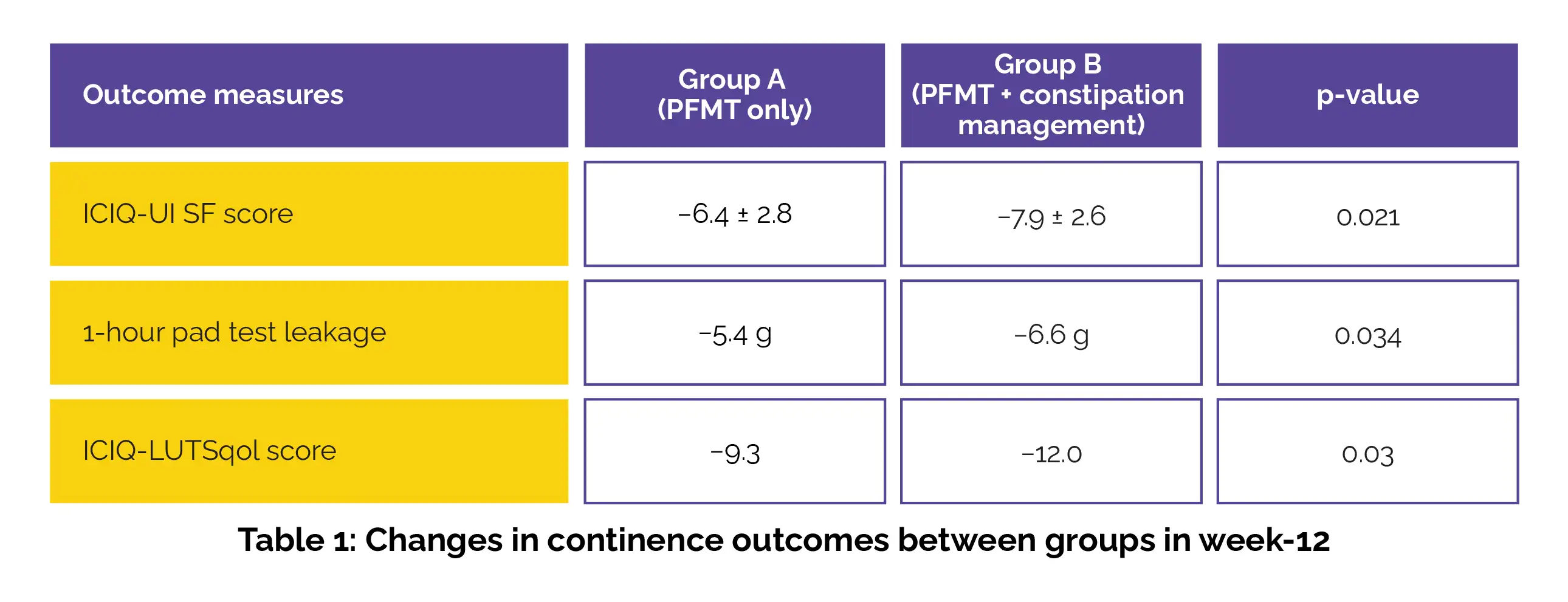
Constipation severity decreased significantly only in group B. The reduction had a p-value below 0.001. These findings position functional constipation as a modifiable risk factor that can decrease responsiveness to PFMT. Thus, integrating gut-focused interventions, behavioral training, and self-efficacy strategies into pelvic floor therapy may enhance treatment outcomes, particularly in telehealth-based rehabilitation programs.
Springer Nature
Constipation as a Hidden Barrier to Pelvic Floor Tele-Rehabilitation: A Randomized Controlled Trial in Women with Stress Urinary Incontinence
Özge Baykan Çopuroğlu et al.













Comments (0)