

Categories
Change Password!
Reset Password!



A new classification system identifies key patterns of mono-segmental thoracic and lumbar nonfusion in ankylosing spondylitis and links lower bone density to its occurrence.
Ankylosing spondylitis (AS) steadily transforms the spine, driving progressive vertebral fusion that results in stiffness and structural rigidity. The mono-segmental thoracic and lumbar nonfusion (MTLN) emerges as a focal interruption, an isolated segment that resists fusion and introduces localized instability and diagnostic uncertainty. Despite its clinical significance, the defining features and underlying risk factors of AS-related MTLN remain insufficiently clarified, and the lack of a standardized classification system continues to challenge consistent evaluation and management.
In response to this knowledge gap, the study set out to comprehensively characterize the clinical profile of AS-associated MTLN, determine variables associated with its development, and establish a novel, practical classification framework to guide clinical application. Researchers conducted a retrospective cohort study of 803 patients with AS, dividing them into two groups:
Overall, 15 clinical and radiological variables were collected and compared between the groups. Statistical analyses were performed to determine significant differences, and binary logistic regression was used to identify independent correlates of MTLN occurrence. To improve diagnostic clarity, the investigators also developed a new classification framework for AS-MTLN, consisting of three main categories and seven subtypes based on inflammatory status and intervertebral structural damage:
TLN was found in 19.3% of patients with AS. The lower thoracic spine was the most commonly affected area, followed by the lumbar spine, while the upper thoracic spine was rarely involved. (Table 1).
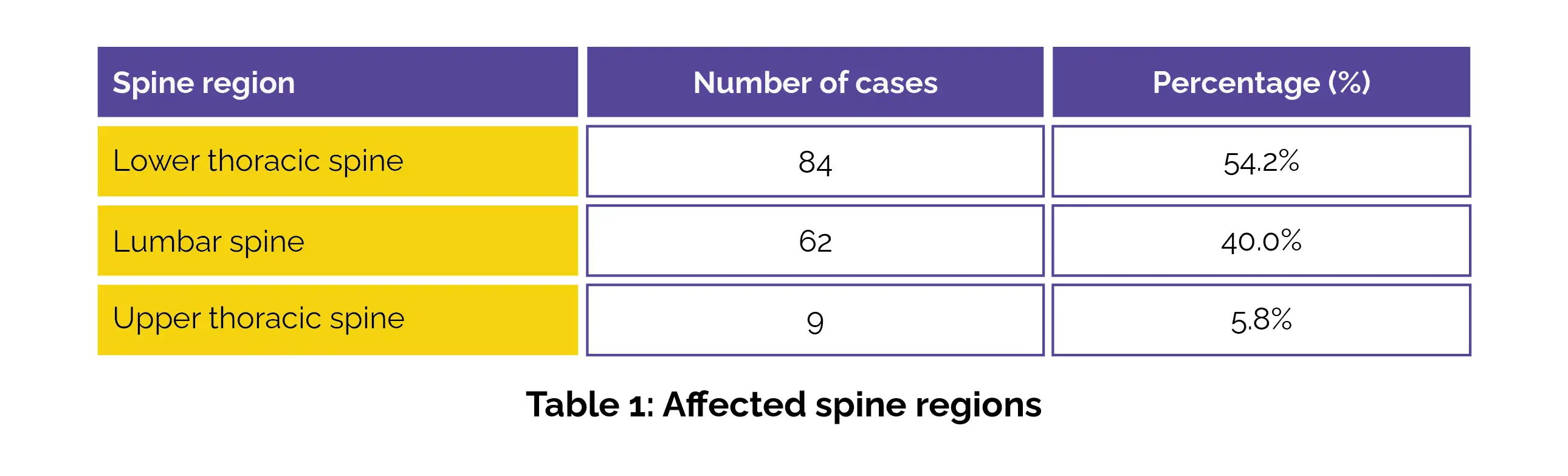
Statistical analysis identified the computed tomography (CT) Hounsfield unit (HU) of the L1 vertebra as the only variable markedly linked with AS-MTLN occurrence. Further binary logistic regression analysis confirmed this correlation, suggesting that vertebral bone density measured on CT scans may serve as a predictive indicator for nonfusion risk in AS patients undergoing spinal fusion assessment.
Using the new classification system, Type 3 was the most common form. Type 1 was mainly seen in the lumbar spine, while Types 2 and 3 were more frequently found in the lower thoracic spine (Table 2).
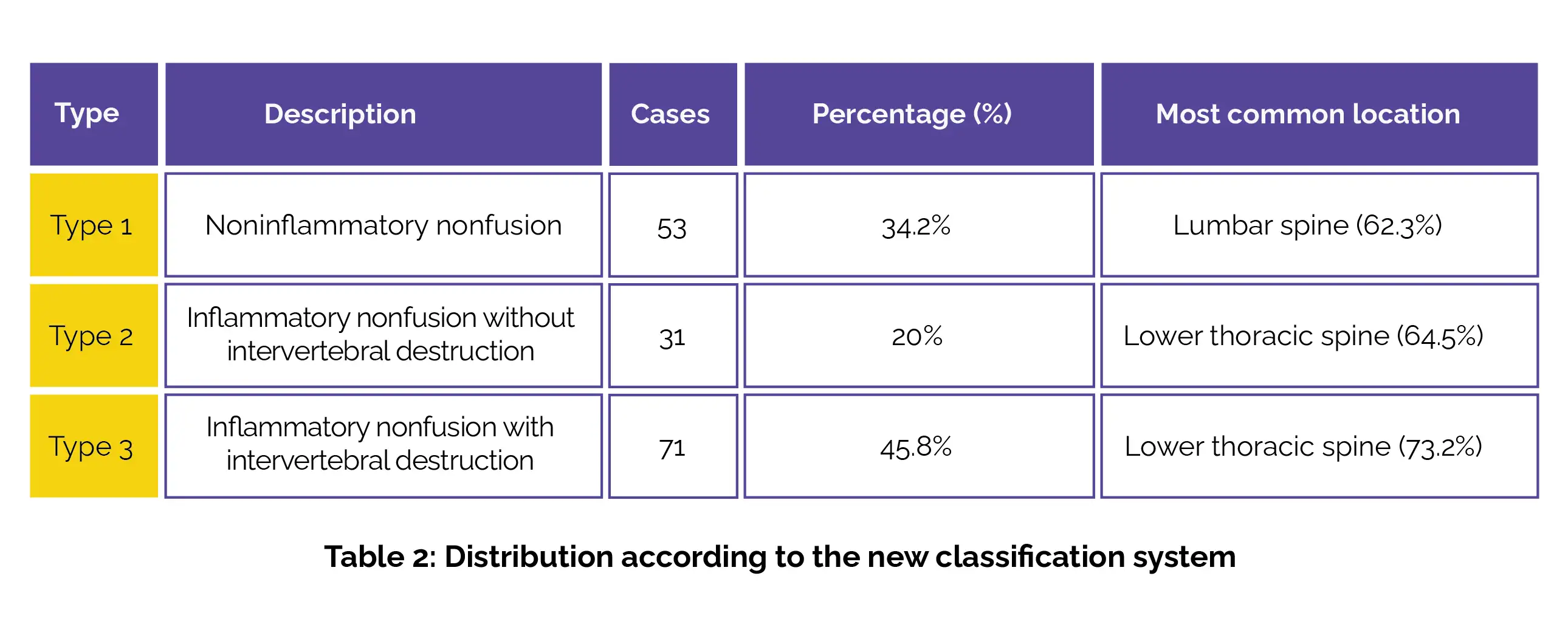
The investigators delivered a clear and comprehensive clinical snapshot of MTLN in AS, pinpointing reduced L1 vertebral bone density as a key factor linked to its development. By introducing a streamlined three-type classification system, they created a practical and inclusive framework that captures the full spectrum of AS-MTLN patterns.
Orthopaedic Surgery
Clinical Characteristics and a New Classification System of Mono-Segmental Thoracic and Lumbar Nonfusion in Patients With Ankylosing Spondylitis
Bingchuan Liu et al.















Comments (0)