

Categories
Change Password!
Reset Password!



Dalbavancin delivers over 90% clinical cure in complex bone and joint infections while minimizing adverse events and treatment complexity.
Bone and joint infections continue to pose substantial therapeutic challenges because they often require prolonged intravenous antibiotics and extended hospital stays. New real-world data from Greece suggest that dalbavancin, a long-acting lipoglycopeptide antibiotic, may offer an effective and simplified alternative.
In this retrospective analysis conducted across two tertiary Greek hospitals, Christina Petropoulou and other researchers examined outcomes in 83 patients treated with dalbavancin for serious bone and joint infections, including septic arthritis, prosthetic joint infections, osteomyelitis, and spondylodiscitis. The cohort exhibited a high burden of comorbidities, with a mean age of 69 ± 16 years, 56.6% male, and an average Charlson Comorbidity Index of 4 ± 2.25. Diabetes (28.9%) and coronary artery disease (18.1%) were the most common underlying ailments.
Nearly half of infections involved vertebral osteomyelitis or spondylodiscitis (48.2%), followed by non-vertebral osteomyelitis (38.5%), prosthetic joint infections (10.8%), and septic arthritis (8.4%). A microbiological diagnosis was established in 62.6% of cases. Staphylococcus aureus was the leading pathogen (38.4%), including methicillin-sensitive strains (30.7%) and methicillin-resistant Staphylococcus aureus (MRSA, 7.7%), while enterococci accounted for 25% of infections, including vancomycin-resistant enterococci (5.7%).
Dalbavancin was used as monotherapy in 32.4% of patients and in combination with other antibiotics in 67.6%, most commonly fluoroquinolones (63.6%) and minocycline (23.6%). Patients received a mean of 2 ± 2.36 dalbavancin doses, corresponding to a total average dose of 4 ± 4.38 g. Surgical debridement was needed in just over one-third of cases (36.1%). Clinical outcomes were highly favorable. Dalbavancin demonstrated excellent real-world clinical cure at day 90 and 180, as shown in Table 1:
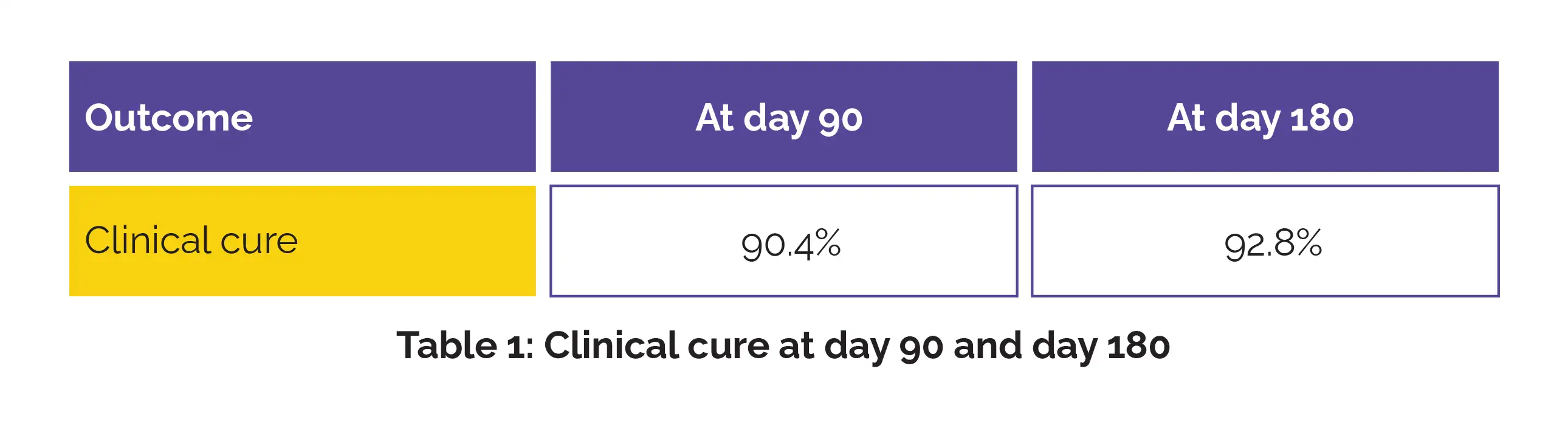
Cure rates were similar between those receiving dalbavancin alone and those receiving combination therapy, indicating that the observed benefit was largely driven by dalbavancin itself. At 1 year, relapse occurred in 10.8% of patients, most often linked to inadequate source control rather than antibiotic failure. Safety outcomes were also encouraging. Adverse events were noted in only 4 patients (4.8%), including acute kidney injury (n=2), angioedema (n=1), and Clostridioides difficile colitis (n=1).
Overall, the findings highlight dalbavancin’s high potency, good tolerability, and potential to simplify treatment of complex bone and joint infections. Its long half-life and reduced requisition for prolonged intravenous access may help minimize hospital stays and catheter-related complications, making it particularly valuable in healthcare settings with limited outpatient parenteral antibiotic therapy infrastructure.
Pathogens
Dalbavancin for Bone and Joint Infections: A Two-Center Greek Real-World Retrospective Study
Christina Petropoulou et al.













Comments (0)