Tradipitant for motion-induced vomiting management :- Medznat
EN | RU
EN | RU

Help Support

By clicking the "Submit" button, you accept the terms of the User Agreement, including those related to the processing of your personal data. More about data processing in the Policy.
Back

Tradipitant

Motion-induced vomiting Motion-induced vomiting

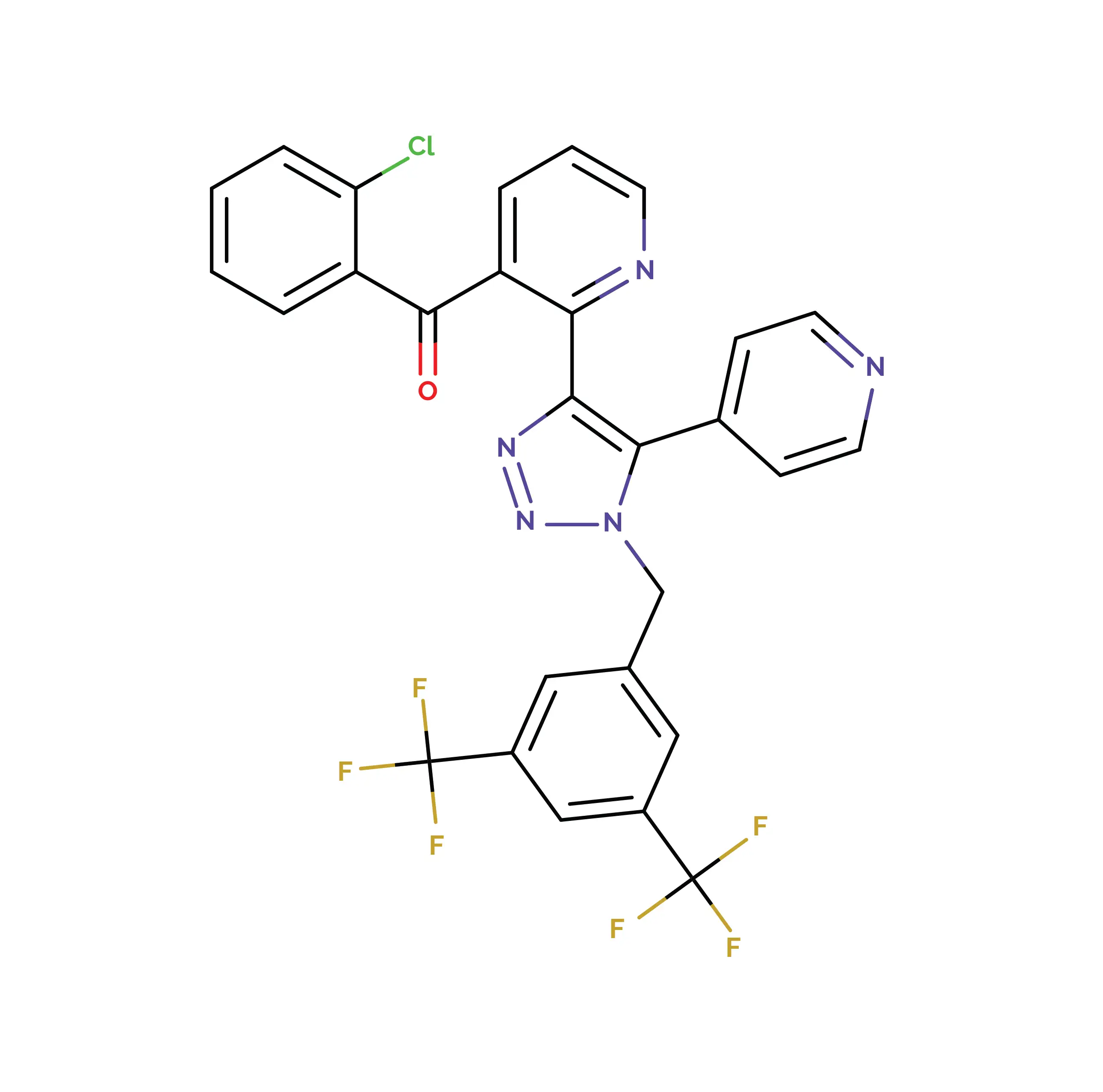
Tradipitant is a centrally acting antiemetic approved by the Food and Drug Administration (FDA) on 30 December 2025 for the prevention of motion sickness–related vomiting in adults.

See All

Introduction

Tradipitant is a centrally acting antiemetic approved by the Food and Drug Administration (FDA) on 30 December 2025 for the prevention of motion sickness–related vomiting in adults.[1,2] Unlike traditional antihistamines or anticholinergics, tradipitant targets substance P-mediated pathways, offering a novel mechanism for managing emesis.[3]

Pharmacological Class: Neurokinin-1 (NK1) receptor antagonist

Indications

It prevents vomiting induced by motion sickness in adults.[4]

Pharmachologic action

The NK1 receptor is a G protein–coupled receptor that primarily interacts with substance P, a neuropeptide released by both nerve cells and inflammatory cells.[2] Tradipitant selectively blocks NK1 receptors, with negligible binding affinity for other receptor systems, including:

  • NK2
  • NK3 neurokinin receptors
  • Serotonin (5-HT3)
  • Dopamine (D2)
  • Cholinergic (muscarinic)
  • Histamine (H1) receptors [4,5]

By blocking the action of substance P at these receptors, it prevents the transmission of nausea and vomiting signals from both central and peripheral pathways.[6]

Dosage

  • A dose of 85 mg or 170 mg is administered orally as a single dose, approximately 60 minutes prior to anticipated motion exposure.
  • Administer on an empty stomach, either at least 1 hour before food intake or 2 hours post-meal, to boost absorption.[4]

Pharmacokinetics

Absorption

  • Tradipitant is rapidly absorbed under fasting conditions, with peak plasma concentrations (Tmax) achieved within approximately 1.5–2 hours.
  • Systemic exposure increases in a dose-proportional manner:
  • 85 mg: Cmax ~84.7 ng/mL; AUC₀–∞ ~1839 ng·h/mL
  • 170 mg: Cmax ~112 ng/mL; AUC₀–∞ ~3526 ng·h/mL
  • Food significantly influences absorption: a high-fat meal markedly increases Cmax and AUC and delays Tmax.
  • For consistent and predictable drug exposure, administration under fasting conditions is recommended.

Distribution

  • It exhibits a large apparent volume of distribution (Vd/F ≈ 1956 L), indicating extensive distribution into peripheral tissues beyond the plasma compartment.
  • It is highly bound to plasma proteins (approximately 96% to >99%), resulting in a limited free (unbound) circulating fraction.

Metabolism

It is extensively metabolized and involves both CYP-dependent and non-CYP pathways:

  • Major: CYP3A4
  • Minor: CYP2C19, CYP2C8
  • It also undergoes glucuronidation via UGT1A4 and UGT2B7.
  • There are four major circulating metabolites that contribute significantly to systemic exposure:
  1. M2 (~40%)
  2. M3 (~33%)
  3. M4 (~43%)
  4. M8 (~42%)
  • These major metabolites retain NK1 receptor binding affinity comparable to the parent compound, suggesting potential pharmacological activity.

Elimination

  • Following administration of a single oral radiolabeled dose, approximately 88% of the total dose is recovered.
  • Elimination occurs primarily via the fecal route (~80%), with a minor contribution from renal excretion (~7%).
  • Parent compound is minimally recovered in feces and is not detectable in urine, indicating that elimination occurs predominantly as metabolites rather than the unchanged drug.
  • Tradipitant has an average elimination half-life of roughly 34 hours.
  • In healthy individuals, its apparent oral clearance is around 41.7 L/h.[6]

Drug interaction

Strong CYP3A4 inhibitors: Tradipitant is metabolized by CYP3A4. Hence, concomitant use with strong CYP3A4 inhibitors may increase systemic exposure, potentially leading to a heightened risk of adverse effects.[4]

Side effects

  • Somnolence
  • Headache
  • Fatigue
  • Impaired alertness (risk with driving/machinery)[4]
     

Precautions

  • Pregnancy: Limited human data available; animal studies do not indicate a significant developmental risk.
  • Lactation: Likely excreted in breast milk; monitor breastfed infants for signs of sedation.
  • Pediatric use: Efficiency and safety have not been verified in pediatrics.
  • Geriatric use: No pivotal differences in safety or efficacy observed; however, increased sensitivity in some individuals cannot be excluded.
  • CNS effects: May impair mental and physical performance; patients should avoid driving or operating heavy machinery after administration.
  • Administration conditions: Should be administered under fasting conditions to ensure predictable drug exposure.
  • Hepatic impairment: Avoid use in hepatic impairment due to lack of safety and pharmacokinetic data.[4]

Clinical evidence

1. Motion SYROS Trial

  • Tradipitant's efficacy was evaluated in a randomized, double-blind, placebo-controlled trial involving 365 adults with a history of motion sickness exposed to real-world sea conditions.
  • Participants received a single dose of tradipitant 170 mg, 85 mg, or placebo prior to approximately 4-hour boat trips.
  • The key endpoint was the vomiting incidence during motion exposure.
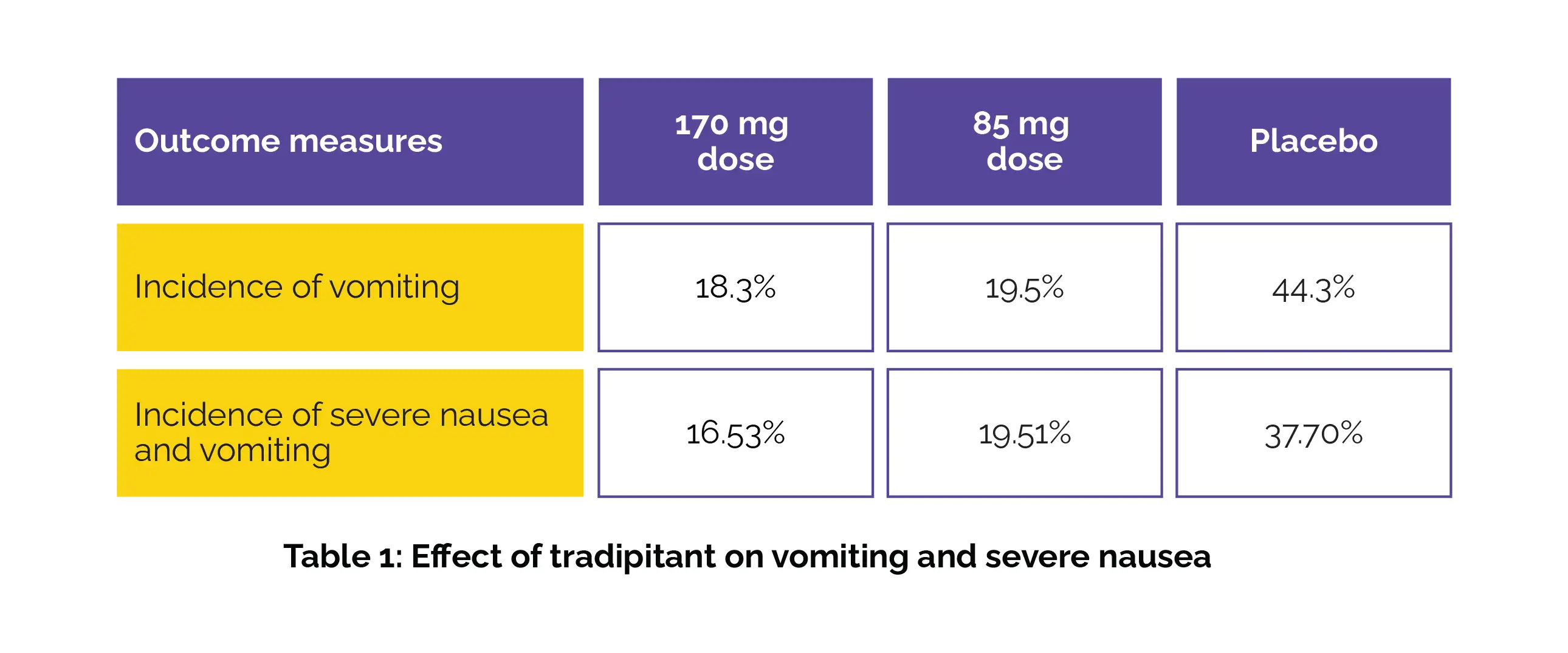
  • Both doses of tradipitant remarkably reduced vomiting when compared to placebo. Reduction in rates of severe nausea and vomiting was also noted (Table 1).

  • Overall, both 170 mg and 85 mg doses of tradipitant successfully mitigated vomiting and severe symptoms of motion sickness across variable sea conditions.[7]

2. Motion SIFNOS Trial

  • A randomized, placebo-controlled study evaluated tradipitant in 126 adults with motion sickness during approximately 4-hour boat trips under varying sea conditions.
  • Participants received tradipitant 170 mg or placebo, and symptom severity was assessed using the Motion Sickness Severity Scale (MSSS) along with recording episodes of vomiting.
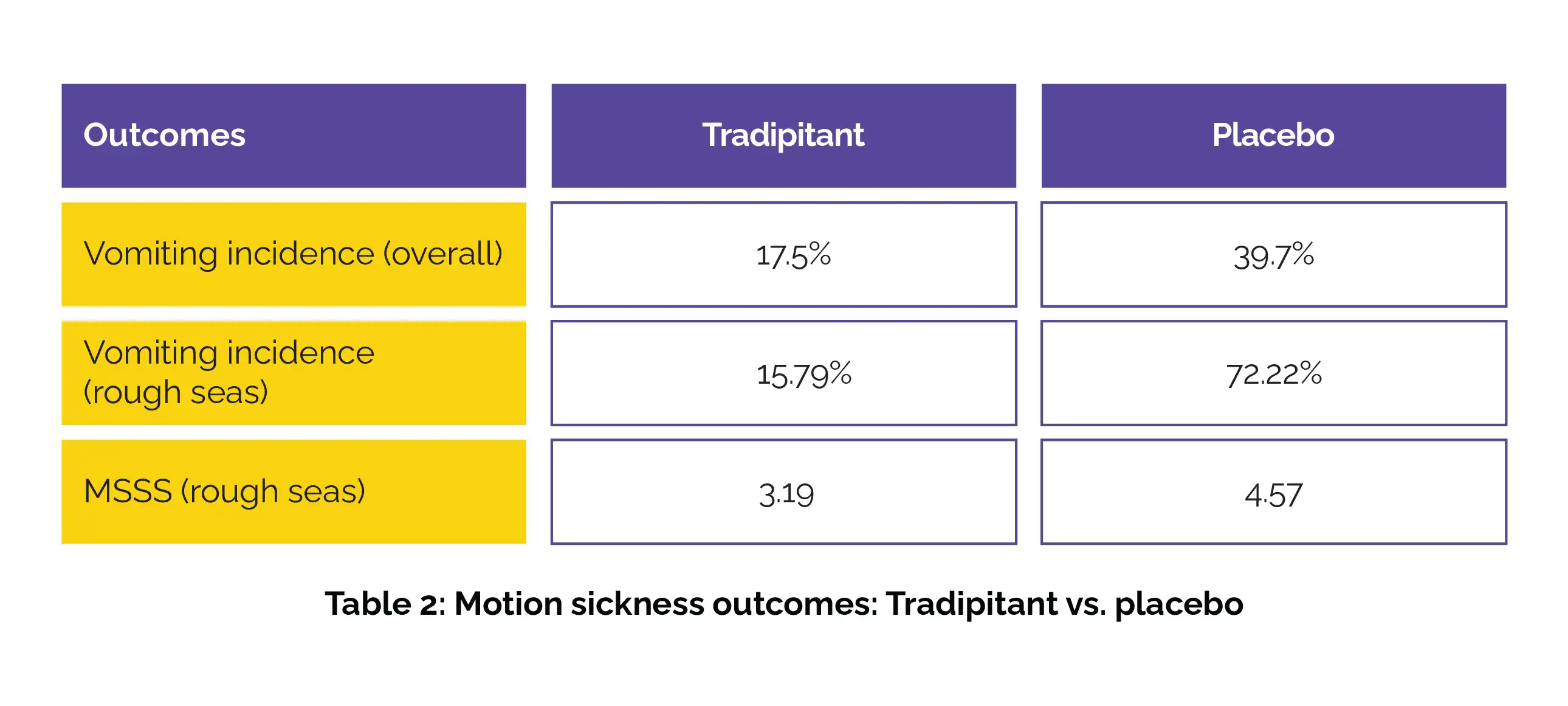
  • Tradipitant substantially reduced vomiting across all trips and showed greater benefit under rough sea conditions. MSSS score was also lower with tradipitant (Table 2).

  • Overall, tradipitant demonstrated robust antiemetic efficacy, particularly in high-risk conditions, supporting its role in both the prevention of vomiting and the reduction of symptom severity in motion sickness.[8]

References

    1. Lee A. Tradipitant: First Approval. Drugs. 2026 Apr 7:1-5.
    2. Tradipitant. PubChem [9916461]. Available from: https://pubchem.ncbi.nlm.nih.gov/compound/Tradipitant
    3. Camilleri M. New Drugs on the Horizon for Functional and Motility Gastrointestinal Disorders. Gastroenterology. 2021 Sep;161(3):761-764.
    4. NEREUS™ (tradipitant) capsules. FDA Label. Available from: https://www.accessdata.fda.gov/drugsatfda_docs/label/2025/220152Orig1s000lbl.pdf
    5. Ibrahim MA, Pellegrini MV, Preuss CV. Antiemetic Neurokinin-1 Receptor Blockers. [Updated 2024 Jan 11]. In: StatPearls [Internet]. Treasure Island (FL): StatPearls Publishing; 2026 Jan. Available from: https://www.ncbi.nlm.nih.gov/books/NBK470394/. Bookshelf ID: NBK470394, PMID: 29262116.
    6. Tradipitant. Drug Bank [DB12580]. Available from: https://go.drugbank.com/drugs/DB12580
    7. Polymeropoulos VM, Kiely L, Bushman ML, Sutherland EB, Goldberg AR, Pham AX et al. Motion Syros: tradipitant effective in the treatment of motion sickness; a multicenter, randomized, double-blind, placebo-controlled study. Frontiers in Neurology. 2025 Mar 4;16:1550670.
    8. Polymeropoulos VM, Czeisler MÉ, Gibson MM, Anderson AA, Miglo J, Wang J et al. Tradipitant in the Treatment of Motion Sickness: A Randomized, Double-Blind, Placebo-Controlled Study. Frontiers in Neurology. 2020 Sep 29;11:563373.

Comments (0)

You want to delete this comment? Please mention comment Invalid Text Content Text Content cannot me more than 1000 Something Went Wrong Cancel Confirm Confirm Delete Hide Replies View Replies View Replies en ru
Try: